


As a bullet-proof car sped past from a campaign rally, a Maya Indian woman screamed angrily at the grey-haired dark-suited man inside: "There are lots of widows here."
But her cries were lost among the dirt streets and clay houses in the Guatemalan highland village of Nebaj as thousands of supporters cheered a man they consider a messiah rather than a monster.
Twenty years after heading a violent 1982-83 dictatorship considered one of the bloodiest periods in Guatemalan history, retired General Efrain Rios Montt is running for president.
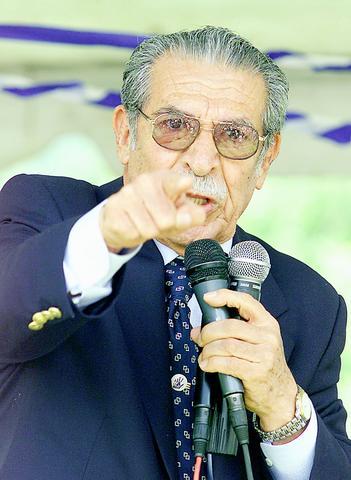
PHOTO: REUTERS
His upbeat campaign ahead of a Nov. 9 election is leading him back to the villages where rights groups say he ordered thousands of Mayas to be massacred in a campaign to wipe out leftist rebels at the height of the Central American nation's 36-year civil war.
At 77, Rios Montt is enjoying a political comeback as head of Congress and the ruling Republican Front (FRG). Now elderly, he was barred from standing for the party in 1990 and 1995 by an article in Guatemala's 1985 constitution banning ex-dictators from the country's top job.
In a ruling that horrified rights groups, Guatemala's highest court on July 14 allowed Rios Montt to stand, agreeing with his argument that the law was created after his term.
An appeal by opposition parties that led the lower Supreme Court to suspend his candidacy on July 20 was overruled, seemingly assuring him a place on the ballot.
Home to ex-paramilitaries forced to fight rebels during his rule and now receiving state compensation under a program critics say is a bid to snare votes for the FRG, war-ravaged outposts like Nebaj are, strangely, major power bases for the veteran politician.
But in villages which are often still tense since 1996 peace accords, and where widows of massacre victims and ex-militiamen reluctantly rub shoulders, not everyone is pleased to see him.
In the central Guatemalan village of Rabinal, amid hills dotted with mass graves, massacre survivors carrying relatives' remains in coffins gate-crashed a campaign meeting and pelted Rios Montt with stones. He was forced to flee in a helicopter.
Christina Laur, part of a team of activists and lawyers working in Guatemala to have Rios Montt tried on charges including genocide during the war in which 200,000 people died, said such a reaction to his campaign was inevitable.
"It's a massive slap in the face to victims," she said.
Rights groups are horrified at the prospect of Rios Montt winning, fearing an escalation in a wave of attacks and intimidation over the past two years against activists, attributed to a shadowy organized crime network linked to the military.
But in war-ravaged villages like Nebaj in Guatemala's western highlands, many remember Rios Montt as a no-nonsense leader who defeated regrouping rebels, and some even consider him a hero.
At a campaign rally, about 3,000 supporters, mostly ex-paramilitaries who had received their first compensation payments, waited hours in the sun for a glimpse of him.
Many in Nebaj say the March 1982 coup that brought Rios Montt to power ushered in an era of relative peace after years of indiscriminate killing under dictator General Romeo Lucas Garcia.
Around Nebaj, massacres continued into Rios Montt's rule, but fighting died down as the army got the upper hand, and some locals say they at last knew where they stood.
But as crowds flocked outdoors to see Rios Montt, others hid indoors.
Mayan widows wearing green and yellow woven headdresses and shawls sat in a dingy office discussing their own compensation bids -- for their husbands' murders during Rios Montt's rule.
Catalina Brito hasn't seen her husband since 40 soldiers kidnapped him on the outskirts of Nebaj in December 1982.
"He's an assassin," she said of Rios Montt. "How can people support an assassin?"
Nearly half of China’s major cities are suffering “moderate to severe” levels of subsidence, putting millions of people at risk of flooding, especially as sea levels rise, according to a study of nationwide satellite data released yesterday. The authors of the paper, published by the journal Science, found that 45 percent of China’s urban land was sinking faster than 3mm per year, with 16 percent at more than 10mm per year, driven not only by declining water tables, but also the sheer weight of the built environment. With China’s urban population already in excess of 900 million people, “even a small portion

UNSETTLING IMAGES: The scene took place in front of TV crews covering the Trump trial, with a CNN anchor calling it an ‘emotional and unbelievably disturbing moment’ A man who doused himself in an accelerant and set himself on fire outside the courthouse where former US president Donald Trump is on trial has died, police said yesterday. The New York City Police Department (NYPD) said the man was declared dead by staff at an area hospital. The man was in Collect Pond Park at about 1:30pm on Friday when he took out pamphlets espousing conspiracy theories, tossed them around, then doused himself in an accelerant and set himself on fire, officials and witnesses said. A large number of police officers were nearby when it happened. Some officers and bystanders rushed

HYPOCRISY? The Chinese Ministry of Foreign Affairs yesterday asked whether Biden was talking about China or the US when he used the word ‘xenophobic’ US President Joe Biden on Wednesday called for a hike in steel tariffs on China, accusing Beijing of cheating as he spoke at a campaign event in Pennsylvania. Biden accused China of xenophobia, too, in a speech to union members in Pittsburgh. “They’re not competing, they’re cheating. They’re cheating and we’ve seen the damage here in America,” Biden said. Chinese steel companies “don’t need to worry about making a profit because the Chinese government is subsidizing them so heavily,” he said. Biden said he had called for the US Trade Representative to triple the tariff rates for Chinese steel and aluminum if Beijing was

Beijing is continuing to commit genocide and crimes against humanity against Uyghurs and other Muslim minorities in its western Xinjiang province, U.S. Secretary of State Antony Blinken said in a report published on Monday, ahead of his planned visit to China this week. The State Department’s annual human rights report, which documents abuses recorded all over the world during the previous calendar year, repeated language from previous years on the treatment of Muslims in Xinjiang, but the publication raises the issue ahead of delicate talks, including on the war in Ukraine and global trade, between the top U.S. diplomat and Chinese


 RSS
RSS