


The British government denied on Monday that it had officially criticized a Ministry of Defense scientist who committed suicide as a Walter Mitty character who exaggerated his role in the country's intelligence gathering regarding Iraq.
Meanwhile, British Prime Minister Tony Blair's official spokesman, Tom Kelly, on Monday night put his hands up and admitted that he might have used the expression "Walter Mitty" when discussing what could have driven the Iraq weapons scientist to his apparent suicide.
The Independent newspaper reported Monday morning that the comparison had been made by an unidentified senior government official as part of a deliberate attempt by Blair's office to criticize the scientist, whose funeral will take place today.
The suicide last month of Ministry of Defense scientist David Kelly has damaged Blair's popularity and credibility.
After his death, the BBC identified Kelly as the main source of a piece it had broadcast that quoted an anonymous official as claiming the government had inflated the threat from Iraq to justify war, an accusation Blair vehemently denies.
Lord Hutton, a senior appeals judge, is heading a public inquiry into the circumstances surrounding Kelly's death.
The Independent newspaper said a senior Blair government source had compared Kelly to Mitty, the daydreaming protagonist of a 1941 James Thurber story, and had called the government weapons expert a fantasist.
Kelly, who had worked as a weapons inspector in Iraq, assisted in the creation of one of the dossiers that Blair's government presented to the public before the Iraq war to justify the conflict. But the officiDuoted by The Independent suggested that Kelly had exaggerated how much he knew about the document while being interviewed by the BBC.
"This guy was a Walter Mitty," the source was quoted as saying.
On Monday, a Blair government spokeswoman first said she did not know where the disparaging comment had originated and that neither the prime minister nor anyone else in his office would say such a thing.
But on Monday night, the spokeswoman made another statement effectively acknowledging that an unidentified government official had spoken to The Independent about Kelly.
But as Downing Street distanced itself from the remark, Kelly let it be known that he was simply mulling over the possibilities with a reporter who misinterpreted his remarks as a calculated effort to smear the man at the heart of the row between No. 10 and the BBC.
In a separate statement, Deputy Prime Minister John Prescott criticized any attempt to berate the late scientist.
Prescott, who is currently leading the government while Blair is on vacation in Barbados, said: "I do not believe these unsubstantiated remarks about Dr. Kelly. I trust that no one in the government would comment on Dr. Kelly at such a sensitive time."
This raises the unsavory prospect that both sides will cast doubt on the late Kelly's conduct when they give evidence to Lord Hutton's judicial inquiry. The BBC will claim it faithfully reported what an expert told its reporters, while Whitehall will suggest Kelly -- the BBC's "single source" -- spoke about things beyond his direct knowledge.
Whatever the exact facts in the normally arcane nuances between formal media contacts and non-attributable background chat, Downing Street was keen to "leave it to Lord Hutton."
Also, a poll published on Monday indicated that more Britons trust the BBC than Blair, thanks to the aftermath of the Iraq war.
Nearly half of China’s major cities are suffering “moderate to severe” levels of subsidence, putting millions of people at risk of flooding, especially as sea levels rise, according to a study of nationwide satellite data released yesterday. The authors of the paper, published by the journal Science, found that 45 percent of China’s urban land was sinking faster than 3mm per year, with 16 percent at more than 10mm per year, driven not only by declining water tables, but also the sheer weight of the built environment. With China’s urban population already in excess of 900 million people, “even a small portion

UNSETTLING IMAGES: The scene took place in front of TV crews covering the Trump trial, with a CNN anchor calling it an ‘emotional and unbelievably disturbing moment’ A man who doused himself in an accelerant and set himself on fire outside the courthouse where former US president Donald Trump is on trial has died, police said yesterday. The New York City Police Department (NYPD) said the man was declared dead by staff at an area hospital. The man was in Collect Pond Park at about 1:30pm on Friday when he took out pamphlets espousing conspiracy theories, tossed them around, then doused himself in an accelerant and set himself on fire, officials and witnesses said. A large number of police officers were nearby when it happened. Some officers and bystanders rushed

HYPOCRISY? The Chinese Ministry of Foreign Affairs yesterday asked whether Biden was talking about China or the US when he used the word ‘xenophobic’ US President Joe Biden on Wednesday called for a hike in steel tariffs on China, accusing Beijing of cheating as he spoke at a campaign event in Pennsylvania. Biden accused China of xenophobia, too, in a speech to union members in Pittsburgh. “They’re not competing, they’re cheating. They’re cheating and we’ve seen the damage here in America,” Biden said. Chinese steel companies “don’t need to worry about making a profit because the Chinese government is subsidizing them so heavily,” he said. Biden said he had called for the US Trade Representative to triple the tariff rates for Chinese steel and aluminum if Beijing was
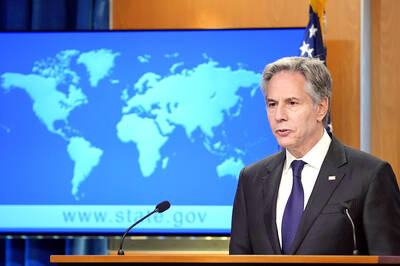
Beijing is continuing to commit genocide and crimes against humanity against Uyghurs and other Muslim minorities in its western Xinjiang province, U.S. Secretary of State Antony Blinken said in a report published on Monday, ahead of his planned visit to China this week. The State Department’s annual human rights report, which documents abuses recorded all over the world during the previous calendar year, repeated language from previous years on the treatment of Muslims in Xinjiang, but the publication raises the issue ahead of delicate talks, including on the war in Ukraine and global trade, between the top U.S. diplomat and Chinese


 RSS
RSS