


Activists jeered South Africa's health minister on Sunday as a national AIDS conference got under way amid mounting anger at a tepid government response to the disease, which activists say kills 600 South Africans a day.
Protesters holding up signs reading "Save Our Youth, Save Our Future, Treat AIDS Now" heckled Health Minister Manto Tshabalala-Msimang as she opened the conference attended by some 2,500 delegates in the port city of Durban.
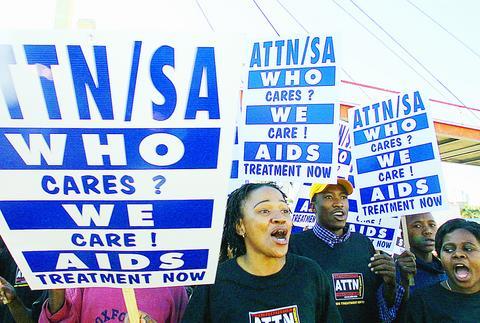
PHOTO: AFP
"Shame on you" rang out in the auditorium as the minister -- blamed by AIDS activists for delaying the introduction of life-prolonging anti-retroviral drugs -- said South Africa would set its AIDS policies "without influence from foreign agendas."
"Some say that providing anti-retrovirals is as simple as administering aspirin. Far from the truth," Tshabalala-Msimang said to boos from the audience. "The provision of anti-retroviral drugs in the public health sector is a subject which must be considered soberly, and the government is doing so."
The four-day Durban conference is the first national AIDS meeting in South Africa, which has the single highest AIDS caseload in the world with some 4.7 million people infected.
Economists say the epidemic is a significant threat to the future of the nation, Africa's economic powerhouse, with average life expectancy estimated at just 45 years by 2005.
Critics say South Africa has moved too slowly on HIV/AIDS and the government's refusal to permit public sector hospitals to use anti-retroviral drugs, the only medicines proven effective against AIDS, has stoked anger.
President Thabo Mbeki's government has questioned the drugs as expensive, potentially dangerous and difficult to take, arguing that priority must go to fighting the widespread black poverty that remains nine years after the end of white rule.
Mbeki did not attend Sunday's meeting. But Deputy President Jacob Zuma, who heads the National AIDS Council, repeated that new drug treatments would be introduced -- albeit only when the country was ready for them.
"We need to ensure that the necessary infrastructures are in place," Zuma said.
Peter Piot, head of the UN AIDS body UNAIDS, hinted that South Africa was dangerously out of step with the rest of the world when it came to AIDS treatment policy.
"Throughout the world the debate is not whether to offer anti-retroviral treatment, but how to do it," Piot said in a video address to the meeting. "For heaven's sake, let's not wait until we have the perfect solution."
The Treatment Action Campaign, the nation's biggest activist group, this week backed civil disobedience as a way to force the government's hand, while protesters marched through Durban on Sunday to make their voices heard.
"If they want proof it works, I am proof. I am alive," said 26-year-old Zinhle Thabetha, one of about 100 HIV-positive people getting anti-retroviral treatment through a local non-governmental organization.
Activist anger was further amplified last week when the Medicines Control Council, an independent state regulator, announced it might withdraw temporary approval for Nevirapine, an anti-retroviral drug used to prevent transmission of HIV from mother to child, because it doubted the research used to back up the drug's efficacy.
At Sunday's opening session, scientists said they were flabbergasted regulators would consider removing one of the few medical options available to fight HIV in the country and vowed to fight the decision.
"The AIDS epidemic has been bedeviled by unscientific, irrational, unreasonable and downright perverse attitudes," said Dr. Jerry Coovadia, the conference chairman.
Nearly half of China’s major cities are suffering “moderate to severe” levels of subsidence, putting millions of people at risk of flooding, especially as sea levels rise, according to a study of nationwide satellite data released yesterday. The authors of the paper, published by the journal Science, found that 45 percent of China’s urban land was sinking faster than 3mm per year, with 16 percent at more than 10mm per year, driven not only by declining water tables, but also the sheer weight of the built environment. With China’s urban population already in excess of 900 million people, “even a small portion

‘IN A DIFFERENT PLACE’: The envoy first visited Shanghai, where he attended a Chinese basketball playoff match, and is to meet top officials in Beijing tomorrow US Secretary of State Antony Blinken yesterday arrived in China on his second visit in a year as the US ramps up pressure on its rival over its support for Russia while also seeking to manage tensions with Beijing. The US diplomat tomorrow is to meet China’s top brass in Beijing, where he is also expected to plead for restraint as Taiwan inaugurates president-elect William Lai (賴清德), and to raise US concerns on Chinese trade practices. However, Blinken is also seeking to stabilize ties, with tensions between the world’s two largest economies easing since his previous visit in June last year. At the

UNSETTLING IMAGES: The scene took place in front of TV crews covering the Trump trial, with a CNN anchor calling it an ‘emotional and unbelievably disturbing moment’ A man who doused himself in an accelerant and set himself on fire outside the courthouse where former US president Donald Trump is on trial has died, police said yesterday. The New York City Police Department (NYPD) said the man was declared dead by staff at an area hospital. The man was in Collect Pond Park at about 1:30pm on Friday when he took out pamphlets espousing conspiracy theories, tossed them around, then doused himself in an accelerant and set himself on fire, officials and witnesses said. A large number of police officers were nearby when it happened. Some officers and bystanders rushed
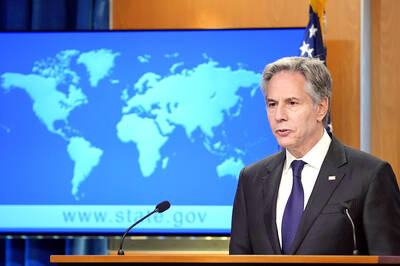
Beijing is continuing to commit genocide and crimes against humanity against Uyghurs and other Muslim minorities in its western Xinjiang province, U.S. Secretary of State Antony Blinken said in a report published on Monday, ahead of his planned visit to China this week. The State Department’s annual human rights report, which documents abuses recorded all over the world during the previous calendar year, repeated language from previous years on the treatment of Muslims in Xinjiang, but the publication raises the issue ahead of delicate talks, including on the war in Ukraine and global trade, between the top U.S. diplomat and Chinese


 RSS
RSS