


Zimbabwe's economic disaster is horrifyingly evident in the morgue at Harare Central Hospital, packed to more than three times capacity with the dead that relatives can't afford to bury.
With mortality rates continuing to spiral out of control, hospital officials said Friday they have no choice but to give dozens of the bodies to the city's medical school to help ease the crisis.
"We have decided to donate the bodies because of serious overcrowding that has affected our cooling system," said Dr. Chris Tapfumaneyi, the hospital's medical superintendent.
The morgue, designed for 164 corpses, holds nearly 600.
Trays in the morgue often hold more than one adult body, along with the tiny corpses of infants. Others, shrouded in canvas and cotton sheets, lie in gurneys or on the floors of the refrigerated corridors.
Some of the unclaimed cadavers were those of vagrants found dead on the streets, Tapfumaneyi said.
Others were the victims of violence kept for as long as three years during police investigations, which are often delayed by fuel shortages and logistics problems amid Zimbabwe's worst political and economic crisis since independence in 1980.
Most of the other corpses were awaiting collection by impoverished relatives, many of whom "just disappear and abandon them" in hopes they will be given decent "paupers' burials" by the city, Tapfumaneyi said.
But in a nation plagued by a hunger crisis and an estimated 5,000 AIDS-related deaths a week, funeral homes hired to bury the unclaimed dead are overwhelmed.
At the same time, city authorities have run out of money and gasoline, paralyzing ambulance, garbage collection and other services.
Zimbabwe is suffering massive inflation and unemployment. A hard currency shortage has led to further shortages of food, medicines and fuel, which in turn have crippled industry.
A routine burial -- including cemetery and grave fees, a casket and transportation -- costs at least 100,000 Zimbabwe dollars, or US$120 at the official exchange rate or less than US$40 at the black market rate.
That is twice the average Zimbabwean's annual income and is well out of the reach of the 70 percent of people here living in poverty. Most rural poor bury their dead on family plots in the bush, following African spiritual traditions that require the dead to be buried.
As the Harare municipal cemeteries filled with AIDS victims in recent years, a raft of suggestions -- for mass graves, for bodies to be buried vertically, and for cremation -- were met with outcry by political and tribal leaders.
White Zimbabweans of those of Indian descent favor cremation, but in June, Harare's cash-strapped city council ran out of imported inflammable gas for the furnaces at its only crematorium.
Since then, private funeral homes have accumulated nearly 100 bodies due for cremation. A few bodies have been taken to the second city of Bulawayo's diesel-fired crematorium.
But diesel fuel, like regular gasoline, is also in short supply, and Bulawayo's ordinances make it difficult to cremate a person who did not live there.
Leaders of Harare's tiny Hindu community, meanwhile, have said they are considering waiving strict religious rules to allow non-Hindus to be cremated in their small diesel-fired crematorium here.
Tapfumaneyi said his hospital's donation of 42 cadavers to the medical school was the first for at least three years.
Medical students of anatomy in the past received some bodies voluntarily "donated to science" by individuals in their wills.
Tapfumaneyi said his hospital was now responding to an appeal from the medical school for unclaimed cadavers.
From the first shipment, the Zimbabwe University medical school will choose those suitable for teaching purposes and promised proper burial of their remains afterward.
Nearly half of China’s major cities are suffering “moderate to severe” levels of subsidence, putting millions of people at risk of flooding, especially as sea levels rise, according to a study of nationwide satellite data released yesterday. The authors of the paper, published by the journal Science, found that 45 percent of China’s urban land was sinking faster than 3mm per year, with 16 percent at more than 10mm per year, driven not only by declining water tables, but also the sheer weight of the built environment. With China’s urban population already in excess of 900 million people, “even a small portion

UNSETTLING IMAGES: The scene took place in front of TV crews covering the Trump trial, with a CNN anchor calling it an ‘emotional and unbelievably disturbing moment’ A man who doused himself in an accelerant and set himself on fire outside the courthouse where former US president Donald Trump is on trial has died, police said yesterday. The New York City Police Department (NYPD) said the man was declared dead by staff at an area hospital. The man was in Collect Pond Park at about 1:30pm on Friday when he took out pamphlets espousing conspiracy theories, tossed them around, then doused himself in an accelerant and set himself on fire, officials and witnesses said. A large number of police officers were nearby when it happened. Some officers and bystanders rushed

HYPOCRISY? The Chinese Ministry of Foreign Affairs yesterday asked whether Biden was talking about China or the US when he used the word ‘xenophobic’ US President Joe Biden on Wednesday called for a hike in steel tariffs on China, accusing Beijing of cheating as he spoke at a campaign event in Pennsylvania. Biden accused China of xenophobia, too, in a speech to union members in Pittsburgh. “They’re not competing, they’re cheating. They’re cheating and we’ve seen the damage here in America,” Biden said. Chinese steel companies “don’t need to worry about making a profit because the Chinese government is subsidizing them so heavily,” he said. Biden said he had called for the US Trade Representative to triple the tariff rates for Chinese steel and aluminum if Beijing was
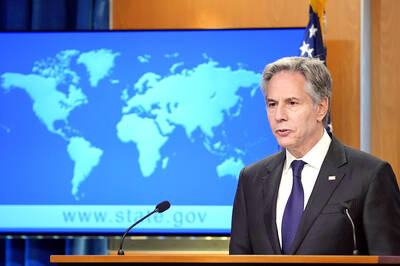
Beijing is continuing to commit genocide and crimes against humanity against Uyghurs and other Muslim minorities in its western Xinjiang province, U.S. Secretary of State Antony Blinken said in a report published on Monday, ahead of his planned visit to China this week. The State Department’s annual human rights report, which documents abuses recorded all over the world during the previous calendar year, repeated language from previous years on the treatment of Muslims in Xinjiang, but the publication raises the issue ahead of delicate talks, including on the war in Ukraine and global trade, between the top U.S. diplomat and Chinese


 RSS
RSS