


After six years and 93 days in office, Tony Blair yesterday notched up the longest continuous service by a Labour Party prime minister -- a personal triumph for the leader and for the party he transformed.
But it's not party time at No. 10 Downing St., and no celebrations of this record -- modest by historical standards -- have been announced.
The sheen of Blair's achievements has been tarnished by a bitter dispute over his decision to attack Iraq, party infighting over his domestic policies and the suicide of defense adviser David Kelly. Lord Hutton, the judge heading the judicial inquiry in Kelly's death, said Friday that Blair would be called to testify.
``There are an awful lot of people in the Labour Party who think he is a war criminal over Iraq. They really loathe him and that is a big problem,'' said Blair biographer John Rentoul.
``You can almost see in his eyes the dawning realization of a man who thought he had more to offer and is suddenly realizing that he is running out of time.''
Blair, who yesterday passed Clement Attlee's 1945-51 record for the longest continuous term as a Labour prime minister, insists he is confident of his achievements, and says he has the will to carry on.
``Overall I believe that we have done what we were elected to do: to keep the economy stable, to get people back to work, to invest in our public services and in doing so create a country that is more modern, stronger and more fair,'' he told reporters on Wednesday. ``There is a big job of work still to do and my appetite for doing it is undiminished.''
When Blair became party leader in 1994, his rebranded ``New Labour'' party courted big business and middle class voters, promising a reformed welfare state driven by a free market economy. He turned his back on many of Labour's hallowed but vote-losing socialist policies, such as nationalization of key sectors of the economy.
The result was a landslide election victory on May 2, 1997, which ended 18 years of Conservative rule.
Blair's longevity is remarkable in part because of the rarity of Labour governments in Britain. Harold Wilson served longer, but his total of seven years, 279 days, was split between governments of 1964-70 and 1974-76.
Blair needs one more election to hope to beat Margaret Thatcher's 20th-century record of 11 years, 209 days in office.
He remains the odds-on favorite to win a third election if he wants to, because there is no precedent for a government with such a big Parliamentary majority losing an election, and because Conservative leader Iain Duncan Smith has yet to spark any detectable enthusiasm among voters.
In Blair's first term, the government set up regional parliaments in Wales and Scotland, and after years of conflict it brokered the terms of a peace process in Northern Ireland.
It expelled most of the hereditary members of the House of Lords, though it still hasn't settled on a new method for appointing or electing members. He has put off a decision to join the European common currency.
Two years after a second landslide election victory, the honeymoon with the electorate and the combative British press is over.
Blair had a joint session of the US Congress standing and applauding on July 17, but he finds no such adulation at home.
Taxes have risen, but voters are still waiting to see significant improvements in Britain's ailing public health service and decrepit transport system. Trade unions claim the party has abandoned its working-class roots and are scaling down their financial support.
Blair's fervent support for US President George W. Bush over the Iraq war angered many Labour members of Parliament, and strained ties with European partners. Two Cabinet members resigned in opposition to the war, and now snipe at Blair from the back benches.
The suicide of Kelly, the source of a British Broadcasting Corporation report that the government exaggerated the danger of Saddam Hussein's weapons programs, has tarnished the government. The coalition's failure to find Iraqi weapons of mass destruction is also proving troublesome for Blair, who made that threat the prime justification for war.
That's been very damaging for a prime minister who once said, ``I'm a pretty straight guy.''
An ICM poll published last month found two-thirds of Britons believe Blair misled them on the case for war. In another survey, 54 percent said they would not trust Blair ``further than I could throw him.''
Geoff Andrews, politics lecturer at the Open University said, ``The authority he has had in the last six years has been waning. New Labour seems to have been encouraging a general cynicism about politics and unless Blair makes inroads into that, he will not recover.''

Republican US lawmakers on Friday criticized US President Joe Biden’s administration after sanctioned Chinese telecoms equipment giant Huawei unveiled a laptop this week powered by an Intel artificial intelligence (AI) chip. The US placed Huawei on a trade restriction list in 2019 for contravening Iran sanctions, part of a broader effort to hobble Beijing’s technological advances. Placement on the list means the company’s suppliers have to seek a special, difficult-to-obtain license before shipping to it. One such license, issued by then-US president Donald Trump’s administration, has allowed Intel to ship central processors to Huawei for use in laptops since 2020. China hardliners
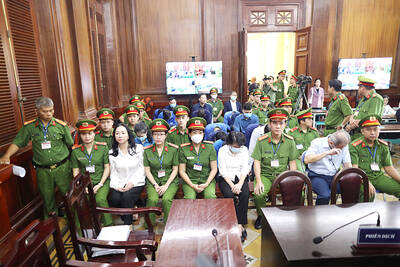
A top Vietnamese property tycoon was on Thursday sentenced to death in one of the biggest corruption cases in history, with an estimated US$27 billion in damages. A panel of three hand-picked jurors and two judges rejected all defense arguments by Truong My Lan, chair of major developer Van Thinh Phat, who was found guilty of swindling cash from Saigon Commercial Bank (SCB) over a decade. “The defendant’s actions ... eroded people’s trust in the leadership of the [Communist] Party and state,” read the verdict at the trial in Ho Chi Minh City. After the five-week trial, 85 others were also sentenced on

‘DELUSIONAL’: Targeting the families of Hamas’ leaders would not push the group to change its position or to give up its demands for Palestinians, Ismail Haniyeh said Israeli aircraft on Wednesday killed three sons of Hamas’ top political leader in the Gaza Strip, striking high-stakes targets at a time when Israel is holding delicate ceasefire negotiations with the militant group. Hamas said four of the leader’s grandchildren were also killed. Ismail Haniyeh’s sons are among the highest-profile figures to be killed in the war so far. Israel said they were Hamas operatives, and Haniyeh accused Israel of acting in “the spirit of revenge and murder.” The deaths threatened to strain the internationally mediated ceasefire talks, which appeared to gain steam in recent days even as the sides remain far
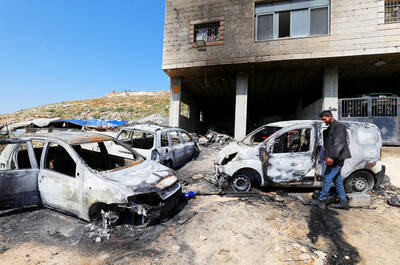
RAMPAGE: A Palestinian man was left dead after dozens of Israeli settlers searching for a missing 14-year-old boy stormed a village in the Israeli-occupied West Bank US President Joe Biden on Friday said he expected Iran to attack Israel “sooner, rather than later” and warned Tehran not to proceed. Asked by reporters about his message to Iran, Biden simply said: “Don’t,” underscoring Washington’s commitment to defend Israel. “We are devoted to the defense of Israel. We will support Israel. We will help defend Israel and Iran will not succeed,” he said. Biden said he would not divulge secure information, but said his expectation was that an attack could come “sooner, rather than later.” Israel braced on Friday for an attack by Iran or its proxies as warnings grew of


 RSS
RSS