


They're driving around US President George W. Bush's hot, dusty ranch in a pickup truck with Texas plates, but the president and his guest, Italian Premier Silvio Berlusconi, are playing a game of European politics.
The visit Sunday and yesterday by Bush's Italian buddy and ally in the war in Iraq gives the president a chance to show the world that not all of Europe is cool to his policies -- that trans-Atlantic relations remain strong even though France and Germany didn't back the war.
For Berlusconi, the visit at the ranch is not only a thank-you from Bush for joining with Britain and Spain in support of the war. It's an opportunity for the flamboyant Italian leader, the current president of the EU, to say to the world that France and Germany aren't the continent's only powers.
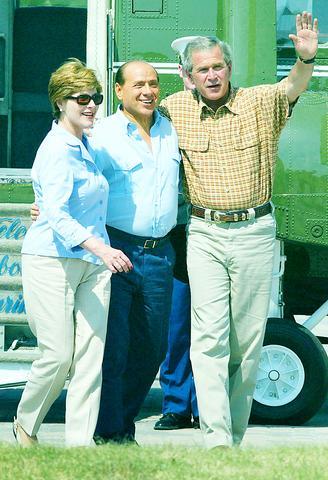
PHOTO: AP
Bush gave Berlusconi a warm welcome when he arrived by helicopter at the ranch late Sunday afternoon.
Bush shook Berlusconi's hand, draped an arm around him and patted him on the back. Berlusconi kissed first lady Laura Bush on the cheek. The two leaders, dressed in casual clothes, then climbed into Bush's white truck -- Mrs. Bush sat in the back seat -- and drove off.
The White House said the visit will give the two leaders time to talk about stopping the spread of nuclear arms, achieving peace in the Middle East, fighting terror and mending fissures in trans-Atlantic relations.
Big opportunity
"This is Berlusconi's opportunity to cement his relationship as President Bush's second-best European friend" behind British Prime Minister Tony Blair, said John Hulsman, who specializes in US-European relations at the Heritage Foundation, a conservative Washington think tank. "For Bush, it's paying back a bingo chip -- as he's done with President Aznar of Spain and, of course, Tony Blair, first and foremost."
Like Berlusconi, Blair and Spanish Prime Minister Jose Maria Aznar have been guests at both the president's ranch and the Camp David presidential retreat in Maryland.
Berlusconi's support of the war has made him unpopular with Germany and France, and his tendency toward brashness has further muddied his relations with Germany. On only the second day of his six-month term as EU president, Berlusconi told a German lawmaker in the European Parliament he would recommend him for a role in a movie as a Nazi concentration camp guard.
Again like Blair and Aznar, Berlusconi's support of the war has cost him politically at home. A majority of Italians were against military action in Iraq; even Pope John Paul II voiced opposition.
"Given the fact that there is very little public support for the war in his country, my sense is that the real reason Berlusconi is standing up with this very strong pro-U.S. stance has to do with defining Italy's position in Europe as a counter to the French and the Germans," said Robin Niblett, an expert on Europe at the Center for Strategic and International Studies in Washington.
"The Italians -- like the Spanish -- are not happy with the re-emergence of France and Germany as the driving force of the central agenda in Europe. Italians worry that their voice might be diluted."
With the outspoken Berlusconi as premier and self-appointed foreign minister, it will be hard not to hear Italy's voice on the world stage.
The Bush administration cringed when Berlusconi alleged that Western civilization was superior to Islamic culture. He said it two weeks after the Sept. 11, 2001, attacks, when the United States was trying eagerly to reach out to Muslims. Western civilization is superior because it "has at its core, as its greatest value, freedom, which is not the heritage of the Islamic culture," Berlusconi said.
Shared beliefs
Despite such gaffes, Bush has embraced the Italian leader. The two have much in common. Both have conservative political ideologies. Both have owned sports teams. Both are plain-talkers.
"We share a clarity in the way you say things: Yes is yes. No is no," Berlusconi told Time magazine in an interview published on the eve of his visit to the ranch. "We only met two years ago, but I feel I know him like I know my grammar school friends."
Berlusconi might reap more political clout from the visit than Bush, who continues to be plagued with questions about the war. US casualties in Iraq are climbing daily, and the Bush administration has been unable to shake off a controversy over Bush's suspect claim in his State of the Union address that Iraq had tried to obtain uranium in Africa. The presence of weapons of mass destruction in Iraq, which have not been found, was Bush's major justification for the war.
"The only thing that Bush can get out of Berlusconi right now is perhaps a pledge to send some troops out to Iraq," Niblett said. "But public support for Berlusconi's position on Iraq is -- like in the UK -- very low. So I would imagine that the most they [the US] would be looking for would be military police-type of support."
In the run-up to the war, Berlusconi helped lobby European leaders for support.
Now America is looking to Europe again for support to end what Army General John Abizaid, the new overall commander of the Iraq operation, is calling "guerilla-type" warfare waged by remnants of ousted President Saddam Hussein's Baathist Party and fundamentalists possibly tied to terrorists.
"It's a fragile time in Iraq. Bush wants to show off to the world that allies are still standing by him," Niblett said. "If you are George Bush, what you don't want is Europe lined up against you."
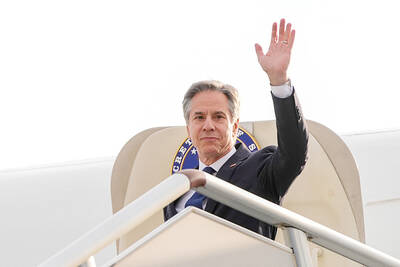
‘IN A DIFFERENT PLACE’: The envoy first visited Shanghai, where he attended a Chinese basketball playoff match, and is to meet top officials in Beijing tomorrow US Secretary of State Antony Blinken yesterday arrived in China on his second visit in a year as the US ramps up pressure on its rival over its support for Russia while also seeking to manage tensions with Beijing. The US diplomat tomorrow is to meet China’s top brass in Beijing, where he is also expected to plead for restraint as Taiwan inaugurates president-elect William Lai (賴清德), and to raise US concerns on Chinese trade practices. However, Blinken is also seeking to stabilize ties, with tensions between the world’s two largest economies easing since his previous visit in June last year. At the
Nearly half of China’s major cities are suffering “moderate to severe” levels of subsidence, putting millions of people at risk of flooding, especially as sea levels rise, according to a study of nationwide satellite data released yesterday. The authors of the paper, published by the journal Science, found that 45 percent of China’s urban land was sinking faster than 3mm per year, with 16 percent at more than 10mm per year, driven not only by declining water tables, but also the sheer weight of the built environment. With China’s urban population already in excess of 900 million people, “even a small portion
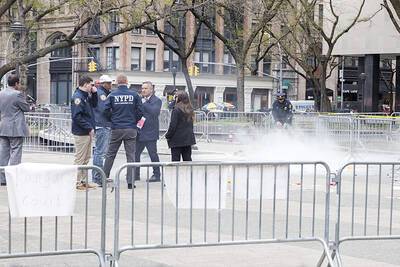
UNSETTLING IMAGES: The scene took place in front of TV crews covering the Trump trial, with a CNN anchor calling it an ‘emotional and unbelievably disturbing moment’ A man who doused himself in an accelerant and set himself on fire outside the courthouse where former US president Donald Trump is on trial has died, police said yesterday. The New York City Police Department (NYPD) said the man was declared dead by staff at an area hospital. The man was in Collect Pond Park at about 1:30pm on Friday when he took out pamphlets espousing conspiracy theories, tossed them around, then doused himself in an accelerant and set himself on fire, officials and witnesses said. A large number of police officers were nearby when it happened. Some officers and bystanders rushed
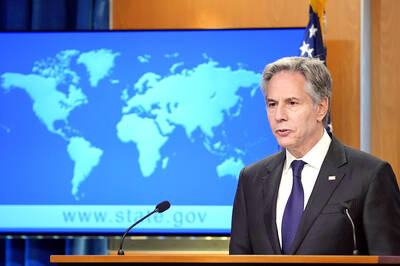
Beijing is continuing to commit genocide and crimes against humanity against Uyghurs and other Muslim minorities in its western Xinjiang province, U.S. Secretary of State Antony Blinken said in a report published on Monday, ahead of his planned visit to China this week. The State Department’s annual human rights report, which documents abuses recorded all over the world during the previous calendar year, repeated language from previous years on the treatment of Muslims in Xinjiang, but the publication raises the issue ahead of delicate talks, including on the war in Ukraine and global trade, between the top U.S. diplomat and Chinese


 RSS
RSS