


US Defense Secretary Donald Rumsfeld said on Wednesday that the US had not gone to war against Iraq because of fresh evidence of weapons of mass destruction but because Washington saw old evidence "in a dramatic new light" after Sept. 11.
The claim, in testimony to the Senate, reflected a sharp change in tactics by an administration that is under fire for knowingly basing its case against former Iraqi president Saddam Hussein on flawed intelligence.
US President George W. Bush on Wednesday accused his critics of "trying to rewrite history," and insisted that Saddam posed a threat to world peace.
In his State of the Union address in January, the president referred to a British intelligence report that Iraq had been trying to buy uranium in Africa, for use in its nuclear weapons program.
But the White House this week admitted the claim was not based on solid information, and that documents purporting an Iraqi attempt to buy "yellow cake" raw uranium from Niger had been forged.
The administration on Wednesday played down the importance of the allegations made by the president in his January speech, and then by Secretary of State Colin Powell in a presentation to the UN in February. Instead, the president and his aides all suggested that the case against Saddam had been built on his cumulative defiance of the international community.
"The coalition did not act in Iraq because we had discovered dramatic new evidence of Iraq's pursuit" of weapons of mass destruction, Rumsfeld told the Senate Armed Services Committee.
"We acted because we saw the evidence in a dramatic new light -- through the prism of our experience on 9/11."
His remarks were controversial not only because they implied that fresh evidence of Saddam's activity did not play a role in going to war. The comments also implied that the link between Iraq and al-Qaeda was built more on changing perceptions of the danger such an alliance would pose, rather than on evidence that it actually existed, as the administration had claimed.
Bush on Wednesday ducked questions over the flawed intelligence on Iraq's nuclear program, but was adamant he was right to oust former Iraqi leader Saddam Hussein.
Bush, in South Africa on the second leg of an African tour, deflected a question on whether he regretted highlighting the allegation in his January speech.
"There is no doubt in my mind that Saddam Hussein was a threat to the world peace and there is no doubt in my mind the United States along with our allies and friends did the right thing in removing him from power," Bush said at a joint appearance with South African President Thabo Mbeki.
"I am absolutely confident in the decision I made. I'm confident that Saddam Hussein had weapons of mass destruction."
Still savoring the White House's backpedalling on its claims that Iraq had tried to obtain nuclear materials from Africa, Democrat Hillary Clinton worried about "the quality, the accuracy and the use of intelligence" including the now-discredited claims of an Africa-Iraq link.
"In this new threat environment in which we find ourselves, we are increasingly reliant on intelligence," Clinton said at the Senate committee meeting.
Rumsfeld testified he had only recently learned the intelligence reports saying Iraq had tried to obtain processed uranium from Africa were bogus.
In London, Britain stood by its claim that Iraq had tried to buy uranium from Africa to kickstart its nuclear weapons program.
Prime Minister Tony Blair's spokesman said Britain had its own intelligence, apart from documents used by the US, which turned out to be based on forged information.
"We had included the material in our dossier on the basis of our knowledge, which was different," the spokesman said.
He was referring to a British government dossier published in September which laid out the threat posed by Saddam and said Iraq had sought to buy significant amounts of uranium from Africa.
Bush, in his address, had said: "The British government has learned that Saddam Hussein recently sought significant quantities of uranium from Africa."
Bush spokesman Ari Fleischer conceded the information "should not have risen to the level of a presidential speech," but argued that the fundamental case for invading Iraq remained sound despite one error in intelligence.
"There is a bigger picture here that is just as valid today as it was the day of the speech," he said, citing Iraq's alleged chemical and biological weapons programs.
US-led forces in Iraq have yet to unearth conclusive evidence of chemical, biological or nuclear weapons, or close ties between Saddam and the al-Qaeda Islamist militant group, two major justifications used by the Bush administration for the war.
The White House's backpedalling followed the publication of a British parliamentary commission report that raised serious questions about the reliability of British intelligence cited by Bush.
A former US ambassador who investigated the Niger allegation for the Central Intelligence Agency said he believed the Bush administration had manipulated data on Iraq to suit its case for war.

Republican US lawmakers on Friday criticized US President Joe Biden’s administration after sanctioned Chinese telecoms equipment giant Huawei unveiled a laptop this week powered by an Intel artificial intelligence (AI) chip. The US placed Huawei on a trade restriction list in 2019 for contravening Iran sanctions, part of a broader effort to hobble Beijing’s technological advances. Placement on the list means the company’s suppliers have to seek a special, difficult-to-obtain license before shipping to it. One such license, issued by then-US president Donald Trump’s administration, has allowed Intel to ship central processors to Huawei for use in laptops since 2020. China hardliners

Conjoined twins Lori and George Schappell, who pursued separate careers, interests and relationships during lives that defied medical expectations, died this month in Pennsylvania, funeral home officials said. They were 62. The twins, listed by Guinness World Records as the oldest living conjoined twins, died on April 7 at the Hospital of the University of Pennsylvania, obituaries posted by Leibensperger Funeral Homes of Hamburg said. The cause of death was not detailed. “When we were born, the doctors didn’t think we’d make 30, but we proved them wrong,” Lori said in an interview when they turned 50, the Philadelphia Inquirer reported. The
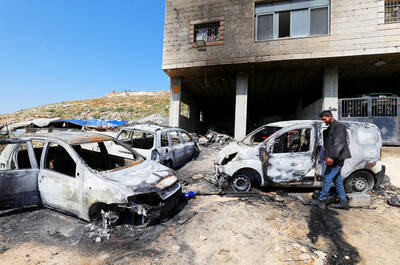
RAMPAGE: A Palestinian man was left dead after dozens of Israeli settlers searching for a missing 14-year-old boy stormed a village in the Israeli-occupied West Bank US President Joe Biden on Friday said he expected Iran to attack Israel “sooner, rather than later” and warned Tehran not to proceed. Asked by reporters about his message to Iran, Biden simply said: “Don’t,” underscoring Washington’s commitment to defend Israel. “We are devoted to the defense of Israel. We will support Israel. We will help defend Israel and Iran will not succeed,” he said. Biden said he would not divulge secure information, but said his expectation was that an attack could come “sooner, rather than later.” Israel braced on Friday for an attack by Iran or its proxies as warnings grew of

IN PURSUIT: Israel’s defense minister said the revenge attacks by Israeli settlers would make it difficult for security forces to find those responsible for the 14-year-old’s death Israeli Prime Minister Benjamin Netanyahu on Saturday condemned the “heinous murder” of an Israeli teenager in the occupied West Bank as attacks on Palestinian villages intensified following news of his death. After Benjamin Achimeir, 14, was reported missing near Ramallah on Friday, hundreds of Jewish settlers backed by Israeli forces raided nearby Palestinian villages, torching vehicles and homes, leaving at least one villager dead and dozens wounded. The attacks escalated in several villages on Saturday after Achimeir’s body was found near the Malachi Hashalom outpost. Agence France-Presse correspondents saw smoke rising from burned houses and fields. Mayor Amin Abu Alyah, of the


 RSS
RSS