


The State Department told a congressional committee on Tuesday that seven days after US President George W. Bush gave his State of the Union address, in which he charged that Saddam Hussein was attempting to purchase uranium in Africa, US diplomats warned the International Atomic Energy Agency that the US could not confirm the reports.
The statement, provided in writing to Representative Henry Waxman, the ranking Democrat on the House Committee on Government Reform, confirms that there were deep misgivings in the government about a portion of the intelligence Bush cited in his January speech.
On Monday the White House said for the first time that the evidence that Iraq sought nuclear fuel in Africa was not credible enough and should not have been included in the his remarks.
Nonetheless, White House officials declined on Tuesday to reveal how the charge made it into Bush's remarks. And they argued, in further statements that went beyond those issued from Air Force One on Monday, that the uranium issue was just one of many pieces of evidence indicating that Saddam was seeking to reconstitute his nuclear weapons program.
The White House acknowledgment that it had used flawed intelligence came nearly six months after the speech was delivered, and after weeks of arguments here and in Britain over how the invasion of Iraq was justified. On Tuesday it touched off a new series of accusations between Democrats and Republicans over whether the administration had deliberately skewed the evidence, or, as the Democrats argue, withheld information that would have cast doubt on the intelligence.
Democrats seized on the admission by the White House as new justification for a full-scale investigation by the intelligence panels, which are now reviewing the Iraq intelligence material but have shied away from portraying their work as an investigation.
"It's a recognition that we were provided faulty information," Senate Democratic Leader Tom Daschle of South Dakota told reporters.
"And I think it's all the more reason why a full investigation of all of the facts surrounding this situation be undertaken, the sooner the better.
Republicans said the White House had been "forthright" in making the admission and they said it was an example of what can come from relying on intelligence from other nations. Bush had cited British intelligence reports when he charged that Saddam had sought uranium in Africa, but that report was at least in part based on information developed by US intelligence agencies.
"Obviously, when you use foreign intelligence, you -- we don't have necessarily as much confidence or as much reliability as you do your own," said Senator Rick Santorum of Pennsylvania, the No. 3 Republican in the Senate.
"It has since turned out to be, at least according to the reports that have been just released, not true," he added. "The president stepped forward and said so. I think that's all you can expect."
The State Department's letter came in response to a statement provided to Waxman by the International Atomic Energy Agency (IAEA), the UN body that monitors nuclear activity around the world. The IAEA said it sought specific information in December from the administration to back up US charges that Iraq had attempted to purchase uranium in Niger.
The initial intelligence had been provided to Congress, in classified form, in late October. But it was not until until Feb. 4, a week after Bush spoke, and the day before Secretary of State Colin Powell made his detailed presentation about Iraq to the UN, that the administration provided documents to the IAEA to back up its charges.
The IAEA quickly concluded that the documents the US had turned over to support Bush's claims were fraudulent. But even in turning over the material, the State Department sent a message to the organization that said, "We cannot confirm these reports and have questions regarding some specific claims."
That statement would appear to show that serious doubts about the intelligence were present even in the days right around Bush's presentation. But Bush also cited other evidence, noting Iraq's efforts to buy rotors and magnets, all essential parts of centrifuges that could enrich uranium.
Michael Anton, a spokesman for the National Security Council, said on Tuesday that, "The documents alleging a transaction between Iraq and Niger were not the sole basis for the line in the president's State of the Union speech that referred to recent Iraqi attempts to acquire uranium from Africa."
He added that at the time a "national intelligence estimate" cited "attempts by Iraq to acquire uranium from several countries in Africa. We now know that documents alleging a transaction between Iraq and Niger had been forged," he said.
Bush never mentioned Niger by name in his speech. But without the Niger evidence, the argument that Saddam was intent on getting a uranium supply from Africa did not hold up.
Anton noted on Tuesday that "other reporting that suggested that Iraq had tried to obtain uranium from Africa is not detailed or specific enough for us to be certain that such attempts were in fact made.
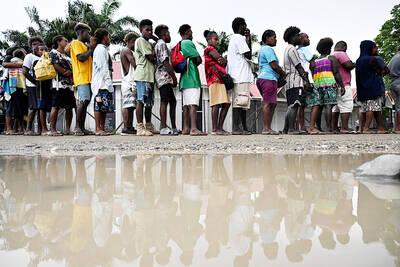
SEEKING CHANGE: A hospital worker said she did not vote in previous elections, but ‘now I can see that maybe my vote can change the system and the country’ Voting closed yesterday across the Solomon Islands in the south Pacific nation’s first general election since the government switched diplomatic allegiance from Taiwan to Beijing and struck a secret security pact that has raised fears of the Chinese navy gaining a foothold in the region. The Solomon Islands’ closer relationship with China and a troubled domestic economy weighed on voters’ minds as they cast their ballots. As many as 420,000 registered voters had their say across 50 national seats. For the first time, the national vote also coincided with elections for eight of the 10 local governments. Esther Maeluma cast her vote in the
Nearly half of China’s major cities are suffering “moderate to severe” levels of subsidence, putting millions of people at risk of flooding, especially as sea levels rise, according to a study of nationwide satellite data released yesterday. The authors of the paper, published by the journal Science, found that 45 percent of China’s urban land was sinking faster than 3mm per year, with 16 percent at more than 10mm per year, driven not only by declining water tables, but also the sheer weight of the built environment. With China’s urban population already in excess of 900 million people, “even a small portion

UNSETTLING IMAGES: The scene took place in front of TV crews covering the Trump trial, with a CNN anchor calling it an ‘emotional and unbelievably disturbing moment’ A man who doused himself in an accelerant and set himself on fire outside the courthouse where former US president Donald Trump is on trial has died, police said yesterday. The New York City Police Department (NYPD) said the man was declared dead by staff at an area hospital. The man was in Collect Pond Park at about 1:30pm on Friday when he took out pamphlets espousing conspiracy theories, tossed them around, then doused himself in an accelerant and set himself on fire, officials and witnesses said. A large number of police officers were nearby when it happened. Some officers and bystanders rushed

HYPOCRISY? The Chinese Ministry of Foreign Affairs yesterday asked whether Biden was talking about China or the US when he used the word ‘xenophobic’ US President Joe Biden on Wednesday called for a hike in steel tariffs on China, accusing Beijing of cheating as he spoke at a campaign event in Pennsylvania. Biden accused China of xenophobia, too, in a speech to union members in Pittsburgh. “They’re not competing, they’re cheating. They’re cheating and we’ve seen the damage here in America,” Biden said. Chinese steel companies “don’t need to worry about making a profit because the Chinese government is subsidizing them so heavily,” he said. Biden said he had called for the US Trade Representative to triple the tariff rates for Chinese steel and aluminum if Beijing was


 RSS
RSS