


Momentum was building yesterday for an international force to deploy to Liberia in a bid to end fighting that has left hundreds dead and a war that has spread chaos in West Africa for more than a decade.
The US, because of historic ties to a country founded by freed American slaves, is under most pressure to lead a mission demanded by UN Secretary-General Kofi Annan, Britain, France and legions of tired and frightened Liberians.
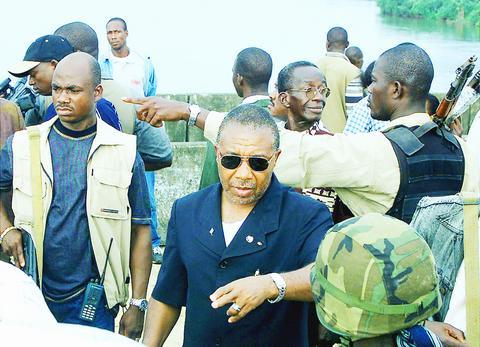
PHOTO: REUTERS
Liberia said on Saturday it was already talking to the US and West African countries about sending troops. Annan, a Ghanaian, said the UN Security Council should meet immediately to approve a force to seal a shaky truce on the ground.
Even that news brought some relief for the tens of thousands of terrified Liberians packed into Monrovia with little idea where to turn for refuge and without adequate food or water.
"Well, at least someone out there has been able to listen to our cries. When the UN speaks, we know something will happen. That is why we decided to go back home," said Bokar Samoki.
Liberia has known little but violence for the past 14 years, but two failed and bloody rebel assaults on the capital, Monrovia, left at least 700 dead in 10 days and brought home the danger of far greater blood-letting.
Two rebel factions control 60 percent of the ruined land and want to get rid of President Charles Taylor, a former warlord indicted for war crimes by an international court.
Taylor has joined calls for the US to step in, despite the fact that President George W. Bush urged him to quit last week and save his country of three million further pain.
"I think the US ought to come now, using my strength, my popularity and my legitimacy and work to bring peace in Liberia," Taylor told reporters on Saturday, dressed in dark suit and sunglasses on a visit to troops in the field.
So far, the Bush administration has not decided on sending any force, although the issue is under discussion. Britain's UN ambassador, Sir Jeremy Greenstock, publicly urged the US last week to lead a multinational force.
"There are at least talks of further intervention, whether that's necessary or appropriate. I don't know at this point," State Department spokesman Richard Boucher said on Friday.
Daily marches to the US embassy in Monrovia since the latest rebel attack have demanded intervention to save Liberians from forces on both sides who inspire little confidence they could bring peace.
France joined calls for foreign intervention and said it was in talks with the US on how to help Liberia quickly.
French Foreign Minister Dominique de Villepin said a US lead was natural given that France was helping end civil war in Ivory Coast and Britain had played a big role in Sierra Leone -- both wars offshoots of the Liberian conflict..
Negotiations in Ghana were adjourned for a week on Friday because of the fighting in spite of a ceasefire.
US-educated Taylor emerged as the dominant faction leader from a war that left 200,000 dead in the 1990s and he went on to win 1997 elections, but the country has stayed on its knees while he is accused of spreading war to the region.
He has offered to step down for a transition government at the end of his elected mandate in January, but he also wants Sierra Leone's war crimes court to drop its indictment.
Regional diplomats said that if any intervention force was sent to Liberia, it would have to be made clear that it had no mandate to arrest Taylor to bring him before the UN-backed tribunal.

Republican US lawmakers on Friday criticized US President Joe Biden’s administration after sanctioned Chinese telecoms equipment giant Huawei unveiled a laptop this week powered by an Intel artificial intelligence (AI) chip. The US placed Huawei on a trade restriction list in 2019 for contravening Iran sanctions, part of a broader effort to hobble Beijing’s technological advances. Placement on the list means the company’s suppliers have to seek a special, difficult-to-obtain license before shipping to it. One such license, issued by then-US president Donald Trump’s administration, has allowed Intel to ship central processors to Huawei for use in laptops since 2020. China hardliners
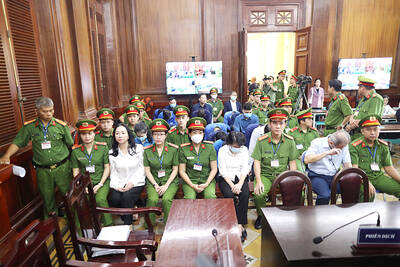
A top Vietnamese property tycoon was on Thursday sentenced to death in one of the biggest corruption cases in history, with an estimated US$27 billion in damages. A panel of three hand-picked jurors and two judges rejected all defense arguments by Truong My Lan, chair of major developer Van Thinh Phat, who was found guilty of swindling cash from Saigon Commercial Bank (SCB) over a decade. “The defendant’s actions ... eroded people’s trust in the leadership of the [Communist] Party and state,” read the verdict at the trial in Ho Chi Minh City. After the five-week trial, 85 others were also sentenced on

‘DELUSIONAL’: Targeting the families of Hamas’ leaders would not push the group to change its position or to give up its demands for Palestinians, Ismail Haniyeh said Israeli aircraft on Wednesday killed three sons of Hamas’ top political leader in the Gaza Strip, striking high-stakes targets at a time when Israel is holding delicate ceasefire negotiations with the militant group. Hamas said four of the leader’s grandchildren were also killed. Ismail Haniyeh’s sons are among the highest-profile figures to be killed in the war so far. Israel said they were Hamas operatives, and Haniyeh accused Israel of acting in “the spirit of revenge and murder.” The deaths threatened to strain the internationally mediated ceasefire talks, which appeared to gain steam in recent days even as the sides remain far
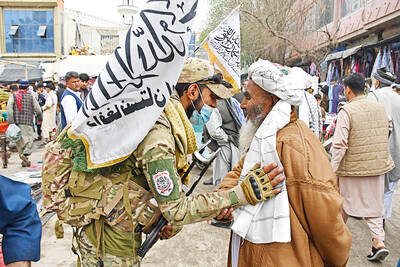
The Taliban’s reclusive supreme leader made a rare public appearance yesterday, an Afghan government spokesman said, leading thousands of worshipers in prayers marking Eid al-Fitr. Hibatullah Akhundzada has made only a handful of public appearances since inheriting the leadership of the Taliban in 2016 and leading the movement back to power with the withdrawal of US forces in 2021. Taliban government spokesman Zabihullah Mujahid said prayer in the largest mosque in Kandahar was “performed under the leadership of the supreme leader.” In a statement on X, he said the early-morning service “was attended by thousands of compatriots” in the southern province considered the


 RSS
RSS