


Which war has claimed the most lives since World War II? Korea? Vietnam? Not even close.
The answer is the continuing conflict in the Democratic Republic of the Congo. There are no firm figures on the death toll, but the range is believed to lie between 2 million and 4.7 million. Assuming the low end estimate, that's equivalent to a 9/11 every day for 666 days. The New York-based Human Rights Watch puts the toll at 3.3 million.
And there is nothing resembling a weapon of mass destruction in the conflict. The victims have been claimed one by one for the most part from war-related disease. Others have been claimed in combat -- from bows and arrows, machetes, assault rifles and rocket-propelled grenades doing most of the damage in recent fighting. Child soldiers abound. Orphans, some of them under 10, often have little choice other than to join one of the militias doing the fighting.
Despite three peace agreements aimed at ending the five-year-old Congolese war, fighting intensified late last year and early this year.
Congo might receive more international attention if it were more strategically located. It is not a place where interests of the US and other big powers intersect.
"There is just no question that Congo has the worst, bloodiest, nastiest conflict in the world, but the amount of attention it has received is negligible," says Scott Pegg, an activist and researcher in African issues.
"It reminds me of the early 1990s when the world's attention was riveted on Bosnia but the most deadly conflict in the world -- by far -- was taking place almost unnoticed in Angola.''
Only recently has the Congolese conflict generated a measure of interest from the outside. Three weeks ago, the UN Security Council authorized a French-led international force to deploy in the eastern Congolese town of Bunia, administrative capital of Ituri Province.
There as elsewhere, fighting has been fueled by ethnic hatreds, competition for gold and other resources and intervention, both direct and indirect, by neighboring countries. In recent weeks, refugees fleeing into neighboring western Uganda alleged that cannibalism was widespread.
The French-led force is empowered to use its weapons to defend civilians against the militias. When fully manned it will have 1,500 troops, but the force's mandate lasts only until Sept. 1. A UN contingent from Bangladesh will then take over.
The UN acted after an estimated 400 people were killed in fighting for control of Bunia early last month. A 750-member UN force that has been stationed there since April was unable to calm the situation because its mandate permitted force only in self defense. The UN authority for this unit expires at the end of this month, and the Security Council is debating whether to dispatch a larger force with more latitude in using their weapons.
The International Crisis Group, which monitors conflicts worldwide, says a sustainable peace can be achieved only with more expansive UN intervention.
The US has shown a clear reluctance to become embroiled in African conflicts. American resources are stretched by commitments in Iraq, Afghanistan and elsewhere. Beyond that, humanitarian interventions received a bad name here after 18 US soldiers were killed in Somalia in October 1993. No US troops are involved in the Congo effort.
The fight against HIV/AIDS is the centerpiece of the administration's humanitarian efforts overseas. US President George W. Bush is asking Congress for US$15 billion to do battle against the scourge. Secretary of State Colin Powell highlighted the magnitude of the challenge two weeks ago.
"You could take all of the lives lost through weapons of mass destruction over the past century ... go through World War I, go through Hiroshima, go through Nagasaki, go through all of them," Powell said two weeks ago. "Put all of those numbers together, multiply by 10 and you don't reach the number of people who will die from HIV/AIDS in the next 12 months."
Nearly half of China’s major cities are suffering “moderate to severe” levels of subsidence, putting millions of people at risk of flooding, especially as sea levels rise, according to a study of nationwide satellite data released yesterday. The authors of the paper, published by the journal Science, found that 45 percent of China’s urban land was sinking faster than 3mm per year, with 16 percent at more than 10mm per year, driven not only by declining water tables, but also the sheer weight of the built environment. With China’s urban population already in excess of 900 million people, “even a small portion

‘IN A DIFFERENT PLACE’: The envoy first visited Shanghai, where he attended a Chinese basketball playoff match, and is to meet top officials in Beijing tomorrow US Secretary of State Antony Blinken yesterday arrived in China on his second visit in a year as the US ramps up pressure on its rival over its support for Russia while also seeking to manage tensions with Beijing. The US diplomat tomorrow is to meet China’s top brass in Beijing, where he is also expected to plead for restraint as Taiwan inaugurates president-elect William Lai (賴清德), and to raise US concerns on Chinese trade practices. However, Blinken is also seeking to stabilize ties, with tensions between the world’s two largest economies easing since his previous visit in June last year. At the

UNSETTLING IMAGES: The scene took place in front of TV crews covering the Trump trial, with a CNN anchor calling it an ‘emotional and unbelievably disturbing moment’ A man who doused himself in an accelerant and set himself on fire outside the courthouse where former US president Donald Trump is on trial has died, police said yesterday. The New York City Police Department (NYPD) said the man was declared dead by staff at an area hospital. The man was in Collect Pond Park at about 1:30pm on Friday when he took out pamphlets espousing conspiracy theories, tossed them around, then doused himself in an accelerant and set himself on fire, officials and witnesses said. A large number of police officers were nearby when it happened. Some officers and bystanders rushed
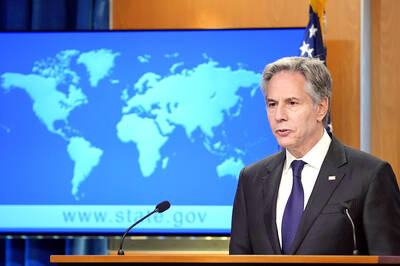
Beijing is continuing to commit genocide and crimes against humanity against Uyghurs and other Muslim minorities in its western Xinjiang province, U.S. Secretary of State Antony Blinken said in a report published on Monday, ahead of his planned visit to China this week. The State Department’s annual human rights report, which documents abuses recorded all over the world during the previous calendar year, repeated language from previous years on the treatment of Muslims in Xinjiang, but the publication raises the issue ahead of delicate talks, including on the war in Ukraine and global trade, between the top U.S. diplomat and Chinese


 RSS
RSS