


Sharon Van Epps remembers the day she first held Haseena, with her rich black hair and dark eyes. The baby, just beginning to walk, did not make a sound, just held on to her tightly.
"I felt like something I'd been missing my whole life that I didn't even know I'd been missing had been found," she recalled.
Van Epps, an American freelance writer, saw Haseena nearly every day afterward, bonding with the girl she hoped to adopt with her husband, John Clements, a partner in a major accounting firm. The couple had received nearly all the necessary approvals from agencies in the US and India, and Van Epps expected to leave here with Haseena within two months.
But that was 15 months ago, and since then she has been locked in battle with a small but determined group of activists.
Led by Gita Ramaswamy, a longtime union organizer-turned-book publisher, the group argues that the foreign adoption system in India is riddled with corruption and encourages trafficking in baby girls, who are often seen as a burden by poor families. In some cases, the police say, babies have been sold by their parents for as little as US$20.
Van Epps, 37, and Ramaswamy, 50, are fighting it out in the state of Andhra Pradesh, but Ramaswamy wants a nationwide moratorium on foreign adoptions for several years.
Last year, according to the Indian government, American and European families adopted nearly 800 children from India, compared with 1,200 in-country adoptions. The numbers may not seem large for a country of a billion people, but Indian law allows only Hindus and Buddhists to adopt; Christians, Muslims and Jews in India may only become guardians.
For Van Epps and other Americans and Europeans seeking to adopt here, the only number that counts is one -- the child they are seeking.
Van Epps' experience has left her pained and angry. "I am a test case for them," she said.
Ramaswamy insists that the dispute is not personal.
"We're not working on Haseena not going abroad," said Ramaswamy, whose five sisters live in the US.
"We're working for changes in the system," Ramaswamy said.
Ramaswamy argues that poverty and the degradation of women in Indian society are the reasons that so many poor women sell their baby daughters. Rather than address these problems, the Indian government allows foreigners to adopt babies as a partial solution, she said.
What really drives baby trafficking, she says, is demand from rich couples from the US and Europe. Poor women do not go around offering their babies, she said, but are persuaded to sell by offers of what to them are irresistible amounts of money.
Ramaswamy and her colleagues have sought to portray Van Epps as a rich American who is throwing her weight around. Indeed, two US senators have written letters on her behalf, and the US Embassy has made inquiries about the case, though it has remained neutral.
"Her faith in the power of the color of her skin, and the superpower status of her country, is so strong" that she is convinced "she must win," Ramaswamy wrote in April in a commentary against foreign adoptions in the Deccan Chronicle, the state's leading English-language daily.
Ramaswamy and her group have publicly asserted that Haseena was trafficked, though Ramaswamy conceded in an interview that there was no hard evidence that Haseena had been bought by the orphanage.
Even if Haseena had been bought, there is no evidence that Van Epps knew this.
Indian law requires that before a child can be adopted by foreigners he or she must first be offered to an Indian couple; then to an Indian couple living abroad; then to a couple with one Indian spouse.
On March 23, 2001, the Central Adoption Resource Agency, the federal body in India that regulates adoptions, said the government had "no objection to the placement" of Haseena with foreigners, after another agency had said it could find no Indian parents because the girl had mildly deformed feet.
But a month later, before Van Epps and Clements could petition the family court for approval, the police in Andhra Pradesh uncovered a baby-selling ring. Baby girls were being bought from poor families and brought to orphanages, which in turn made them available to foreign applicants, who pay more for a child than do Indians seeking to adopt.
After the scandal, two orphanages in Andhra Pradesh were closed. A few months later, charges were filed against St. Theresa's Tender Loving Care Home, the orphanage where Haseena was. It was charged with "procuring children since 1996 for the purpose of giving the majority of the children in intercountry adoption for huge monetary considerations."
The case is pending, and the orphanage remains open, though its license has not been renewed.
Sister Teresa Marie, the 69-year old nun who runs the orphanage, denied that it had ever engaged in baby-trafficking. She said the charges were politically motivated.
Ramaswamy and her colleagues have mounted an effort to find Indian parents for these and other baby girls in the process of being adopted by Americans and Europeans.
One Indian couple, B. Venkata Subrahmanyam, a businessman, and his wife, have come forward for Haseena. About two weeks ago, the state agency for Women Development and Child Welfare wrote to the court that Subrahmanyam's desire to adopt Haseena "does not come out of love and affection for the child." Its director added that there was "strong reason to believe" that Subrahmanyam was acting "on account of certain external pressures," a clear reference to foreign adoption opponents.
Subrahmanyam dismissed that notion as "absolutely rubbish." In a telephone interview, he said it was the welfare agency that had acted under external pressure -- from the US government.
On May 28, the state removed Haseena from the Tender Loving Care Home and placed her in the state-run Sishu Vihar orphanage here. The head of that orphanage declined requests to be interviewed.
Since June 7, the state authorities have not allowed Van Epps to see Haseena. But every afternoon, she shows up at the orphanage, hoping she will be granted permission.
On a recent day, sitting outside in a car, she looked dejected, holding a photo album with pictures of the little girl. "When I open it now," she said, "I just cry."
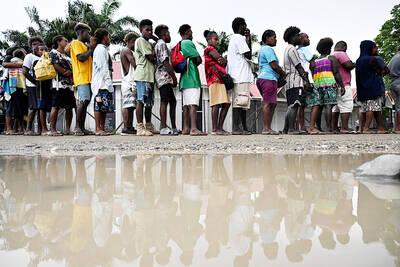
SEEKING CHANGE: A hospital worker said she did not vote in previous elections, but ‘now I can see that maybe my vote can change the system and the country’ Voting closed yesterday across the Solomon Islands in the south Pacific nation’s first general election since the government switched diplomatic allegiance from Taiwan to Beijing and struck a secret security pact that has raised fears of the Chinese navy gaining a foothold in the region. The Solomon Islands’ closer relationship with China and a troubled domestic economy weighed on voters’ minds as they cast their ballots. As many as 420,000 registered voters had their say across 50 national seats. For the first time, the national vote also coincided with elections for eight of the 10 local governments. Esther Maeluma cast her vote in the
Nearly half of China’s major cities are suffering “moderate to severe” levels of subsidence, putting millions of people at risk of flooding, especially as sea levels rise, according to a study of nationwide satellite data released yesterday. The authors of the paper, published by the journal Science, found that 45 percent of China’s urban land was sinking faster than 3mm per year, with 16 percent at more than 10mm per year, driven not only by declining water tables, but also the sheer weight of the built environment. With China’s urban population already in excess of 900 million people, “even a small portion

UNSETTLING IMAGES: The scene took place in front of TV crews covering the Trump trial, with a CNN anchor calling it an ‘emotional and unbelievably disturbing moment’ A man who doused himself in an accelerant and set himself on fire outside the courthouse where former US president Donald Trump is on trial has died, police said yesterday. The New York City Police Department (NYPD) said the man was declared dead by staff at an area hospital. The man was in Collect Pond Park at about 1:30pm on Friday when he took out pamphlets espousing conspiracy theories, tossed them around, then doused himself in an accelerant and set himself on fire, officials and witnesses said. A large number of police officers were nearby when it happened. Some officers and bystanders rushed

HYPOCRISY? The Chinese Ministry of Foreign Affairs yesterday asked whether Biden was talking about China or the US when he used the word ‘xenophobic’ US President Joe Biden on Wednesday called for a hike in steel tariffs on China, accusing Beijing of cheating as he spoke at a campaign event in Pennsylvania. Biden accused China of xenophobia, too, in a speech to union members in Pittsburgh. “They’re not competing, they’re cheating. They’re cheating and we’ve seen the damage here in America,” Biden said. Chinese steel companies “don’t need to worry about making a profit because the Chinese government is subsidizing them so heavily,” he said. Biden said he had called for the US Trade Representative to triple the tariff rates for Chinese steel and aluminum if Beijing was


 RSS
RSS