


When the first American pilot was ordered to fly to West Berlin early on June 24, 1948, defying a Soviet blockade and unofficially beginning the Berlin Airlift, he was carrying potatoes to people in need.
Fifty-five years on, one "Candy Bomber," as the aircraft became known, still flies over the German capital but its cargo has changed somewhat.
"It's really important to have fun while you're learning history. It's cruel for children and adults to have to suffer through all those museums. Oh, no... you really have to feel it," says Commander Frank Hellberg.
These days Hellberg fills a Douglas Dakota DC-3, the civilian version of the C-47 transport planes used to keep alive around two million trapped and starving people for over a year, with tourists and shows them Berlin from a new angle.
"They were taking off every two or three minutes," remembers Helmut Streamel, a 71-year-old former airman who is a passenger this time on a 45-minute flight over the German capital and neighboring Tempelhofring Potsdam.
The "they" were the pilots and crew of 500 US and British aircraft, many of them C-47s.
They helped break a stalemate on June 21, 1948 when the Soviets stopped a US supply train reaching West Berlin, which snowballed into a blockade of land and water access points aimed at uniting the city by starving the population into submission.
The pilots broke cargo transport records almost daily, shipping around 2.5 million tonnes of food and essential supplies to Tempelhof airport on some 277,000 flights.
Landing in Tempelhof today is a visually impressive but technically easy approach low over homes and shops -- 55 years ago, a pilot had to fly between multi-storey apartment buildings before he could set his aircraft down.
But a flight in Hellberg's plane over Berlin, including a stunning pirouette around the city's landmark television tower, is not for the faint of heart or weak of stomach.
As they fire up, the aircraft's engines throb like twin helicopters and they are screaming by the time the 12,700kg plane hauls itself slowly into the air amid a faint smell of aviation fuel.
"Sounds like a Buick engine," a businessman wearing a fine suit and a broad grin, yells over the din to a neighbor among the 25 passengers aboard.
The craft bucks and yaws and demands plenty of physical effort from its pilot and co-pilot, whom passengers clearly see through the open cockpit door.
In 1948, the crew would have been fighting with up to 3,000 additional kilograms in cargo.
While a lot of that was food, pilots also had to manoeuvre coal and fuel for homes and industry in along the three 35km wide air corridors through the Soviet zone.
When the winter hit, energy supplies dropped so low that people were forced to cut down most of the city's trees to heat their homes, scenes that have been largely forgotten these days.
With anti-American sentiment boosted in largely pacifist Germany by the US-led war on Iraq, Streamel says that many people and especially the young need reminding about the help the US gave in the past to save Berlin citizens from certain death.
Nearly half of China’s major cities are suffering “moderate to severe” levels of subsidence, putting millions of people at risk of flooding, especially as sea levels rise, according to a study of nationwide satellite data released yesterday. The authors of the paper, published by the journal Science, found that 45 percent of China’s urban land was sinking faster than 3mm per year, with 16 percent at more than 10mm per year, driven not only by declining water tables, but also the sheer weight of the built environment. With China’s urban population already in excess of 900 million people, “even a small portion

UNSETTLING IMAGES: The scene took place in front of TV crews covering the Trump trial, with a CNN anchor calling it an ‘emotional and unbelievably disturbing moment’ A man who doused himself in an accelerant and set himself on fire outside the courthouse where former US president Donald Trump is on trial has died, police said yesterday. The New York City Police Department (NYPD) said the man was declared dead by staff at an area hospital. The man was in Collect Pond Park at about 1:30pm on Friday when he took out pamphlets espousing conspiracy theories, tossed them around, then doused himself in an accelerant and set himself on fire, officials and witnesses said. A large number of police officers were nearby when it happened. Some officers and bystanders rushed
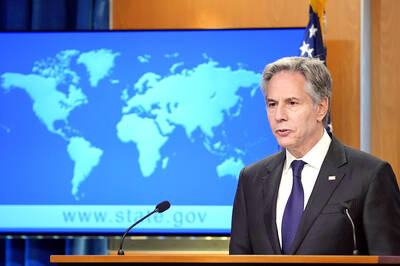
Beijing is continuing to commit genocide and crimes against humanity against Uyghurs and other Muslim minorities in its western Xinjiang province, U.S. Secretary of State Antony Blinken said in a report published on Monday, ahead of his planned visit to China this week. The State Department’s annual human rights report, which documents abuses recorded all over the world during the previous calendar year, repeated language from previous years on the treatment of Muslims in Xinjiang, but the publication raises the issue ahead of delicate talks, including on the war in Ukraine and global trade, between the top U.S. diplomat and Chinese

HYPOCRISY? The Chinese Ministry of Foreign Affairs yesterday asked whether Biden was talking about China or the US when he used the word ‘xenophobic’ US President Joe Biden on Wednesday called for a hike in steel tariffs on China, accusing Beijing of cheating as he spoke at a campaign event in Pennsylvania. Biden accused China of xenophobia, too, in a speech to union members in Pittsburgh. “They’re not competing, they’re cheating. They’re cheating and we’ve seen the damage here in America,” Biden said. Chinese steel companies “don’t need to worry about making a profit because the Chinese government is subsidizing them so heavily,” he said. Biden said he had called for the US Trade Representative to triple the tariff rates for Chinese steel and aluminum if Beijing was


 RSS
RSS