


Summer's here and it's time to cover up. With their sun hats, ultra-violet (UV) filtering parasols, sun creams and skin-whitening lotions, Japanese women are keener than ever to adhere to the traditional Asian concept of white-skinned beauty.
The sun has set on the short-lived era of the ganguro (literally "black faces") -- young women with deeply tanned complexions and heavy make-up -- often seen in the capital's trendy Shibuya district. Instead the fashion among most women is to be as pale-skinned as possible.
After office hours on a recent evening, the umbrella section of the Mitsukoshi department store in the heart of the glitzy Ginza district was packed with young women.
"Over the last three years, we've noticed a marked increase in purchases [of parasols] by young women aged between 20 and 30," section manager Tomoyasu Muto said.
The Japanese umbrella market is now worth ?20 billion (US$169 million) a year, according to industry figures.
While all the parasols sold by Mitsukoshi are billed as able to provide UV protection and television weather forecasts include UV levels, "our customers are actually more worried about the beauty of their skin than concerned about their health and the risks associated with too much exposure to the sun," Muto said.
With her diamond jewellery, fashionably elegant clothes and her beautifully manicured hands, Makiko Yamamoto is a typical, affluent urban housewife.
"When I go to the beach, I use total sunblock, and when the sun is too strong, I cover up completely to go out. I haven't had a tan for seven years, I'm too old for that," said the fair-skinned, slender woman who does not look her 39 years.
Like Yamamoto, other women shoppers professed themselves terrified of the risk of dark patches appearing on their skin which signifies aging to them, quoting the old saying: "a white face hides seven defects."
Outside Mitsukoshi, talking on her mobile phone, 51-year-old Kyoko Fukumura's red lips and kimono worn so as to expose the white nape of her neck are the telltale signs of her profession as a geisha in the hotspring resort town of Hakone, near Mount Fuji.
"I forgot my parasol which was a big mistake because the sun is strong today. Naturally, as a geisha, I've always tried to keep my skin white," Fukumura said.
French fashion and beauty consultant Francoise Morechand, who first came to Japan in the 1960s, agreed there is a tendency among women to have as pale a complexion as possible.
"The cosmetics companies became interested in whitening products about seven years ago -- first the Japanese companies that grabbed the wider Asian market for them, then the foreign companies like Lancome, Estee Lauder, and Helena Rubenstein.
"Today, there isn't a single company which does not have skin whitening products aimed at the Asian markets," she said.
"White skin has always had an important connotation [in Japan] because it shows that you are not a laborer or a peasant. On top of that, just as elsewhere in Asia, the best compliment you can pay a woman is to tell her that her face is like the moon."
According to Morechand, in the collective Japanese imagination, the moon's characteristics of roundness and paleness symbolize a particular kind of fragility, "a touching and alluring weakness," which Japanese women know will appeal to their boss or husband.
In the 1960s, leading Japanese cosmetics company Shiseido became the first to launch a vitamin C-based product to lighten the complexion, but it was only toward the end of the 1990s that it began to expand its range.
"Even the youngest customers dream of having skin the color of [the outside of] a hardboiled egg -- shining white," said Masami Kumaki, who is in charge of training saleswomen for Shiseido.
Sales of skin-whitening products in Asia grew by 20 percent between 1997 and last year and accounted for 23 percent of the company's total sales in the region, said Shiseido official Toshiaki Igeta. Sales of sunscreen creams jumped by 52 percent.
"Women in Singapore or Taiwan, where I've worked, want to have skin as beautiful as the Japanese. They don't just want white skin, but translucent, almost transparent skin," Igeta said. "In East Asia the sun's rays are very strong, that's why they want Japanese products."
Nearly half of China’s major cities are suffering “moderate to severe” levels of subsidence, putting millions of people at risk of flooding, especially as sea levels rise, according to a study of nationwide satellite data released yesterday. The authors of the paper, published by the journal Science, found that 45 percent of China’s urban land was sinking faster than 3mm per year, with 16 percent at more than 10mm per year, driven not only by declining water tables, but also the sheer weight of the built environment. With China’s urban population already in excess of 900 million people, “even a small portion

UNSETTLING IMAGES: The scene took place in front of TV crews covering the Trump trial, with a CNN anchor calling it an ‘emotional and unbelievably disturbing moment’ A man who doused himself in an accelerant and set himself on fire outside the courthouse where former US president Donald Trump is on trial has died, police said yesterday. The New York City Police Department (NYPD) said the man was declared dead by staff at an area hospital. The man was in Collect Pond Park at about 1:30pm on Friday when he took out pamphlets espousing conspiracy theories, tossed them around, then doused himself in an accelerant and set himself on fire, officials and witnesses said. A large number of police officers were nearby when it happened. Some officers and bystanders rushed
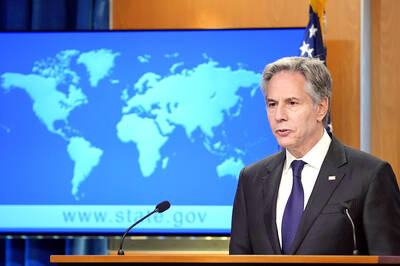
Beijing is continuing to commit genocide and crimes against humanity against Uyghurs and other Muslim minorities in its western Xinjiang province, U.S. Secretary of State Antony Blinken said in a report published on Monday, ahead of his planned visit to China this week. The State Department’s annual human rights report, which documents abuses recorded all over the world during the previous calendar year, repeated language from previous years on the treatment of Muslims in Xinjiang, but the publication raises the issue ahead of delicate talks, including on the war in Ukraine and global trade, between the top U.S. diplomat and Chinese

HYPOCRISY? The Chinese Ministry of Foreign Affairs yesterday asked whether Biden was talking about China or the US when he used the word ‘xenophobic’ US President Joe Biden on Wednesday called for a hike in steel tariffs on China, accusing Beijing of cheating as he spoke at a campaign event in Pennsylvania. Biden accused China of xenophobia, too, in a speech to union members in Pittsburgh. “They’re not competing, they’re cheating. They’re cheating and we’ve seen the damage here in America,” Biden said. Chinese steel companies “don’t need to worry about making a profit because the Chinese government is subsidizing them so heavily,” he said. Biden said he had called for the US Trade Representative to triple the tariff rates for Chinese steel and aluminum if Beijing was


 RSS
RSS