


Does living in the suburbs make you fat?
Probably, say a group of urban planners, architects and researchers who are studying how the design of communities affects human health. The reason: People have to drive everywhere.
"We're not at the point now that we know that sprawl makes you fat," said Lawrence Frank, associate professor of urban planning at the University of British Columbia. "But if you choose to live in a sprawling environment, you are more likely to be overweight."
Frank co-wrote a vast new study that set out to ask: "If we make places more walkable -- denser, more mixed-use, more pedestrian-friendly and more interconnected -- do people in fact walk more, and if they walk more, are they healthier?"
With responses from 12,000 people, the authors determined that people who live in areas of low building density (read: suburbs) tend to weigh more than people in higher-density, mixed-use areas (read: cities), even accounting for income, age, gender and ethnicity.
At the lowest density levels in Atlanta, 68 percent of white men were overweight; at the highest density levels, 50 percent were. In terms of obesity, at the lowest density in the city, 23 percent were considered obese. At the highest levels, 13 percent were obese.
The study found the same pattern for white women and black men but did not survey enough black women to determine if the same held true for them.
Frank discussed his survey here on Thursday at a conference of the Congress for the New Urbanism, a movement that advocates more mass transit and pedestrian-friendly development. The movement's critics say that the new urbanists are liberal, elite suburb-bashers who want government to control how and where everyone lives.
But Frank's colleagues at the conference agreed that his findings, if not a matter of common sense, were important for supporting a long-held perception.
"The research is validating something that I've long observed when I've been in cities, which is that you see a lot of slender people," said Peter Katz, a marketing consultant and real estate developer from Alexandria, Virginia. "You go out to the heartland, the middle of America, the small towns and suburban areas, you see a lot of obese people."
An estimated 60 percent of Americans are overweight or obese.
Daniel Solomon, an architect from San Francisco, said that Katz's observations were true wherever suburbs were sprouting. He pointed to Beijing and Shanghai, China, where people still walk and ride bicycles, but said that those cities' new suburbs, where people drive more, also had higher rates of diabetes and obesity.
As a result, he said, parents are taking a stern approach to combating obesity in their children.
"There are ads now on Beijing television for summer camps modeled on World War II Japanese concentration camps," he said. "Middle-class parents send their obese children to be disciplined by guards dressed in Japanese World War II uniforms."
In the US, the planners said, the cities most suitable for walking are San Francisco, Boston, New York, Seattle and Chicago. Those least friendly for walking -- and with overall higher rates of diabetes and obesity -- are Phoenix, Atlanta and Houston.
But not everyone buys the idea that environmental sprawl is responsible for sprawling waistlines. Ron Utt, a housing and transportation analyst at the Heritage Foundation, a Washington-based conservative research group, said the theory "has a touch of intuitive credibility, but you're fat for a lot of reasons."
He added that "the heaviest people" are residents of urban public housing.
"They are living in Congress of New Urbanism nirvana, with small apartments, small land use, taking public transit," Utt said, "but they tend to be significantly overweight. Your weight has less to do with housing than with a sedentary life, more people making their living not doing any kind of physical labor, and our recreation options are sedentary -- VCRs and DVDs have eliminated the need even to go to a movie theater."
And other factors complicate the picture. For example, cities may force a person to walk more and become slimmer. But cities can also trap pollution from cars, making it extremely unhealthy, especially for people with asthma.
Still, Frank's findings could hold useful implications for urban planning and for how people think about where they want to live.
Stephanie Bothwell, a health and design consultant for the Robert Wood Johnson Foundation, the largest philanthropy devoted exclusively to health issues in the US, said foundation officials were especially concerned about obesity and the link with community design.
"If people didn't exercise as part of their everyday activity, as opposed to relying on gyms and diet, they probably weren't going to win this war," she said. "So they began looking at how you design urban settings in such a way that people want to walk, love to walk, need to walk, are delighted to walk."

Republican US lawmakers on Friday criticized US President Joe Biden’s administration after sanctioned Chinese telecoms equipment giant Huawei unveiled a laptop this week powered by an Intel artificial intelligence (AI) chip. The US placed Huawei on a trade restriction list in 2019 for contravening Iran sanctions, part of a broader effort to hobble Beijing’s technological advances. Placement on the list means the company’s suppliers have to seek a special, difficult-to-obtain license before shipping to it. One such license, issued by then-US president Donald Trump’s administration, has allowed Intel to ship central processors to Huawei for use in laptops since 2020. China hardliners

Conjoined twins Lori and George Schappell, who pursued separate careers, interests and relationships during lives that defied medical expectations, died this month in Pennsylvania, funeral home officials said. They were 62. The twins, listed by Guinness World Records as the oldest living conjoined twins, died on April 7 at the Hospital of the University of Pennsylvania, obituaries posted by Leibensperger Funeral Homes of Hamburg said. The cause of death was not detailed. “When we were born, the doctors didn’t think we’d make 30, but we proved them wrong,” Lori said in an interview when they turned 50, the Philadelphia Inquirer reported. The
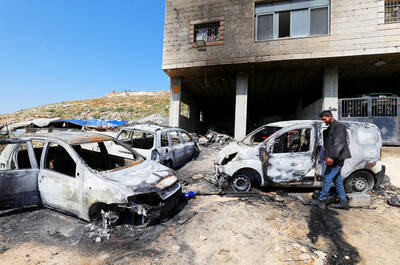
RAMPAGE: A Palestinian man was left dead after dozens of Israeli settlers searching for a missing 14-year-old boy stormed a village in the Israeli-occupied West Bank US President Joe Biden on Friday said he expected Iran to attack Israel “sooner, rather than later” and warned Tehran not to proceed. Asked by reporters about his message to Iran, Biden simply said: “Don’t,” underscoring Washington’s commitment to defend Israel. “We are devoted to the defense of Israel. We will support Israel. We will help defend Israel and Iran will not succeed,” he said. Biden said he would not divulge secure information, but said his expectation was that an attack could come “sooner, rather than later.” Israel braced on Friday for an attack by Iran or its proxies as warnings grew of

A prominent Christian leader has allegedly been stabbed at the altar during a Mass yesterday in southwest Sydney. Bishop Mar Mari Emmanuel was saying Mass at Christ The Good Shepherd Church in Wakeley just after 7pm when a man approached him at the altar and allegedly stabbed toward his head multiple times. A live stream of the Mass shows the congregation swarm forward toward Emmanuel before it was cut off. The church leader gained prominence during the COVID-19 pandemic, amassing a large online following, Officers attached to Fairfield City police area command attended a location on Welcome Street, Wakeley following reports a number


 RSS
RSS