


The European Commission found itself bogged down in a fresh scandal over alleged fraud and mismanagement on Tuesday with its critics claiming that the EU executive has learned nothing from its sleaze-soaked past.
In a twist that delighted British Euroskeptics, a powerful panel of MEPs cross-examined Neil Kinnock, the commission vice-president, and two of his fellow commissioners about the affair.
The commission, MEPs claimed, had done too little too late about a burgeoning scandal involving the alleged "looting" of a million euros, despite the fact that it embarked upon a radical reform program in 1999 after the fraud-induced demise of the last commission.
Since Kinnock is in charge of reforming the commission, and was given the job of improving the way in which the commission handles such allegations, he was one of those in the line of fire yesterday.
He and his colleagues flatly denied that the commission had handled the matter incompetently and said that the matter was still being investigated.
They did concede, however, that there appeared to be problems "far more significant" than previously thought.
The allegations are serious. EU officials, it is claimed, illegally transferred 1 million euros into unofficial bank accounts. The case is being investigated by authorities in France and Luxembourg as well as by Olaf, the EU's anti-fraud office.
At the center of the matrix lies Eurostat, the commission's Luxembourg-based statistical arm.
Although it sounds obscure, the Eurostat is the body which provides the figures that the commission uses to inform its decision-making and therefore has considerable influence.
Its two most senior figures -- Yves Franchet and Daniel Byk -- are the two main suspects in the affair. Both deny wrongdoing and were moved from their posts at their own request last month.
MEPs said yesterday that the commission had known about the problems at Eurostat in 1999 but had failed to act.
It was also suggested in some quarters that Romano Prodi, the commission president, knew about the allegations and did not act, an allegation which drew a furious denial from his spokesman.

Republican US lawmakers on Friday criticized US President Joe Biden’s administration after sanctioned Chinese telecoms equipment giant Huawei unveiled a laptop this week powered by an Intel artificial intelligence (AI) chip. The US placed Huawei on a trade restriction list in 2019 for contravening Iran sanctions, part of a broader effort to hobble Beijing’s technological advances. Placement on the list means the company’s suppliers have to seek a special, difficult-to-obtain license before shipping to it. One such license, issued by then-US president Donald Trump’s administration, has allowed Intel to ship central processors to Huawei for use in laptops since 2020. China hardliners

DISADVANTAGE: Erin O’Toole, who led the Conservatives during the election campaign in 2021, estimated that the interference cost his party as many as nine legislative seats Canada’s domestic spy agency on Monday concluded that China interfered in the past two elections, an official probe heard, the firmest evidence so far of suspected Chinese meddling in Canadian politics. Canadian Prime Minister Justin Trudeau’s Liberal Party won both the elections, held in 2019 and 2021. Under pressure from opposition lawmakers unhappy about media reports on China’s possible role, Trudeau set up a commission into foreign interference. The commission was shown a slide on Monday containing an extract of a briefing in February last year from the Canadian Security Intelligence Service (CSIS). “We know that the PRC [People’s Republic of China] clandestinely
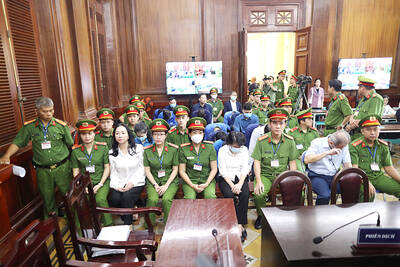
A top Vietnamese property tycoon was on Thursday sentenced to death in one of the biggest corruption cases in history, with an estimated US$27 billion in damages. A panel of three hand-picked jurors and two judges rejected all defense arguments by Truong My Lan, chair of major developer Van Thinh Phat, who was found guilty of swindling cash from Saigon Commercial Bank (SCB) over a decade. “The defendant’s actions ... eroded people’s trust in the leadership of the [Communist] Party and state,” read the verdict at the trial in Ho Chi Minh City. After the five-week trial, 85 others were also sentenced on

‘DELUSIONAL’: Targeting the families of Hamas’ leaders would not push the group to change its position or to give up its demands for Palestinians, Ismail Haniyeh said Israeli aircraft on Wednesday killed three sons of Hamas’ top political leader in the Gaza Strip, striking high-stakes targets at a time when Israel is holding delicate ceasefire negotiations with the militant group. Hamas said four of the leader’s grandchildren were also killed. Ismail Haniyeh’s sons are among the highest-profile figures to be killed in the war so far. Israel said they were Hamas operatives, and Haniyeh accused Israel of acting in “the spirit of revenge and murder.” The deaths threatened to strain the internationally mediated ceasefire talks, which appeared to gain steam in recent days even as the sides remain far


 RSS
RSS