


Scientists have unearthed three 160,000-year-old human skulls in Ethiopia that are the oldest known and best-preserved fossils of modern humans' immediate predecessors.
The nearly complete skulls of an adult male and a child and the partial skull of a second adult appear to represent a crucial stage of human evolution when the facial features of modern humans arose.
Discovered in Ethiopia's fossil-rich Afar region, the skulls have clearly modern features -- a prominent forehead, flattened face and reduced brow -- that contrast with older humans' projecting, heavy-browed skulls.
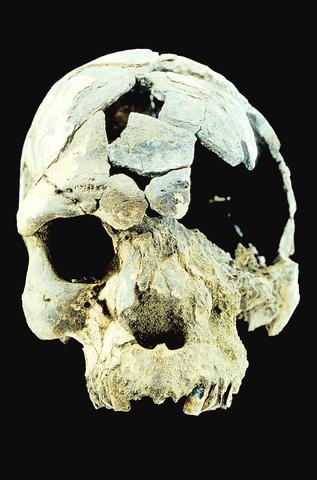
PHOTO: AP
"They're not quite completely modern, but they're well on their way. They're close enough to call Homo sapiens,'' said Tim White, a University of California, Berkeley paleontologist who was co-leader of the international team that excavated and analyzed the skulls.
Previously, the earliest fossils of Homo sapiens found in Africa had been dated to about 130,000 to 100,000 years, although they were less complete and sometimes poorly dated, White said.
White and his colleagues assigned the new creatures to a subspecies of Homo sapiens they named Homo sapiens idaltu -- idaltu meaning "elder" in the Afar language.
Two other scientists said the skulls are an important find that fill a big gap in the African human fossil record, the period between about 100,000 and 300,000 years ago.
They agreed with White that the skulls' age and appearance strongly support genetic evidence that modern humans arose in Africa between 100,000 and 200,000 years ago -- and not at multiple locations in Europe, Africa and Asia as some researchers suggest.
Rick Potts, director of the Human Origins Program at the Smithsonian Institution, said the skulls, while still large and thick-boned, are undeniably modern.
Unlike the heavy brows and projecting facial features of earlier humans, in the new skulls those features have retracted dramatically under the braincase and there is a prominent forehead.
Potts said that while White and his colleagues conclude that the fossil skulls are likely those of ancestral subspecies of Homo sapiens, he believes they represent modern Homo sapiens.
Potts said he would not be surprised if additional excavations in Africa push back the origins of modern humans to about 200,000 years -- humans who would have then spread to Europe and Asia.
The skulls were found in a desolate area about 225km northeast of Ethiopia's capital, Addis Ababa, near the village of Herto.
Skull fragments from a total of 10 individuals were unearthed, but conspicuously lacking were their jaws and any bones below the neck.
White said two of the skulls appear to have been scraped clean of flesh, suggesting an ancient mortuary practice, or possibly cannibalism.
Scattered across the same area were thousands of various stone tools, including hand axes, along with the butchered bones of hippopotamus and antelope. White said the site, once the lush shoreline of a large lake, was probably a seasonal foraging ground for the humans.
Nearly half of China’s major cities are suffering “moderate to severe” levels of subsidence, putting millions of people at risk of flooding, especially as sea levels rise, according to a study of nationwide satellite data released yesterday. The authors of the paper, published by the journal Science, found that 45 percent of China’s urban land was sinking faster than 3mm per year, with 16 percent at more than 10mm per year, driven not only by declining water tables, but also the sheer weight of the built environment. With China’s urban population already in excess of 900 million people, “even a small portion

UNSETTLING IMAGES: The scene took place in front of TV crews covering the Trump trial, with a CNN anchor calling it an ‘emotional and unbelievably disturbing moment’ A man who doused himself in an accelerant and set himself on fire outside the courthouse where former US president Donald Trump is on trial has died, police said yesterday. The New York City Police Department (NYPD) said the man was declared dead by staff at an area hospital. The man was in Collect Pond Park at about 1:30pm on Friday when he took out pamphlets espousing conspiracy theories, tossed them around, then doused himself in an accelerant and set himself on fire, officials and witnesses said. A large number of police officers were nearby when it happened. Some officers and bystanders rushed

Beijing is continuing to commit genocide and crimes against humanity against Uyghurs and other Muslim minorities in its western Xinjiang province, U.S. Secretary of State Antony Blinken said in a report published on Monday, ahead of his planned visit to China this week. The State Department’s annual human rights report, which documents abuses recorded all over the world during the previous calendar year, repeated language from previous years on the treatment of Muslims in Xinjiang, but the publication raises the issue ahead of delicate talks, including on the war in Ukraine and global trade, between the top U.S. diplomat and Chinese

HYPOCRISY? The Chinese Ministry of Foreign Affairs yesterday asked whether Biden was talking about China or the US when he used the word ‘xenophobic’ US President Joe Biden on Wednesday called for a hike in steel tariffs on China, accusing Beijing of cheating as he spoke at a campaign event in Pennsylvania. Biden accused China of xenophobia, too, in a speech to union members in Pittsburgh. “They’re not competing, they’re cheating. They’re cheating and we’ve seen the damage here in America,” Biden said. Chinese steel companies “don’t need to worry about making a profit because the Chinese government is subsidizing them so heavily,” he said. Biden said he had called for the US Trade Representative to triple the tariff rates for Chinese steel and aluminum if Beijing was


 RSS
RSS