


US Secretary of Defense Donald Rumsfeld warned on Wednesday about Iran's nuclear activities and called on the Atlantic alliance to find new ways of combating "the nexus of terror and weapons of mass destruction," which he called the biggest threat facing the countries of both "old" and "new" Europe.
Speaking in this resort town in the Bavarian Alps, Rumsfeld struck a mostly conciliatory tone, shaking hands warmly with the German defense minister, Peter Struck, who was here to greet him.
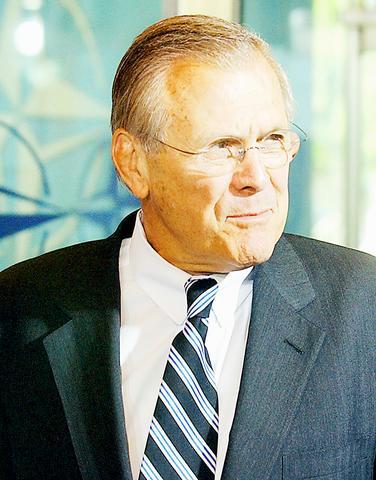
PHOTO: APN
"Like a family, sometimes we don't agree on everything and sometimes we have debates, but when we are threatened or challenged, we need to come together, as we did after Sept. 11," Rumsfeld said.
One such threat, Rumsfeld said to a group of students before his formal remarks, is Iran's development of nuclear weapons, which Washington says Tehran is doing under the guise of a civilian nuclear program.
"The intelligence community in the United States and around the world currently assess that Iran does not have nuclear weapons," he said. "The assessment is that they do have a very active program and are likely to have nuclear weapons in a relatively short period of time."
Still, Rumsfeld exhibited some of his customary combativeness, reiterating his now famous reference to "old" and "new" Europe, and made it clear that the countries of "new" Europe -- especially those that belonged to the Soviet bloc that have joined the Atlantic alliance -- understand what he called "the new threat" better than some of the countries of "old" Europe.
"The distinction between old and new in Europe today is not really of a matter of age or size or even geography," Rumsfeld said. "It is a matter of attitude, of the vision that countries bring to the trans-Atlantic relationship.
"It is no surprise that many of the nations with fresh memories of tyranny and occupation have been among those most willing to face the new threats, and contribute to dealing with them," he said. "This attitude is why, a decade after the Cold War ended, NATO has now invited 10 new allies to join the Atlantic alliance. They are bringing new vision and new vitality to our old alliance.
"Let me be clear: Those countries have not been invited as junior partners, allowed to join the grown-ups' table so long as they sit quietly," Rumsfeld continued. "No, they have been invited to lead."
Rumsfeld is on a four-stop tour that began in Portugal and is due to end at a NATO meeting in Brussels, Belgium, on Thursday. It will be the first since the end of the Iraq war. He stopped for a few hours in Germany to attend the 10th anniversary celebrations of the George C. Marshall European Center for Security Studies, a joint institution of the German and American military establishments, which holds seminars and classes for government officials from former communist countries in Europe and Asia.
The site, now a complex of stately cream-colored stucco buildings, was first used by the US in 1945 as a prisoner-of-war camp for officers. Later, it was used to train American officers in Russian and Soviet studies, while a part of it was the headquarters for a mountain division of the German army.
The meeting here, attended by ministers of defense from several former communist countries, including Albania, Azerbaijan, Slovenia and Ukraine, was not the occasion for a major policy address by Rumsfeld. Still, the presence of so many senior officials from the former Soviet bloc seemed to underscore the American enthusiasm for countries like Poland and Romania, as opposed to Germany and France, which opposed the American-led war in Iraq.
The text of Rumsfeld's speech, given to reporters only minutes before the ceremonies began, made reference to countries that want to "define themselves by their opposition to the United States" -- an unmistakable reference to France -- but Rumsfeld omitted the reference in his actual remarks.

Republican US lawmakers on Friday criticized US President Joe Biden’s administration after sanctioned Chinese telecoms equipment giant Huawei unveiled a laptop this week powered by an Intel artificial intelligence (AI) chip. The US placed Huawei on a trade restriction list in 2019 for contravening Iran sanctions, part of a broader effort to hobble Beijing’s technological advances. Placement on the list means the company’s suppliers have to seek a special, difficult-to-obtain license before shipping to it. One such license, issued by then-US president Donald Trump’s administration, has allowed Intel to ship central processors to Huawei for use in laptops since 2020. China hardliners

Conjoined twins Lori and George Schappell, who pursued separate careers, interests and relationships during lives that defied medical expectations, died this month in Pennsylvania, funeral home officials said. They were 62. The twins, listed by Guinness World Records as the oldest living conjoined twins, died on April 7 at the Hospital of the University of Pennsylvania, obituaries posted by Leibensperger Funeral Homes of Hamburg said. The cause of death was not detailed. “When we were born, the doctors didn’t think we’d make 30, but we proved them wrong,” Lori said in an interview when they turned 50, the Philadelphia Inquirer reported. The
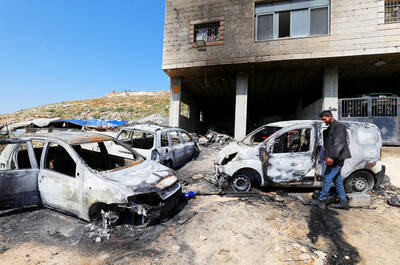
RAMPAGE: A Palestinian man was left dead after dozens of Israeli settlers searching for a missing 14-year-old boy stormed a village in the Israeli-occupied West Bank US President Joe Biden on Friday said he expected Iran to attack Israel “sooner, rather than later” and warned Tehran not to proceed. Asked by reporters about his message to Iran, Biden simply said: “Don’t,” underscoring Washington’s commitment to defend Israel. “We are devoted to the defense of Israel. We will support Israel. We will help defend Israel and Iran will not succeed,” he said. Biden said he would not divulge secure information, but said his expectation was that an attack could come “sooner, rather than later.” Israel braced on Friday for an attack by Iran or its proxies as warnings grew of

IN PURSUIT: Israel’s defense minister said the revenge attacks by Israeli settlers would make it difficult for security forces to find those responsible for the 14-year-old’s death Israeli Prime Minister Benjamin Netanyahu on Saturday condemned the “heinous murder” of an Israeli teenager in the occupied West Bank as attacks on Palestinian villages intensified following news of his death. After Benjamin Achimeir, 14, was reported missing near Ramallah on Friday, hundreds of Jewish settlers backed by Israeli forces raided nearby Palestinian villages, torching vehicles and homes, leaving at least one villager dead and dozens wounded. The attacks escalated in several villages on Saturday after Achimeir’s body was found near the Malachi Hashalom outpost. Agence France-Presse correspondents saw smoke rising from burned houses and fields. Mayor Amin Abu Alyah, of the


 RSS
RSS