


Taiwan's government is winning praise from bankers and analysts for making it easier for lenders to sell bad loans and to merge. It's also under fire for pushing the same banks to extend more loans to ailing companies.
Welcome to Taiwan's "on-again-off-again" effort to fix its banking system -- without cutting credit to some of its biggest companies and thus increasing unemployment ahead of the nation's December parliamentary elections.
Taiwan needs to reduce bad loans at banks, running at as much as 15 percent of total loans according to some analysts. Yet it's wary of stalling an economy already growing at its slowest pace in nearly three decades.
"The government has political pressure with the year-end elections coming up and reform is a longer-term goal," said Winnie Tiao, who helps manage NT$16 billion (US$465 million) in investments at Grand Pacific Securities Investment Trust Ltd (
The DPP executive and the Nationalist Party-controlled legislature reached a rare agreement and passed half a dozen financial industry laws in a special two-day session.
The laws make it easier for banks to merge by allowing them to form holding companies. Supervision of the financial industry will be taken over by a single authority, and lawmakers earmarked US$4 billion to buy bad loans from the island's smallest lenders.
Still, in the 13 months since the DPP came to power, its efforts to pass legislation have been stonewalled by the KMT, which holds a slim majority in the 220-member parliament.
Its hopes of winning a majority of seats may be stymied by the island's worst economic conditions in more than two decades.
The economy grew at its slowest pace in more than 26 years in the first-quarter, 1.1 percent. It's jobless rate rose to 4.4 percent in May, the highest since the government began compiling statistics in 1978.
"Taiwan is still flat on its back economically," said Han Ong, head of Asia-Pacific strategy at Salomon Smith Barney Hong Kong Ltd.
At the same time, the Central Bank of China and Ministry of Finance have been pressuring banks to keep lending to viable companies since last year -- with some success, as the government controls the assets of nine of the island's top 10 banks.
It's also trying to help companies that have already stopped repaying debt, such as Hualon Corp (
"The ministry has agreed with our request for a payment extension though talks are still ongoing," said Yao Chia-chih, a Hualon spokeswoman. "We expect a decision in the next month." That type of interference shouldn't happen, say bankers.
"I don't think government intervention is the right approach," said Jason Wang, chief financial officer at Chinatrust Commercial Bank (
For its part, the government says it's only asking banks not to create a credit crunch by cutting off loans to good companies just because the economy is slowing.
"We don't ask banks to extend loans to [just] any enterprises," said Gary Tseng, deputy director general of the finance ministry's bureau of monetary affairs.
Yet textile-maker Hualon is in an industry that's seeing a slump in business, as are the construction and technology industries. Rival Tuntex Distinct Corp (東雲紡織), the textile-making arm of the Tuntex Group, in May sought court protection from creditors seeking repayment of NT$29 billion.
"Business leaders" are putting pressure on banks to extend credit to companies that are suffering as the island's economy slows, Chinatrust's Wang said.
CBC Governor Perng Fai-nan (
Total lending by Taiwan banks to private enterprises rose 0.6 percent to NT$63.87 trillion in the year to May 31, according to the central bank. The government wants 4 percent loan growth this year, Tseng said.
The government says less than 6 percent of loans are non-performing, though CSFB says they could be as much as 13 percent of all credit. Goldman Sachs Group Inc estimates they could be as much as 15 percent.
Since the key TAIEX's year high on Feb. 15, the TWSE Bank and Insurance Index has fallen 25 percent this year, compared to a 20 percent drop on the TAIEX.
"As the tide goes out in Taiwan we'll see who's swimming naked," said Christian Dangerfield, chief investment officer at AIB Govett Asia Ltd.
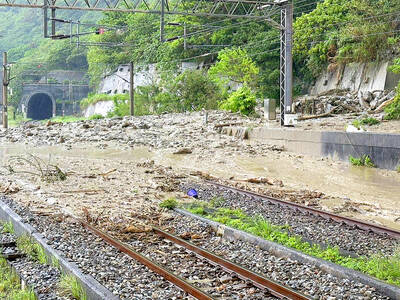
ROLLER-COASTER RIDE: More than five earthquakes ranging from magnitude 4.4 to 5.5 on the Richter scale shook eastern Taiwan in rapid succession yesterday afternoon Back-to-back weather fronts are forecast to hit Taiwan this week, resulting in rain across the nation in the coming days, the Central Weather Administration said yesterday, as it also warned residents in mountainous regions to be wary of landslides and rockfalls. As the first front approached, sporadic rainfall began in central and northern parts of Taiwan yesterday, the agency said, adding that rain is forecast to intensify in those regions today, while brief showers would also affect other parts of the nation. A second weather system is forecast to arrive on Thursday, bringing additional rain to the whole nation until Sunday, it

CONDITIONAL: The PRC imposes secret requirements that the funding it provides cannot be spent in states with diplomatic relations with Taiwan, Emma Reilly said China has been bribing UN officials to obtain “special benefits” and to block funding from countries that have diplomatic ties with Taiwan, a former UN employee told the British House of Commons on Tuesday. At a House of Commons Foreign Affairs Committee hearing into “international relations within the multilateral system,” former Office of the UN High Commissioner for Human Rights (OHCHR) employee Emma Reilly said in a written statement that “Beijing paid bribes to the two successive Presidents of the [UN] General Assembly” during the two-year negotiation of the Sustainable Development Goals. Another way China exercises influence within the UN Secretariat is

LANDSLIDES POSSIBLE: The agency advised the public to avoid visiting mountainous regions due to more expected aftershocks and rainfall from a series of weather fronts A series of earthquakes over the past few days were likely aftershocks of the April 3 earthquake in Hualien County, with further aftershocks to be expected for up to a year, the Central Weather Administration (CWA) said yesterday. Based on the nation’s experience after the quake on Sept. 21, 1999, more aftershocks are possible over the next six months to a year, the agency said. A total of 103 earthquakes of magnitude 4 on the local magnitude scale or higher hit Hualien County from 5:08pm on Monday to 10:27am yesterday, with 27 of them exceeding magnitude 5. They included two, of magnitude

Taiwan’s first drag queen to compete on the internationally acclaimed RuPaul’s Drag Race, Nymphia Wind (妮妃雅), was on Friday crowned the “Next Drag Superstar.” Dressed in a sparkling banana dress, Nymphia Wind swept onto the stage for the final, and stole the show. “Taiwan this is for you,” she said right after show host RuPaul announced her as the winner. “To those who feel like they don’t belong, just remember to live fearlessly and to live their truth,” she said on stage. One of the frontrunners for the past 15 episodes, the 28-year-old breezed through to the final after weeks of showcasing her unique


 RSS
RSS