


President Ma Ying-jeou (馬英九), fresh off an election victory in 2008, offered a vision of prosperity through closer ties with China: The economy would grow 6 percent a year, per capita income would reach US$30,000 and unemployment would be 3 percent.
Four years on and in a heated re-election campaign for next month’s presidential poll, voters are hearing a starkly different message, and tone, from the man who dramatically opened the nation’s economy to political rival China and brought relations to their best in six decades: He needs more time.
“There are goals we failed to achieve, such as the unemployment rate. I apologize for failing to achieve the goal and I understand that public frustration will be reflected in my approval rating,” Ma told a television audience in October. “However, we managed to revitalize the economy amid the global financial crisis ... give me four more years and I will do better.”
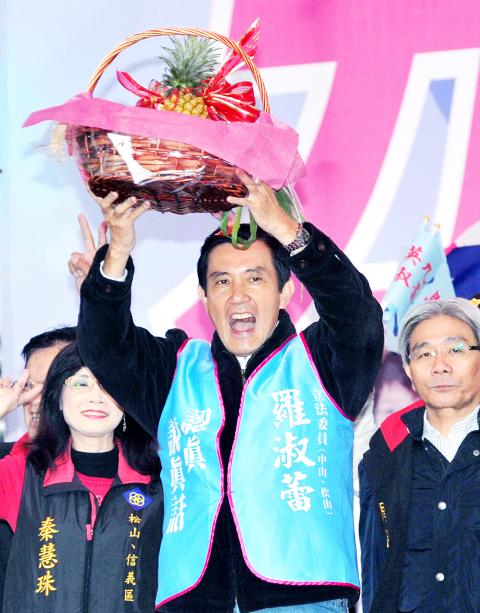
Photo: CNA
To be sure, the Chinese Nationalist Party (KMT) candidate’s ambitious forecasts came before the collapse of Lehman Brothers and the ensuing global financial crisis severely squeezed export-led economies such as Taiwan in 2008 and 2009.
Nonetheless, Ma’s apology, repeated again at a live television debate this month, has given his main challenger, the Democratic Progressive Party’s (DPP) presidential candidate Tsai Ing-wen (蔡英文), an opening to attack his record on the campaign trail and put Ma on the back foot.
It has also cast a spotlight on his mixed economic legacy.
The nation’s GDP grew 10.8 percent last year in a recovery from the crisis-induced 1.9 percent contraction in 2009 and the government has forecast 4.5 percent growth this year. However, per capita income hovers at about US$20,000 and unemployment has remained stubbornly above 4 percent all year.
Other measures show an increasing wealth gap, an area where Ma has come under heavy attack from the DPP, which lags Ma’s KMT by only a few percentage points in opinion polls.
Government figures show the number of families living below the poverty line increased by 10,000 to 114,000 in less than two years from the middle of 2009 to the second quarter of this year. Meanwhile, average house prices remain at 9.2 times annual household income, making housing unaffordable for many.
In a report last month, a poll commissioned by brokerage CLSA showed that only 8 percent found that their personal and family economic situation was either much better or better in the past two to three years, with 53.5 percent saying it was about the same and 19.5 percent saying it was worse.
Grumbling about the economy has been common throughout the electorate. Young new voters complain about a lack of jobs and poor wages and older voters are feeling the pinch as well.
“Before, even though work was hard, we didn’t have any livelihood pressures,” said a 64-year-old scrap metal seller in Pingtung County’s Changjhih Township (長治), who would only give his surname, Liu (劉). “Nowadays, not only do we have tough jobs, our life burden is also very heavy ... these past two to three years I feel things are a lot worse.”
Others see the economic integration with China mostly benefiting big businesses such as Taiwanese technology companies, who have poured millions into plants across China to make everything from flat-panel screens to iPads.
“Smaller businesses like us can’t increase our income because of China,” said Shih Hsi-liang, a business owner in Greater Taichung, whose firm does interior design and woodcrafts in local workshops and factories. “We’re too small and don’t have the means to touch this larger market, they won’t come to look for us.”
Still, there has been clear progress from Ma’s initiatives.
The controlled opening of the economy has boosted trade and investment, increasing the number of direct flights between Taiwan and China from virtually nil to 100 a day and bringing more than 2 million Chinese tourists to Taiwan who have spent more than US$3 billion.
China has become Taiwan’s top trading partner, taking 28 percent of its exports so far this year compared with 12 percent for the US. Cross-strait trade totaled US$145.37 billion last year, up 36.9 percent from 2009.
Officially reported and approved Taiwanese investment in China has totaled US$39.3 billion during Ma’s four-year tenure since 2008, almost two-thirds of the total US$58.3 billion in the 16 years prior to his term in office.
Fledgling Chinese investment in Taiwan is trickling in too, totaling US$170.1 million between when it was first allowed in June 2009 and October, according to the Ministry of Economic Affairs.
Ma’s policy of economic engagement with China reached a zenith with last year’s Economic Cooperation Framework Agreement (ECFA) that slashed hundreds of tariffs on Taiwanese exports to China and paved the way for more talks on economic integration.
“It’s a good direction and a right direction ... at least he [Ma] has settled cross-strait relations and enhanced Taiwan’s international value,” said Bert Lim (林建山), president of Taipei-based economic policy think tank The World Economics Society.
That agreement had helped give an edge to goods “Made in Taiwan” over those “Made in China,” both in China and internationally, said Lim, an economist who also sits on government policy advisory panels.
“That’s Ma’s biggest achievement. Now what he has to do is let the people feel that value,” he said.
Another aspect of Ma’s legacy remains a sensitive issue for many voters: How long will China, which has a stated policy of reclaiming Taiwan, by force if necessary, continue its largesse.
China’s growing economic clout has become an increasingly important means for it to exert influence over Taiwan. Beijing views Tsai with suspicion and warned that progress will halt if the DPP, which leans toward a more independent Taiwan, wins the election.
There will eventually be a limit for the preferential policies with which China can entice Taiwan, according to Zheng Zhenqing, assistant professor at Tsinghua University’s Institute of Taiwan Studies, suggesting Beijing would start to tire if Taipei did not in some way reciprocate.
“It needs to work both ways,” Zheng said. “China cannot go on giving out preferential policies for Taiwan forever. People at home will start to get angry.”
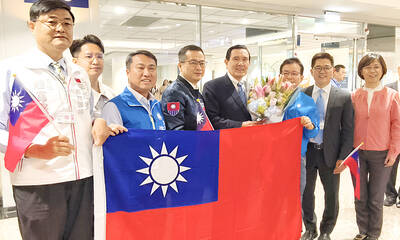
Former president Ma Ying-jeou’s (馬英九) mention of Taiwan’s official name during a meeting with Chinese President Xi Jinping (習近平) on Wednesday was likely a deliberate political play, academics said. “As I see it, it was intentional,” National Chengchi University Graduate Institute of East Asian Studies professor Wang Hsin-hsien (王信賢) said of Ma’s initial use of the “Republic of China” (ROC) to refer to the wider concept of “the Chinese nation.” Ma quickly corrected himself, and his office later described his use of the two similar-sounding yet politically distinct terms as “purely a gaffe.” Given Ma was reading from a script, the supposed slipup
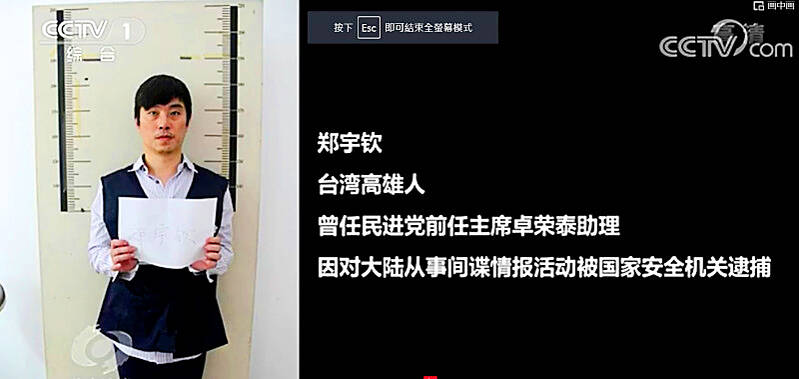
Former Czech Republic-based Taiwanese researcher Cheng Yu-chin (鄭宇欽) has been sentenced to seven years in prison on espionage-related charges, China’s Ministry of State Security announced yesterday. China said Cheng was a spy for Taiwan who “masqueraded as a professor” and that he was previously an assistant to former Cabinet secretary-general Cho Jung-tai (卓榮泰). President-elect William Lai (賴清德) on Wednesday last week announced Cho would be his premier when Lai is inaugurated next month. Today is China’s “National Security Education Day.” The Chinese ministry yesterday released a video online showing arrests over the past 10 years of people alleged to be
THE HAWAII FACTOR: While a 1965 opinion said an attack on Hawaii would not trigger Article 5, the text of the treaty suggests the state is covered, the report says NATO could be drawn into a conflict in the Taiwan Strait if Chinese forces attacked the US mainland or Hawaii, a NATO Defense College report published on Monday says. The report, written by James Lee, an assistant research fellow at Academia Sinica’s Institute of European and American Studies, states that under certain conditions a Taiwan contingency could trigger Article 5 of NATO, under which an attack against any member of the alliance is considered an attack against all members, necessitating a response. Article 6 of the North Atlantic Treaty specifies that an armed attack in the territory of any member in Europe,
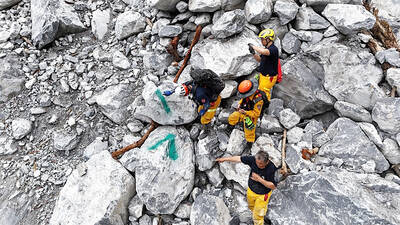
The bodies of two individuals were recovered and three additional bodies were discovered on the Shakadang Trail (砂卡礑) in Taroko National Park, eight days after the devastating earthquake in Hualien County, search-and-rescue personnel said. The rescuers reported that they retrieved the bodies of a man and a girl, suspected to be the father and daughter from the Yu (游) family, 500m from the entrance of the trail on Wednesday. The rescue team added that despite the discovery of the two bodies on Friday last week, they had been unable to retrieve them until Wednesday due to the heavy equipment needed to lift


 RSS
RSS