


The Consumers’ Foundation yesterday called on the Department of Health (DOH) to implement stricter regulations following a number of recently aired food and cosmetic infomercials containing exaggerated claims about product performance or effects. The consumer rights watchdog recently monitored 15 infomercials on U-life, Momo and Viva channels, including 11 advertising food products and four advertising cosmetic products.
The infomercials monitored by the foundation featured a wide range of products, from oyster shell capsules that claimed to cure erectile dysfunction to foodstuffs that supposedly cure insomnia and reverse the aging process.
Consumers’ Foundation secretary-general Hwang Yu-sheng (黃鈺生) said that six of the infomercials violated the Act Governing Food Sanitation (食品衛生管理法) by promoting the alleged medical benefits of foodstuffs, claiming products could help detoxify the body or cure arthritis and other diseases.
Six of the infomercials did not advocate medical benefits but were misleading because they exaggerated the products’ performance, such as lightening skin color or helping users to lose weight instantly, he said
The four cosmetic infomercials monitored by the foundation allegedly violated the Statute for Control of Cosmetic Hygiene (化妝品衛生管理條例) because their content was either obscene or exaggerated and were promoted via various broadcasting channels, he said.
The foundation also suspected that one of the cosmetic advertisements had failed to obtain proper licensing because it was unable to confirm the advertisement’s registration number.
“The authorities should conduct stricter inspections of product marketers and broadcasting channels to protect consumers from being misled by inappropriate advertising content,” Hwang said.
The secretary-general said that businesses try to get away with violating the law because they know the authorities do not prioritize catching violators and punishing them with heavy fines. He said that cosmetic companies face a maximum fine for inappropriate advertisements of just NT$100,000.
In effect, many businesses consider the fines the cost of doing business, so penalties fail to deter companies from breaking the law.
In response, the DOH’s Food and Drug Administration said that protection of consumers’ rights is a priority. It vowed to look into the cases and fine any violators.
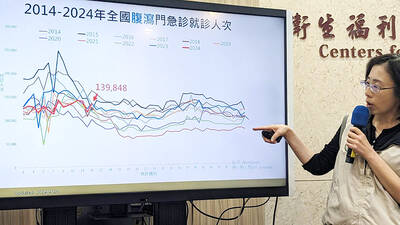
FLU SEASON: Twenty-six severe cases were reported from Tuesday last week to Monday, including a seven-year-old girl diagnosed with influenza-associated encephalopathy Nearly 140,000 people sought medical assistance for diarrhea last week, the Centers for Disease Control (CDC) said on Tuesday. From April 7 to Saturday last week, 139,848 people sought medical help for diarrhea-related illness, a 15.7 percent increase from last week’s 120,868 reports, CDC Epidemic Intelligence Center Deputy Director Lee Chia-lin (李佳琳) said. The number of people who reported diarrhea-related illness last week was the fourth highest in the same time period over the past decade, Lee said. Over the past four weeks, 203 mass illness cases had been reported, nearly four times higher than the 54 cases documented in the same period

A group of Taiwanese-American and Tibetan-American students at Harvard University on Saturday disrupted Chinese Ambassador to the US Xie Feng’s (謝鋒) speech at the school, accusing him of being responsible for numerous human rights violations. Four students — two Taiwanese Americans and two from Tibet — held up banners inside a conference hall where Xie was delivering a speech at the opening ceremony of the Harvard Kennedy School China Conference 2024. In a video clip provided by the Coalition of Students Resisting the CCP (Chinese Communist Party), Taiwanese-American Cosette Wu (吳亭樺) and Tibetan-American Tsering Yangchen are seen holding banners that together read:
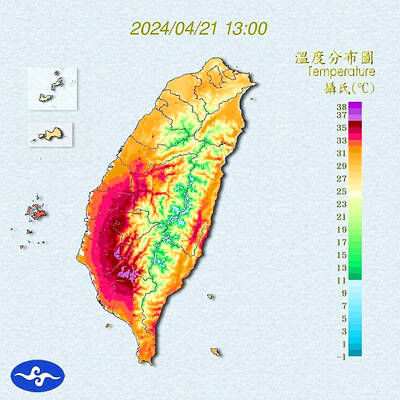
Heat advisories were in effect for nine administrative regions yesterday afternoon as warm southwesterly winds pushed temperatures above 38°C in parts of southern Taiwan, the Central Weather Administration (CWA) said. As of 3:30pm yesterday, Tainan’s Yujing District (玉井) had recorded the day’s highest temperature of 39.7°C, though the measurement will not be included in Taiwan’s official heat records since Yujing is an automatic rather than manually operated weather station, the CWA said. Highs recorded in other areas were 38.7°C in Kaohsiung’s Neimen District (內門), 38.2°C in Chiayi City and 38.1°C in Pingtung’s Sandimen Township (三地門), CWA data showed. The spell of scorching

UNAWARE: Many people sit for long hours every day and eat unhealthy foods, putting them at greater risk of developing one of the ‘three highs,’ an expert said More than 30 percent of adults aged 40 or older who underwent a government-funded health exam were unaware they had at least one of the “three highs” — high blood pressure, high blood lipids or high blood sugar, the Health Promotion Administration (HPA) said yesterday. Among adults aged 40 or older who said they did not have any of the “three highs” before taking the health exam, more than 30 percent were found to have at least one of them, Adult Preventive Health Examination Service data from 2022 showed. People with long-term medical conditions such as hypertension or diabetes usually do not


 RSS
RSS