


Although it is often said that the mild weather of spring makes it the perfect time for dog walking, veterinarians yesterday warned that allergens in the spring air often make that time of year a nightmare for pets.
Cat and dogs have a higher average body temperature than humans, making them far more sensitive to weather and environmental change, the experts said.
While people flock to see the beautiful spring blossoms in Yangmingshan National Park, animals might be allergic.
National Taiwan University (NTU) Veterinary Hospital doctor Huang Hui-bi (黃慧璧) urged pet owners to reduce the amount of time their animals spend outdoors during times of volatile temperature change.
“Owners should also move birds indoors. If a dog is scratching harder than usual, a cat is constantly licking its fur in the abdominal region or experiencing severe shedding, these could all be signs that your pets are suffering. One important measure is to lower your animal’s exposure to allergy risks,” she said.
Huang said pet owners should consider using air purifiers to ensure good air circulation in the home.
Research by Chan Chang-chuan (詹長權), a professor at NTU’s Institute of Occupational Medicine and Industrial Hygiene, and Jasmine Chao (趙馨), an associate professor at Taipei Medical University School of Public Health, showed that during dust storms, the level of germs in Greater Taipei escalates to a point that can cause lung infection and accelerated heart beats in animals.
Huang said that if a dog begins coughing or wheezing, it could have contracted a yeast infection.
Mycobacterium is also known to lead to pneumonia, she added.
“The average body temperature for a dog is 39.1ºC, 39.5ºC for cats, and 41ºC for birds,” Huang said.
Doctors said animals with heart conditions or bronchitis were at particularly high risk of death because of weather changes during the months of March and April.
In 2000, about 20 percent of dogs with bronchitis were known to have allergies; that figure jumped to 25 percent by 2005, they said.
Lin Wen-chieh (林文傑), a veterinarian at Muan Animal Hospital, said dogs should wear an Elizabethan collar or space collar when outside to prevent canine eye infection.
Another veterinarian, Chang Cheng-tung (張振東), said that given drastic temperature changes in spring, owners should wait until summer to shave their pets.

Former president Ma Ying-jeou’s (馬英九) mention of Taiwan’s official name during a meeting with Chinese President Xi Jinping (習近平) on Wednesday was likely a deliberate political play, academics said. “As I see it, it was intentional,” National Chengchi University Graduate Institute of East Asian Studies professor Wang Hsin-hsien (王信賢) said of Ma’s initial use of the “Republic of China” (ROC) to refer to the wider concept of “the Chinese nation.” Ma quickly corrected himself, and his office later described his use of the two similar-sounding yet politically distinct terms as “purely a gaffe.” Given Ma was reading from a script, the supposed slipup

Former Czech Republic-based Taiwanese researcher Cheng Yu-chin (鄭宇欽) has been sentenced to seven years in prison on espionage-related charges, China’s Ministry of State Security announced yesterday. China said Cheng was a spy for Taiwan who “masqueraded as a professor” and that he was previously an assistant to former Cabinet secretary-general Cho Jung-tai (卓榮泰). President-elect William Lai (賴清德) on Wednesday last week announced Cho would be his premier when Lai is inaugurated next month. Today is China’s “National Security Education Day.” The Chinese ministry yesterday released a video online showing arrests over the past 10 years of people alleged to be

THE HAWAII FACTOR: While a 1965 opinion said an attack on Hawaii would not trigger Article 5, the text of the treaty suggests the state is covered, the report says NATO could be drawn into a conflict in the Taiwan Strait if Chinese forces attacked the US mainland or Hawaii, a NATO Defense College report published on Monday says. The report, written by James Lee, an assistant research fellow at Academia Sinica’s Institute of European and American Studies, states that under certain conditions a Taiwan contingency could trigger Article 5 of NATO, under which an attack against any member of the alliance is considered an attack against all members, necessitating a response. Article 6 of the North Atlantic Treaty specifies that an armed attack in the territory of any member in Europe,
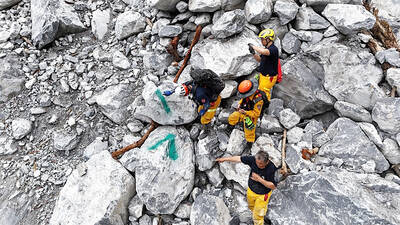
The bodies of two individuals were recovered and three additional bodies were discovered on the Shakadang Trail (砂卡礑) in Taroko National Park, eight days after the devastating earthquake in Hualien County, search-and-rescue personnel said. The rescuers reported that they retrieved the bodies of a man and a girl, suspected to be the father and daughter from the Yu (游) family, 500m from the entrance of the trail on Wednesday. The rescue team added that despite the discovery of the two bodies on Friday last week, they had been unable to retrieve them until Wednesday due to the heavy equipment needed to lift


 RSS
RSS