


Taiwan is interested in forging closer ties with the Trans-Pacific Strategic Economic Partnership Agreement (TPP) countries, but talks are still in the initial stage, the Ministry of Foreign Affairs said yesterday.
“Feasibility studies must take place before any further discussions can be held,” said Ger Bau-shuan (葛葆萱), deputy director-general of the Department of East Asian and Pacific Affairs.
The TPP is a multilateral regional trade agreement currently comprising Chile, Brunei, Singapore and New Zealand. Ger said all APEC member states are allowed to join, including Taiwan.
In December, US Trade Representative (USTR) Ron Kirk notified Congress that US President Barack Obama intended to enter into negotiations with the TPP to shape a broad-based regional pact.
Such an agreement would help expand US exports, saving and creating good jobs here in the US, the USTR said.
The first round of negotiations between the US and the TPP is scheduled for next month.
At the moment, Taiwan is excluded from ASEAN, another major regional economic integrated entity.
President Ma Ying-jeou (馬英九) has repeatedly touted plans to sign an economic cooperation framework agreement (ECFA) with China, saying it would facilitate Taiwan’s signing of free-trade agreements (FTA) with ASEAN members and other countries.
“It is a fact that the current cross-strait detente has created a more amiable atmosphere for Taiwan to approach other countries on the subject of free trade agreement. Things are looking up,” ministry spokesman Henry Chen (陳銘政) said.
Meanwhile, in a recent interview with an Indian publication, Asia Age, Taiwanese Representative to India Ong Wen-chyi (翁文琪) said a Taiwan-India FTA was a definite possibility and both sides were conducting feasibility studies on the issue.
Both sides have held three rounds of discussions on Double Taxation Avoidance Agreement (DTAA) and the pact could be inked as early as end of this year, he said, adding that signing the pact could help accelerate progress on other issues such as trade and investment, as well as an FTA.
Taiwan’s yearly trade volume with India stands at US$5.9 billion, Ger said.
In other developments, the ministry yesterday rejected a Democratic Progressive Party lawmaker’s (DPP) claim that Indonesia had banned all made-in-Taiwan fishing vessels because of Beijing’s interference.
On Wednesday, DPP Lawmaker Kuan Bi-ling (管碧玲) said China had been putting pressure on Indonesia via ASEAN to stop purchasing Taiwanese boats.
Kuan said the action had seriously harmed Taiwan’s shipbuilding industry because since Taiwan’s fisheries’ industry has shrunk, the industry now relies on Indonesia and other Southeast Asian counties for orders.
Speaking at the regular weekly briefing, Ger said the ministry had summoned Indonesian Representative Suhartono to explain immediately after the lawmaker’s claim.
On Wednesday, Suhartono reportedly told the ministry that since Taiwan and Indonesia are WTO members, Jakarta would not take any discriminatory actions, such as stopping its fishermen from buying Taiwan-made fishing vessels.
However, to protect its fishing market and tighten up the country’s maritime management and surveillance work, the Indonesian government has enacted a policy under which only foreign companies or Indonesian fishing companies with foreign shareholders are allowed to purchase used foreign-made fishing boats.
The policy is comprehensive and does not single out any country, said Ger, adding that new fishing vessels are not included in the new rule.
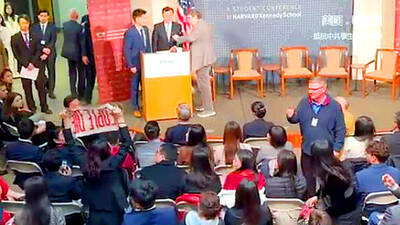
A group of Taiwanese-American and Tibetan-American students at Harvard University on Saturday disrupted Chinese Ambassador to the US Xie Feng’s (謝鋒) speech at the school, accusing him of being responsible for numerous human rights violations. Four students — two Taiwanese Americans and two from Tibet — held up banners inside a conference hall where Xie was delivering a speech at the opening ceremony of the Harvard Kennedy School China Conference 2024. In a video clip provided by the Coalition of Students Resisting the CCP (Chinese Communist Party), Taiwanese-American Cosette Wu (吳亭樺) and Tibetan-American Tsering Yangchen are seen holding banners that together read:

UNAWARE: Many people sit for long hours every day and eat unhealthy foods, putting them at greater risk of developing one of the ‘three highs,’ an expert said More than 30 percent of adults aged 40 or older who underwent a government-funded health exam were unaware they had at least one of the “three highs” — high blood pressure, high blood lipids or high blood sugar, the Health Promotion Administration (HPA) said yesterday. Among adults aged 40 or older who said they did not have any of the “three highs” before taking the health exam, more than 30 percent were found to have at least one of them, Adult Preventive Health Examination Service data from 2022 showed. People with long-term medical conditions such as hypertension or diabetes usually do not
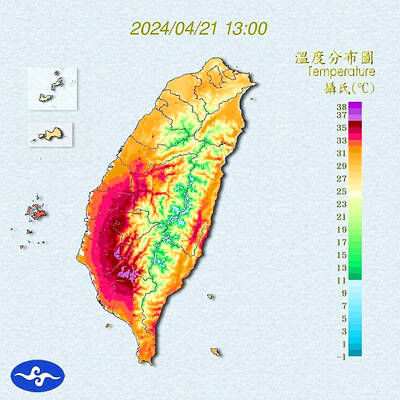
Heat advisories were in effect for nine administrative regions yesterday afternoon as warm southwesterly winds pushed temperatures above 38°C in parts of southern Taiwan, the Central Weather Administration (CWA) said. As of 3:30pm yesterday, Tainan’s Yujing District (玉井) had recorded the day’s highest temperature of 39.7°C, though the measurement will not be included in Taiwan’s official heat records since Yujing is an automatic rather than manually operated weather station, the CWA said. Highs recorded in other areas were 38.7°C in Kaohsiung’s Neimen District (內門), 38.2°C in Chiayi City and 38.1°C in Pingtung’s Sandimen Township (三地門), CWA data showed. The spell of scorching
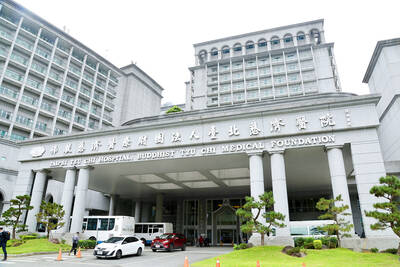
POLICE INVESTIGATING: A man said he quit his job as a nurse at Taipei Tzu Chi Hospital as he had been ‘disgusted’ by the behavior of his colleagues A man yesterday morning wrote online that he had witnessed nurses taking photographs and touching anesthetized patients inappropriately in Taipei Tzu Chi Hospital’s operating theaters. The man surnamed Huang (黃) wrote on the Professional Technology Temple bulletin board that during his six-month stint as a nurse at the hospital, he had seen nurses taking pictures of patients, including of their private parts, after they were anesthetized. Some nurses had also touched patients inappropriately and children were among those photographed, he said. Huang said this “disgusted” him “so much” that “he felt the need to reveal these unethical acts in the operating theater


 RSS
RSS