


The proposed economic cooperation framework agreement (ECFA) with China will be the core issue in this year’s cross-strait negotiations, Straits Exchange Foundation (SEF) Chairman Chiang Pin-kung (江丙坤) said yesterday.
Speaking at the SEF’s year-end press conference, Chiang touted the cross-strait developments over the past year and dubbed the 12 agreements signed since November 2008 as “highways” in providing added convenience for the people of Taiwan and China.
“The core negotiations this year will be on the ECFA, followed by intellectual property rights and avoidance of dual taxation,” Chiang said.
Preliminary EFCA negotiations were held last month in Beijing. The SEF said no dates and locations have been set for the second round of talks.
Chiang said the progress of the cross-strait talks is following the outline both sides have agreed upon — starting with more straight-forward topics such as economics and working toward thornier issues such as politics.
While the opposition has heavily criticized the government for making secret concessions and forging backroom deals with Beijing, President Ma Ying-jeou (馬英九) has repeatedly said the ECFA talks will be held in an open and transparent manner.
“The ECFA negotiation process will be monitored by the media, the legislature and the public. Everyone will see that the talks suit the interests of Taiwan and that both sides are treated equally,” Chiang said.
The Presidential Office will call a press conference today at which the president will speak on the controversial trade deal.
On the issue of the possibility of the SEF and its counterpart, the Association for Relations Across the Taiwan Strait, establishing representative offices on either side of the Taiwan Strait, Chiang said the idea has been put forward but that the SEF was still waiting for further instructions from the government.
Chiang was non-committal when asked about Taiwan’s willingness to allow China-based newspapers to set up bureaus in Taiwan and whether the government would demand Beijing treat Taiwanese prisoners more humanely, saying the Mainland Affairs Council was responsible for these matters.
The chairman was also confident that the cross-strait detente would continue to develop despite recent US arms sales to Taiwan.
Washington’s latest decision to sell US$6.4 billion worth of military equipment to Taipei has angered Beijing, which has protested by suspending military dialogue with Washington and threatened to take sanctions against US companies involved in the sale.
SEF statistics show cross-strait exchanges have increased considerably since the Ma government took office in May 2008.
Last year alone, more than 4 million Taiwanese visited China while Taiwan received roughly 960,000 Chinese tourists, bringing a total of NT$36 billion (US$1.12 billion) in revenue, the SEF said, quoting the Tourism Bureau.
The SEF failed to mention China’s temporary ban on tourists visiting Kaoshiung in September last year as a form of retaliation against the decision by Kaoshiung Mayor Chen Chu (陳菊) and other local politicians to invite the Dalai Lama to Taiwan.
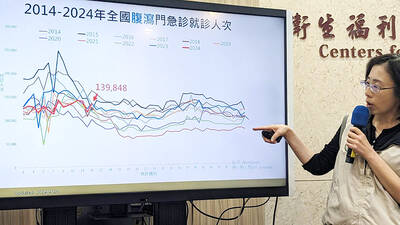
FLU SEASON: Twenty-six severe cases were reported from Tuesday last week to Monday, including a seven-year-old girl diagnosed with influenza-associated encephalopathy Nearly 140,000 people sought medical assistance for diarrhea last week, the Centers for Disease Control (CDC) said on Tuesday. From April 7 to Saturday last week, 139,848 people sought medical help for diarrhea-related illness, a 15.7 percent increase from last week’s 120,868 reports, CDC Epidemic Intelligence Center Deputy Director Lee Chia-lin (李佳琳) said. The number of people who reported diarrhea-related illness last week was the fourth highest in the same time period over the past decade, Lee said. Over the past four weeks, 203 mass illness cases had been reported, nearly four times higher than the 54 cases documented in the same period
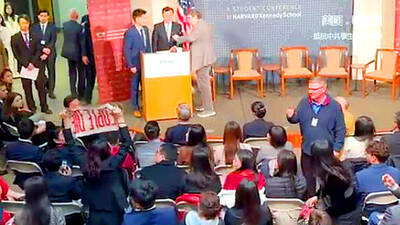
A group of Taiwanese-American and Tibetan-American students at Harvard University on Saturday disrupted Chinese Ambassador to the US Xie Feng’s (謝鋒) speech at the school, accusing him of being responsible for numerous human rights violations. Four students — two Taiwanese Americans and two from Tibet — held up banners inside a conference hall where Xie was delivering a speech at the opening ceremony of the Harvard Kennedy School China Conference 2024. In a video clip provided by the Coalition of Students Resisting the CCP (Chinese Communist Party), Taiwanese-American Cosette Wu (吳亭樺) and Tibetan-American Tsering Yangchen are seen holding banners that together read:
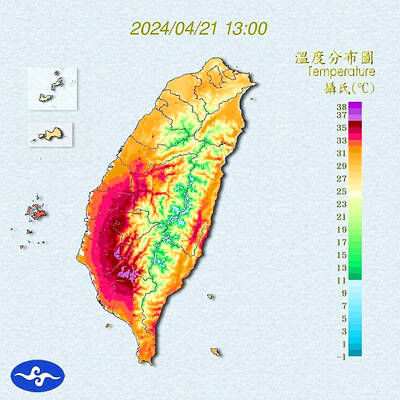
Heat advisories were in effect for nine administrative regions yesterday afternoon as warm southwesterly winds pushed temperatures above 38°C in parts of southern Taiwan, the Central Weather Administration (CWA) said. As of 3:30pm yesterday, Tainan’s Yujing District (玉井) had recorded the day’s highest temperature of 39.7°C, though the measurement will not be included in Taiwan’s official heat records since Yujing is an automatic rather than manually operated weather station, the CWA said. Highs recorded in other areas were 38.7°C in Kaohsiung’s Neimen District (內門), 38.2°C in Chiayi City and 38.1°C in Pingtung’s Sandimen Township (三地門), CWA data showed. The spell of scorching

UNAWARE: Many people sit for long hours every day and eat unhealthy foods, putting them at greater risk of developing one of the ‘three highs,’ an expert said More than 30 percent of adults aged 40 or older who underwent a government-funded health exam were unaware they had at least one of the “three highs” — high blood pressure, high blood lipids or high blood sugar, the Health Promotion Administration (HPA) said yesterday. Among adults aged 40 or older who said they did not have any of the “three highs” before taking the health exam, more than 30 percent were found to have at least one of them, Adult Preventive Health Examination Service data from 2022 showed. People with long-term medical conditions such as hypertension or diabetes usually do not


 RSS
RSS