


The "Washington Times" reported on Jan. 20 that the US National Security Council (NSC) had recently directed its spy agencies to lower the priority placed on intelligence collection for China. The decision, the report said, would downgrade China from “Priority 1” status — which includes countries such as Iran and North Korea — to “Priority 2,” which covers specific humanitarian crises and conflicts like Indo-Pakistani tensions.
The move, the paper wrote, was part of efforts by the administration of US President Barack Obama to “develop a more cooperative relationship with Beijing.”
Amid opposition within the intelligence community and fears that the downgrading would hamper efforts to monitor China's growing military strength and cyber-attack capabilities, the NSC said the change “would not affect the allocation of resources for spying on China or the urgency of focusing on Chinese spying targets.”
While proponents of the new policy maintain that the downgrade would not change anything, critics fear that while not immediate, the repercussions would be felt over time.
“A change in tier priority usually means that projects targeting a country will be scrutinized more skeptically on budgetary and other grounds,” the paper said.
Spending on human intelligence and electronic surveillance could also suffer, while the CIA and the US Defense Intelligence Agency could take fewer risks targeting the downgraded country.
Washington's decision allegedly came in the wake of protests by Beijing following the release in September of a National Intelligence Strategy that identified China among the top four threats to US interests alongside Iran, North Korea and Russia.
National Intelligence Director Dennis Blair, whose office released the strategy, as well as CIA Director Leon Panetta, have publicly opposed the downgrading.
The Washington Times also wrote that the announcement was made just as civilian and military leaders were pointing to deficiencies on intelligence collection and analysis on China, which often led to underestimates on Beijing's military and espionage capabilities.
Information obtained by the Taipei Times indicated that the downgrade would not only apply to foreign intelligence collection, such as by the CIA, the NSC and the Defense Intelligence Agency, but also domestically, meaning that the de-prioritization would also affect domestic agencies like the FBI, which handles counterespionage on US territory.
For security experts, the decision made little sense. While some said that better management of finite intelligence resources was desirable and agreed that priority No. 1 for the US intelligence apparatus should be terrorism, it did not mean that resources should be taken away from China.
“Given China's increased missile activity, not to mention the development of anti-satellite and space warfare capability, it does not make sense,” said Wendell Minnick, Asia bureau chief for the Washington-based weekly Defense News. “If there is one weak area for our intelligence collection it is what China is doing in the cyber warfare area. Speculation is rampant, but there are very few hard clues as to how many of the hacker attacks are patriotic netizens or government-sponsored ops,” he said.
For Toshi Yoshihara, associate professor of strategy at the US Naval War College, the main problem with the decision concerned the risk of underestimating China's military modernization.
“Part of the problem are the assumptions that underwrite assessments of the Chinese military,” Yoshihara told the Taipei Times on Tuesday. “In the 1990s, analysts tended to extrapolate how China's military-industrial complex will do in the early 21st century based on its performance in the 1960s and 1970s. Such linear projections, premised as they were on a qualitatively different kind of China, significantly skewed many of the forecasts.
“In this context, we need to learn more, not less, about China's military modernization. We need more data sets that can serve to challenge longstanding assumptions that are deeply ingrained in individuals and institutions,” he said. “Underestimation carries its own risks. If the US or Japan encounters a strategic technical surprise from China, then the risks of overreaction could substantially increase [and] overreaction might involve the kinds of worst-case scenario thinking that would not be conducive to stability.”
The American Institute in Taiwan on Tuesday refused to comment on the decision, saying it did not normally discuss intelligence and defense matters.
The reprioritization also comes at a time when the US has its hands full in Afghanistan and Pakistan, as well as with the North Koran and Iranian nuclear programs, all areas where assistance from China might be welcome.
Gary Schmitt, a US official during the Ronald Reagan administration and now director of advanced strategic studies at the American Enterprise Institute, said this wasn't the first time a US administration had sent political signals through a reassessment in the hope of securing China's cooperation elsewhere.
“At the time [in the 1980s], many in the [Reagan] administration believed that China would be a necessary asset for balancing against the Soviet Union. The thought was that by changing the priority given China for intelligence collection, we would be signaling them that we no longer saw them as an adversary,” he wrote on the Center for Defense Studies Web site.
“Ironically,” Schmitt wrote, “the effort made during the 1980s ... made more sense then than today ... given the fact that the US government is continually surprised by the military advances China is making, how little we really know about what the inner circle of the PRC [People's Republic of China] is thinking and, according to ... report after report by [US] counterintelligence officials, the avalanche of Chinese spying we are attempting to deal with. Downgrading the priority given the PRC as a target will certainly not make those gaps any easier to fill.”
Given the close relationship between US and Taiwanese intelligence and defense agencies, any downgrading of US collection on China could have serious repercussions for Taiwan's ability to monitor developments across the Taiwan Strait and defend itself, especially if intelligence-sharing agreements were undermined as a result.
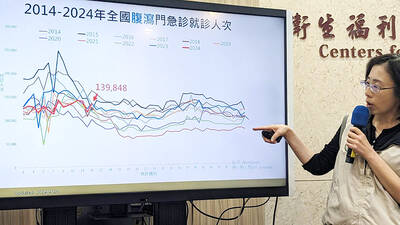
FLU SEASON: Twenty-six severe cases were reported from Tuesday last week to Monday, including a seven-year-old girl diagnosed with influenza-associated encephalopathy Nearly 140,000 people sought medical assistance for diarrhea last week, the Centers for Disease Control (CDC) said on Tuesday. From April 7 to Saturday last week, 139,848 people sought medical help for diarrhea-related illness, a 15.7 percent increase from last week’s 120,868 reports, CDC Epidemic Intelligence Center Deputy Director Lee Chia-lin (李佳琳) said. The number of people who reported diarrhea-related illness last week was the fourth highest in the same time period over the past decade, Lee said. Over the past four weeks, 203 mass illness cases had been reported, nearly four times higher than the 54 cases documented in the same period
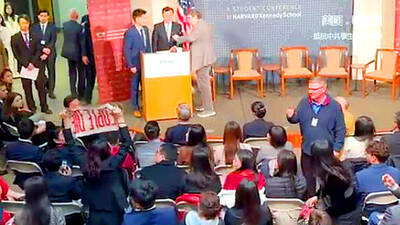
A group of Taiwanese-American and Tibetan-American students at Harvard University on Saturday disrupted Chinese Ambassador to the US Xie Feng’s (謝鋒) speech at the school, accusing him of being responsible for numerous human rights violations. Four students — two Taiwanese Americans and two from Tibet — held up banners inside a conference hall where Xie was delivering a speech at the opening ceremony of the Harvard Kennedy School China Conference 2024. In a video clip provided by the Coalition of Students Resisting the CCP (Chinese Communist Party), Taiwanese-American Cosette Wu (吳亭樺) and Tibetan-American Tsering Yangchen are seen holding banners that together read:
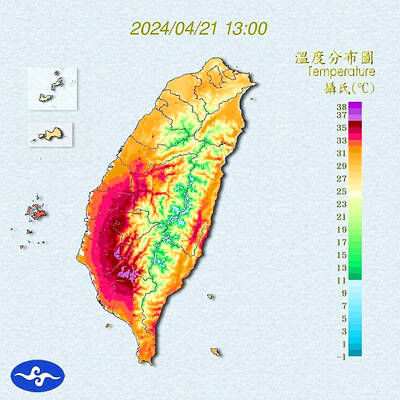
Heat advisories were in effect for nine administrative regions yesterday afternoon as warm southwesterly winds pushed temperatures above 38°C in parts of southern Taiwan, the Central Weather Administration (CWA) said. As of 3:30pm yesterday, Tainan’s Yujing District (玉井) had recorded the day’s highest temperature of 39.7°C, though the measurement will not be included in Taiwan’s official heat records since Yujing is an automatic rather than manually operated weather station, the CWA said. Highs recorded in other areas were 38.7°C in Kaohsiung’s Neimen District (內門), 38.2°C in Chiayi City and 38.1°C in Pingtung’s Sandimen Township (三地門), CWA data showed. The spell of scorching

UNAWARE: Many people sit for long hours every day and eat unhealthy foods, putting them at greater risk of developing one of the ‘three highs,’ an expert said More than 30 percent of adults aged 40 or older who underwent a government-funded health exam were unaware they had at least one of the “three highs” — high blood pressure, high blood lipids or high blood sugar, the Health Promotion Administration (HPA) said yesterday. Among adults aged 40 or older who said they did not have any of the “three highs” before taking the health exam, more than 30 percent were found to have at least one of them, Adult Preventive Health Examination Service data from 2022 showed. People with long-term medical conditions such as hypertension or diabetes usually do not


 RSS
RSS