


A Buddhist nun has taken in more than 70 orphans and displaced children, raising them and sending them to school for the past 11 years.
Despite her limited savings, Zhenrong (真融) managed to establish an orphanage in Yilan County’s Wujie Township (五結), making ends meet by producing and selling dried Chinese radish, and spinning “like a Tibetan prayer wheel” as she ferries the kids to and from school.
It all began in 1998 when she saw two boys dressed in rags wandering near a river in Suao (蘇澳).
Talking to them, she learned that the boys, ages six and seven, had to scavenge for food because their father was a jobless alcoholic and their mother had left.
She allowed the boys to live at her mini-monastery named after Samantabhadra, a boddhisatva who symbolizes truth and reality and who, in Tibetan Buddhism, is considered an Abi-Buddha or primordial Buddha.
“There is a sad story behind every child I have taken in,” she said.
The youngsters were originally displaced or abandoned because their parents had either died, separated or had been locked up for drug or alcohol abuse.
“Some babies were sent here after being born out of wedlock to teenage girls,” she said.
“It grieves me that none of the abandoned babies’ parents have ever visited since,” she said.
With about NT$4 million (US$120,000) in her savings account, she took out a loan of more than NT$8 million from a bank the next year to buy an abandoned resort in Wujie, where she set up an orphanage, which allowed her to take in more children.
Since it cost at least NT$70,000 per month to run the home and her monthly mortgage was NT$80,000, Zhenrong needed to make money and began curing Chinese radish, making it a staple of the home’s dining table.
Her dried radish turned out to be a major source of income after a restaurant franchise operator from Taipei visited the orphanage and offered to buy her product.
Zhenrong also raised money by running a recycling plant and soliciting donations from Buddhists.
She said she finds her life of hardship and toil quite rewarding when she sees “her” children receive an education, become socially adapted and emerge from their shells after an early childhood of poverty and being uncomfortable even making eye contact with other people.
“Their wardrobe now is basic but clean,” Zhenrong said.

THE HAWAII FACTOR: While a 1965 opinion said an attack on Hawaii would not trigger Article 5, the text of the treaty suggests the state is covered, the report says NATO could be drawn into a conflict in the Taiwan Strait if Chinese forces attacked the US mainland or Hawaii, a NATO Defense College report published on Monday says. The report, written by James Lee, an assistant research fellow at Academia Sinica’s Institute of European and American Studies, states that under certain conditions a Taiwan contingency could trigger Article 5 of NATO, under which an attack against any member of the alliance is considered an attack against all members, necessitating a response. Article 6 of the North Atlantic Treaty specifies that an armed attack in the territory of any member in Europe,
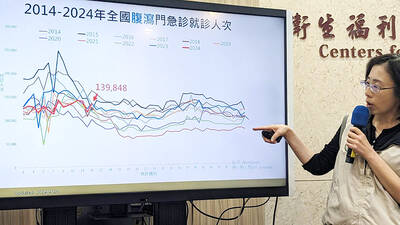
FLU SEASON: Twenty-six severe cases were reported from Tuesday last week to Monday, including a seven-year-old girl diagnosed with influenza-associated encephalopathy Nearly 140,000 people sought medical assistance for diarrhea last week, the Centers for Disease Control (CDC) said on Tuesday. From April 7 to Saturday last week, 139,848 people sought medical help for diarrhea-related illness, a 15.7 percent increase from last week’s 120,868 reports, CDC Epidemic Intelligence Center Deputy Director Lee Chia-lin (李佳琳) said. The number of people who reported diarrhea-related illness last week was the fourth highest in the same time period over the past decade, Lee said. Over the past four weeks, 203 mass illness cases had been reported, nearly four times higher than the 54 cases documented in the same period
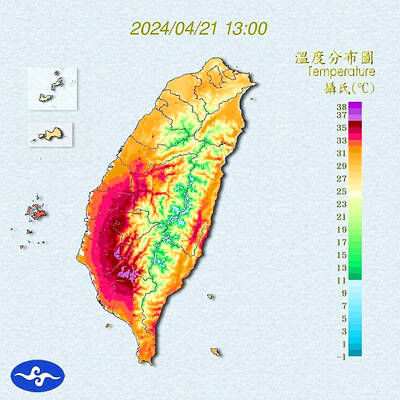
Heat advisories were in effect for nine administrative regions yesterday afternoon as warm southwesterly winds pushed temperatures above 38°C in parts of southern Taiwan, the Central Weather Administration (CWA) said. As of 3:30pm yesterday, Tainan’s Yujing District (玉井) had recorded the day’s highest temperature of 39.7°C, though the measurement will not be included in Taiwan’s official heat records since Yujing is an automatic rather than manually operated weather station, the CWA said. Highs recorded in other areas were 38.7°C in Kaohsiung’s Neimen District (內門), 38.2°C in Chiayi City and 38.1°C in Pingtung’s Sandimen Township (三地門), CWA data showed. The spell of scorching

A group of Taiwanese-American and Tibetan-American students at Harvard University on Saturday disrupted Chinese Ambassador to the US Xie Feng’s (謝鋒) speech at the school, accusing him of being responsible for numerous human rights violations. Four students — two Taiwanese Americans and two from Tibet — held up banners inside a conference hall where Xie was delivering a speech at the opening ceremony of the Harvard Kennedy School China Conference 2024. In a video clip provided by the Coalition of Students Resisting the CCP (Chinese Communist Party), Taiwanese-American Cosette Wu (吳亭樺) and Tibetan-American Tsering Yangchen are seen holding banners that together read:


 RSS
RSS