


With top cross-strait negotiators due to meet in Taiwan next month, a think tank yesterday urged the government to prevent the police from abusing their power and violating human rights.
On Tuesday it was exactly one year since China’s ARATS Chairman Chen Yunlin visited Taipei. Chen is set to meet his Taiwanese counterpart, Straits Exchange Foundation Chairman Jiang Pin-kung (江丙坤), in Taichung next month.
Wu Hao-jen (吳豪人), a law professor at Fu Jen Catholic University, said that while the government should be held partially responsible for a regression of Taiwan’s democracy, such arguments oversimplified the issue.
“The crux of the problem lies in the fact that many problems caused by transitional justice were not properly dealt with over the past 20 years,” he said. “Now former president Chen Shui-bian (陳水扁) is paying the price.”
Wu made the remarks at a forum organized by the Taiwan Thinktank in Taipei yesterday. The event was entitled “The first anniversary of Chen Yunlin’s visit to Taiwan and the first anniversary of the demise of Taiwan’s democracy and human rights.”
Wu said President Ma Ying-jeou’s (馬英九) administration obtained its mandate legally, but what it was doing was unjust and eroding Taiwan’s democracy.
The China factor makes matters worse, he said, adding that it has caused a decline in national income and retrogression of human rights. While more and more intellectuals are afraid to speak up, he said, the more people give up their freedom, the more prosperous the suppressing regime would be.
Hsueh Ching-feng (薛欽峰), an attorney-at-law handling many cases connected to Chen Yunlin’s visit last year, expressed concern over the judiciary’s identification with the old system, despite the transfer of power.
As most members of the judiciary are not from suppressed groups, he said, they have little sympathy for those who are.
In one case he handled, Hsueh said a judge asked the plaintiff why he chose to join the protest against Chen Yunlin rather than staying home and watching TV.
Hsueh said his heart sank when the judge said law enforcement officers in many countries used violence against protesters.
The judge of another case considered police brutality as “improper individual conduct” and refused to call witnesses or obtain evidence to find out who gave orders, he said.
Urging the judiciary to take a neutral stance, Hsueh emphasized the importance of procedural justice and the replacement of unsuitable judges and prosecutors.
Chung Shu-chi (鍾淑姬) alleges she suffered police brutality and said she would never apologize to the law enforcement officers who she says violated her rights at a protest during Chen Yunlin’s visit. Nor would she settle the matter out of court, she said.
A female police officer took Chung to court, accusing her of obstructing public affairs and assault.
“I have two little children and an elderly mother. I don’t want to go to jail,” she said. “I will never apologize or admit doing anything wrong. I will join the protest when Chen [Yunlin] comes this time around.”
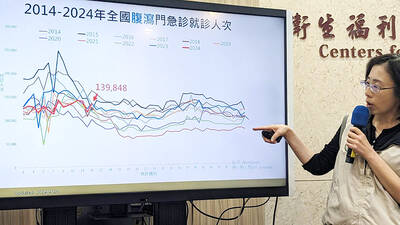
FLU SEASON: Twenty-six severe cases were reported from Tuesday last week to Monday, including a seven-year-old girl diagnosed with influenza-associated encephalopathy Nearly 140,000 people sought medical assistance for diarrhea last week, the Centers for Disease Control (CDC) said on Tuesday. From April 7 to Saturday last week, 139,848 people sought medical help for diarrhea-related illness, a 15.7 percent increase from last week’s 120,868 reports, CDC Epidemic Intelligence Center Deputy Director Lee Chia-lin (李佳琳) said. The number of people who reported diarrhea-related illness last week was the fourth highest in the same time period over the past decade, Lee said. Over the past four weeks, 203 mass illness cases had been reported, nearly four times higher than the 54 cases documented in the same period
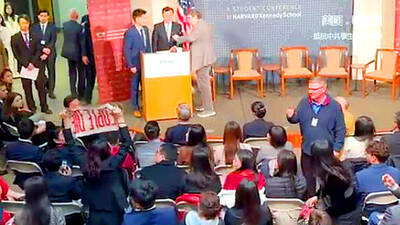
A group of Taiwanese-American and Tibetan-American students at Harvard University on Saturday disrupted Chinese Ambassador to the US Xie Feng’s (謝鋒) speech at the school, accusing him of being responsible for numerous human rights violations. Four students — two Taiwanese Americans and two from Tibet — held up banners inside a conference hall where Xie was delivering a speech at the opening ceremony of the Harvard Kennedy School China Conference 2024. In a video clip provided by the Coalition of Students Resisting the CCP (Chinese Communist Party), Taiwanese-American Cosette Wu (吳亭樺) and Tibetan-American Tsering Yangchen are seen holding banners that together read:
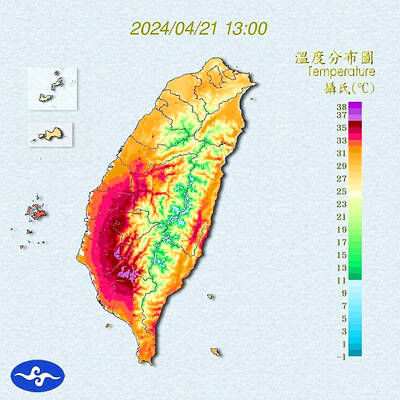
Heat advisories were in effect for nine administrative regions yesterday afternoon as warm southwesterly winds pushed temperatures above 38°C in parts of southern Taiwan, the Central Weather Administration (CWA) said. As of 3:30pm yesterday, Tainan’s Yujing District (玉井) had recorded the day’s highest temperature of 39.7°C, though the measurement will not be included in Taiwan’s official heat records since Yujing is an automatic rather than manually operated weather station, the CWA said. Highs recorded in other areas were 38.7°C in Kaohsiung’s Neimen District (內門), 38.2°C in Chiayi City and 38.1°C in Pingtung’s Sandimen Township (三地門), CWA data showed. The spell of scorching

UNAWARE: Many people sit for long hours every day and eat unhealthy foods, putting them at greater risk of developing one of the ‘three highs,’ an expert said More than 30 percent of adults aged 40 or older who underwent a government-funded health exam were unaware they had at least one of the “three highs” — high blood pressure, high blood lipids or high blood sugar, the Health Promotion Administration (HPA) said yesterday. Among adults aged 40 or older who said they did not have any of the “three highs” before taking the health exam, more than 30 percent were found to have at least one of them, Adult Preventive Health Examination Service data from 2022 showed. People with long-term medical conditions such as hypertension or diabetes usually do not


 RSS
RSS