


For Hsu Jen-hui (徐仁輝) and Hsu Jen-ming (徐仁明), the road home on Aug. 7 was a long one.
On the eve of Father’s Day, held on Aug. 8 in Taiwan, they received a telephone call from home saying that their grandmother was critically ill. The two brothers, who are serving in the military, asked for a leave of absence from their units and readied to go home. However, the highway leading home was blocked by mudslides caused by Typhoon Morakot, which began lashing Taiwan on the same day. They were not able to say goodbye to their grandmother, who died the following day.
On Aug. 9, news of the disaster began to appear on TV, but they saw no reports about their hometown of Jiamu Village (佳暮), a mountainous settlement in Wutai Township (霧台), Pingtung County.
When they called their cousin, Lai Meng-chuan (賴孟傳), he told them that the torrential rain had caused the mountain to collapse, leading to landslides that cut off roads and bridges.
Worried about their parents and community, the two brothers reported the situation to the southern disaster response center and asked for assistance.
On Aug. 10, the two brothers and their cousin embarked on the journey home despite the bad weather. They set off at 4am, bringing medical supplies for chronic illnesses, generators and daily necessities. They first drove, then rode bicycles and then walked because of the bad road conditions.
When they reached Ila settlement at around 7am, they were asked to help in the search for five villagers buried alive by mudslides. The search went on until that afternoon, but turned up nothing.
The weather improved on Aug. 11 and helicopters were sent out to search for survivors. The county attempted to airlift Jiamu residents from the isolated village, but found out that there was no landing pad for rescue helicopters.
The two brothers, natives of the Rukai Aboriginal tribe, who the military trained in jungle warfare and outdoor survival skills, requested to be airlifted to Jiamu so they could help build a landing pad.
The relocation effort, which saved the lives of 72 tribal members, took three days to complete. The two brothers and their cousin were the first rescuers to arrive and the last to leave. They were each awarded a medal by President Ma Ying-jeou (馬英九) on Thursday for their heroic deeds, among a total of 60 soldiers and military officers.
Morakot brought more than a year’s worth of rainfall in just a few days, triggering the most serious flooding and mudslides in 50 years. Fatalities from the disaster were at least 700. The military came under fire for responding too slowly to the disaster. Although Ma is the commander-in-chief of the armed forces, then-minister of national defense Chen Chao-min (陳肇敏) took the heat and later resigned.
Aside from their military duties, the 34-year-old Hsu Jen-hui and 30-year-old Hsu Jen-ming are members of the Retired Paratrooper Association and Mountain Calamity Relief Association.
Asked to describe how they felt about receiving the award, the 34-year-old said he and his brother felt the honor should go to the entire army. As for what kept them going during the crisis, he said they simply wanted to go home.
Marine Sergeant first class Pan Kuo-ching (潘國清) lost his father, brother, grandparents and 30 other family members in the disaster.
Stationed in Kaohsiung, Pan flew on rescue helicopters over his hometown of Namasiya Township (那瑪夏), Kaohsiung County, but he was unable to get there because of his assignment to other disaster areas. It was not until one week after the disaster struck that he had a chance to return home.
He seemed to have come to terms with desolation when he talked about the loss of his family members.
“As a soldier, my priority is to do the job I am told. It is an obligation that I cannot decline,” he said. “If there is one more person contributing to the relief effort, there is more power.”
Sergeant Tsao Pei-chi (曹沛淇) was one of the soldiers sent to the Aboriginal community of Sinkai (新開) in Liouguei Township (六龜), Kaohsiung County, to help recover bodies buried under mudslides.
To call attention to their plight during rescue efforts in the wake of the disaster, mudslide victims put up a cardboard sign reading “32 people killed, SOS.”
The image was broadcast on TV and published the front pages of newspapers.
Tsao said she and four other female colleagues requested to go to Sinkai two weeks into the disaster.
“We thought if men could do it, we could do it too,” the 21-year-old said.
She said she did not think twice when they were asked to sniff out the bodies with their noses. The unconventional approach, however, was scrapped the next day following public outcry and was later replaced with more scientific means.
Tsao said she did not feel moral suffering or lose sleep because she was well prepared before she took on the mission.
“I just told myself not to think too much and that I was there to do my job,” she said.
Deputy commander of the land force Lee Ching-kuo (李清國) said they sent more than 1,000 soldiers and 40 heavy machines to Sinkai. The excavation project consisted of two stages, the first one focusing on exhuming more than 4 hectares of land. During the second stage, they dug at spots requested by families, he said.
Lee, who also participated in the rescue operations after the 921 Earthquake, said the devastation caused by the 1999 quake could not rival that caused by Morakot because the two disasters were completely different.
“The catastrophe caused by Morakot was the combination of the 921 Earthquake, 87 Flooding [of 1959], foot-and-mouth disease and H1N1 [swine flu],” he said, adding that the area affected by Morakot was bigger, rainfall was heavier and the response was slower.
Lee said he entered the Morakot disaster area on Aug. 8 and completed the mission on Sept. 30. He was also involved in the pre-emptive deployment of military personnel ahead of Tropical Storm Parma earlier this month. During his two-month involvement in relief work, Lee said he lost 4kg.
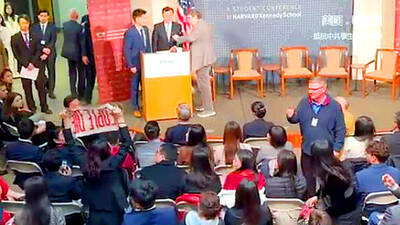
A group of Taiwanese-American and Tibetan-American students at Harvard University on Saturday disrupted Chinese Ambassador to the US Xie Feng’s (謝鋒) speech at the school, accusing him of being responsible for numerous human rights violations. Four students — two Taiwanese Americans and two from Tibet — held up banners inside a conference hall where Xie was delivering a speech at the opening ceremony of the Harvard Kennedy School China Conference 2024. In a video clip provided by the Coalition of Students Resisting the CCP (Chinese Communist Party), Taiwanese-American Cosette Wu (吳亭樺) and Tibetan-American Tsering Yangchen are seen holding banners that together read:

UNAWARE: Many people sit for long hours every day and eat unhealthy foods, putting them at greater risk of developing one of the ‘three highs,’ an expert said More than 30 percent of adults aged 40 or older who underwent a government-funded health exam were unaware they had at least one of the “three highs” — high blood pressure, high blood lipids or high blood sugar, the Health Promotion Administration (HPA) said yesterday. Among adults aged 40 or older who said they did not have any of the “three highs” before taking the health exam, more than 30 percent were found to have at least one of them, Adult Preventive Health Examination Service data from 2022 showed. People with long-term medical conditions such as hypertension or diabetes usually do not
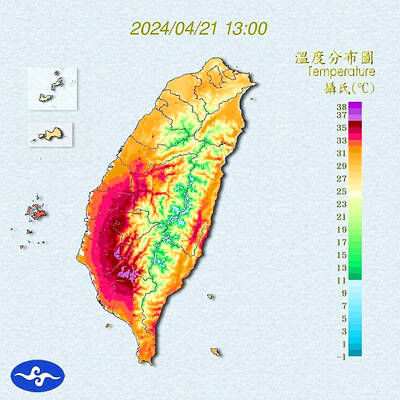
Heat advisories were in effect for nine administrative regions yesterday afternoon as warm southwesterly winds pushed temperatures above 38°C in parts of southern Taiwan, the Central Weather Administration (CWA) said. As of 3:30pm yesterday, Tainan’s Yujing District (玉井) had recorded the day’s highest temperature of 39.7°C, though the measurement will not be included in Taiwan’s official heat records since Yujing is an automatic rather than manually operated weather station, the CWA said. Highs recorded in other areas were 38.7°C in Kaohsiung’s Neimen District (內門), 38.2°C in Chiayi City and 38.1°C in Pingtung’s Sandimen Township (三地門), CWA data showed. The spell of scorching
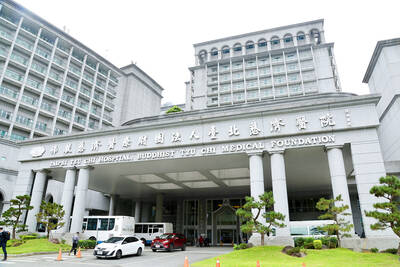
POLICE INVESTIGATING: A man said he quit his job as a nurse at Taipei Tzu Chi Hospital as he had been ‘disgusted’ by the behavior of his colleagues A man yesterday morning wrote online that he had witnessed nurses taking photographs and touching anesthetized patients inappropriately in Taipei Tzu Chi Hospital’s operating theaters. The man surnamed Huang (黃) wrote on the Professional Technology Temple bulletin board that during his six-month stint as a nurse at the hospital, he had seen nurses taking pictures of patients, including of their private parts, after they were anesthetized. Some nurses had also touched patients inappropriately and children were among those photographed, he said. Huang said this “disgusted” him “so much” that “he felt the need to reveal these unethical acts in the operating theater


 RSS
RSS