


Beijing believes it has made many concessions since President Ma Ying-jeou (馬英九) came to power and is likely to ask Taiwan for something in return, an expert attending a cross-strait forum said yesterday.
Liu Bih-rong (劉必榮), a political science professor at Soochow University, said that Beijing has made several concessions over the past year, including not opposing former vice president Lien Chan's (連戰) attendance at the APEC as Ma's envoy, Taiwan's participation in the World Health Assembly as an observer and Ma attending the Kaohsiung World Games in his capacity as the head of state, as well as refraining from luring Taiwan's diplomatic allies in Southern and Central America.
“But Taiwan has also made some concessions too, including not seeking UN membership this year,” he said.
“With Beijing making so many concessions, some people are worried that it may ask Taiwan for something in return,” he said.
Liu said that it could concern arms procurement, or an economic cooperation framework agreement (ECFA) the administration seeks to sign with Beijing, adding that anything economic, political or military could be a bargaining chip.
That is why some hope to see the administration take a slower path to improving cross-strait relations, he said.
Liu made the remarks during an international forum on cross-strait relations in Muzha yesterday. The two-day event, entitled “International Conference on China: Six Decades and After,” was organized by National Chengchi University's Center for China Studies and Institute of Development Studies in conjunction with the Mainland Affairs Council.
You Ji (由驥), a professor at the School of Social Sciences and International Studies at the University of New South Wales, said Ma had made the payback when he announced his “three noes” policy.
The “three noes” refer to no discussion of unification with Beijing during his presidency, no pursuit or support of de jure Taiwanese independence and no use of military force to resolve cross-strait tensions.
Liu said it would be a good thing if Beijing shared the same thinking, but he was worried that it did not.
“I'm sure there must be some people among the hardliners calculating what concessions Beijing has made for Taipei and how much Taipei has paid back,” he said.
Liu said it would pose great uncertainty for cross-strait ties if Chinese Vice President Xi Jinping (習近平), a front-runner to succeed President Hu Jintao (胡錦濤) as party leader in 2012 and president in 2013, wishes to pursue Hu's path of peaceful development in the Taiwan Strait but cannot make hardliners agree.
You said Beijing's Taiwan policy has changed over time, from using military force to resolve the issue to using the military campaign as a threat to maintain the “status quo.”
“In fact there are other better and more cost-effective means available for Beijing to promote ultimate reunification,” You said. “Economic and cultural integration. This is the core content of Hu's Taiwan strategy defined by 'peaceful development,' which reflects Hu's confidence that time is on Beijing's side.”
With Taipei and Beijing becoming economically inseparable, You said the initiative will be firmly in Beijing's hands.
“Therefore, as long as the Taiwan Strait remains stable, CCP [Chinese Communist Party] leaders would be less concerned about ultimate reunification than about effective management of complicated domestic and international affairs,” he said.
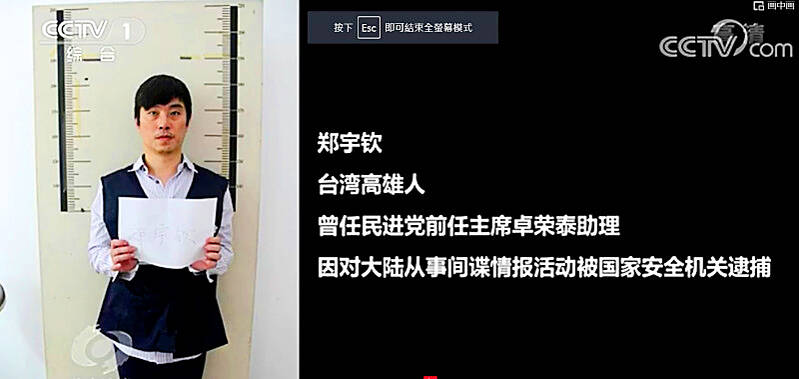
Former Czech Republic-based Taiwanese researcher Cheng Yu-chin (鄭宇欽) has been sentenced to seven years in prison on espionage-related charges, China’s Ministry of State Security announced yesterday. China said Cheng was a spy for Taiwan who “masqueraded as a professor” and that he was previously an assistant to former Cabinet secretary-general Cho Jung-tai (卓榮泰). President-elect William Lai (賴清德) on Wednesday last week announced Cho would be his premier when Lai is inaugurated next month. Today is China’s “National Security Education Day.” The Chinese ministry yesterday released a video online showing arrests over the past 10 years of people alleged to be
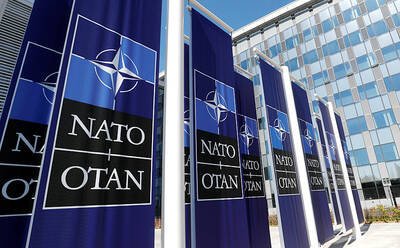
THE HAWAII FACTOR: While a 1965 opinion said an attack on Hawaii would not trigger Article 5, the text of the treaty suggests the state is covered, the report says NATO could be drawn into a conflict in the Taiwan Strait if Chinese forces attacked the US mainland or Hawaii, a NATO Defense College report published on Monday says. The report, written by James Lee, an assistant research fellow at Academia Sinica’s Institute of European and American Studies, states that under certain conditions a Taiwan contingency could trigger Article 5 of NATO, under which an attack against any member of the alliance is considered an attack against all members, necessitating a response. Article 6 of the North Atlantic Treaty specifies that an armed attack in the territory of any member in Europe,

LIKE FAMILY: People now treat dogs and cats as family members. They receive the same medical treatments and tests as humans do, a veterinary association official said The number of pet dogs and cats in Taiwan has officially outnumbered the number of human newborns last year, data from the Ministry of Agriculture’s pet registration information system showed. As of last year, Taiwan had 94,544 registered pet dogs and 137,652 pet cats, the data showed. By contrast, 135,571 babies were born last year. Demand for medical care for pet animals has also risen. As of Feb. 29, there were 5,773 veterinarians in Taiwan, 3,993 of whom were for pet animals, statistics from the Animal and Plant Health Inspection Agency showed. In 2022, the nation had 3,077 pediatricians. As of last
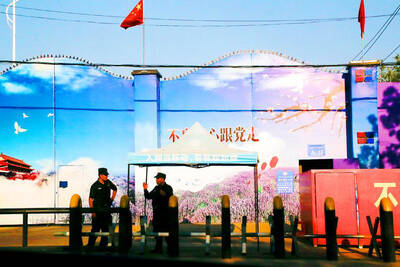
XINJIANG: Officials are conducting a report into amending an existing law or to enact a special law to prohibit goods using forced labor Taiwan is mulling an amendment prohibiting the importation of goods using forced labor, similar to the Uyghur Forced Labor Prevention Act (UFLPA) passed by the US Congress in 2021 that imposed limits on goods produced using forced labor in China’s Xinjiang region. A government official who wished to remain anonymous said yesterday that as the US customs law explicitly prohibits the importation of goods made using forced labor, in 2021 it passed the specialized UFLPA to limit the importation of cotton and other goods from China’s Xinjiang Uyghur region. Taiwan does not have the legal basis to prohibit the importation of goods


 RSS
RSS