


Since the devastating 921 Earthquake hit the nation a decade ago, horizontal displacement, caused by the collision of the Earth’s tectonic plates, has occurred two to three times faster than previously in central Taiwan, including in Taichung County’s Sinshih (新社) Township and Nantou County’s Puli (埔里) Township, geologists say.
As Taiwan is located on the convergent boundary between the Eurasian Plate and the Philippine Plate, it has suffered from long-term collision of plates that have led to topographical changes. Academics say the fast changes in the crustal formation of Taiwan are proof that seismic activities are active, a warning that another major earthquake could occur.
Academics forecast that in 2500, a strong earthquake will likely occur in Nantou County’s Jiji (集集) Township, one of the worst-hit areas during the 921 Earthquake, and they are concerned that the next quake with a magnitude greater than 7.0 on the Richter scale will strike the Jianan Plain (嘉南平原).
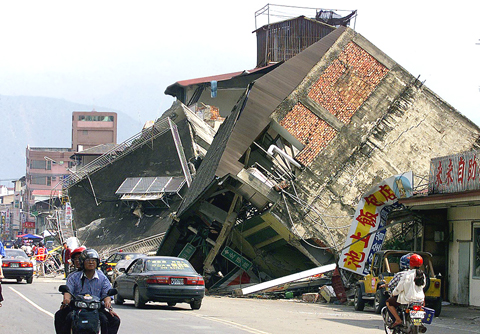
PHOTO: AFP
Yu Shui-beih (余水倍), a researcher at Academia Sinica’s Institute of Earth Sciences says that Green Island and Lanyu on the Philippine Plate are moving closer to Penghu on the Eurasian Plate because of the compression resulting from the collision of the two plates. The Central Mountain Range has gradually been raised by the tectonic movement and energy accumulated in the earth’s crust.
Yu’s research team discovered that before the 921 Earthquake, a horizontal displacement of 1cm a year had been observed between Sinshih Township and the west coast, but that the displacement rate has increased between 3cm and 4cm a year since the quake occurred. To this day, the area has an accumulated horizontal displacement of 30cm and Sun Moon Lake has a displacement of 40cm.
Studies also show a horizontal shortening of 3cm a year in central Taiwan and a shortening of up to 4cm in southwestern Taiwan, while the East Rift Valley sees a steady shortening of 3cm a year.
Chen Wen-shan (陳文山), a professor of geology at National Taiwan University, said that a total of seven Paleo-earthquakes have been recorded at the Chelongpu (車籠埔) Fault in Taichung County over the past 3,000 years. A seismic analysis says the Chelongpu fault belongs to the time-predictable recurrence model and may experience a major temblor with a similar magnitude or higher than the 921 Earthquake again in around 400 years’ time.
Yu said, however, this does not mean that central Taiwan will not be struck by a quake with a magnitude of between 5 and 6 before then, so the public should remain vigilant.
A study by Yu showed that the Jianan Plain is one of the regions with a high risk of a strong earthquake. He said the next quake with a magnitude of 6.3 would be likely to occur in the Jianan Plain, Taipei, or central areas of the country, but since the exact time of the quake cannot be predicted, the public should take precautions against earthquakes at all times.
Wang Chien-ying (王乾盈), a professor of earth sciences at National Central University, said that two earthquakes that struck Chiayi County in 1792 and 1906 both measured 7.1 on the Richter Scale, killing thousands of people. In light of this, he is concerned that a strong earthquake may rattle Chiayi County about every 100 years.
In addition to conducting cooperation projects on earthquakes with the US and Japan, Taiwanese academics are also planning to work with China on artificial seismic sources to analyze seismic wave paths in the hope of getting a better understanding of the thickness and structure of the crust along the Taiwan Strait.
Both Yu and Chen said, however, that because of technology constraints, scientists still cannot predict when and where an earthquake will occur.
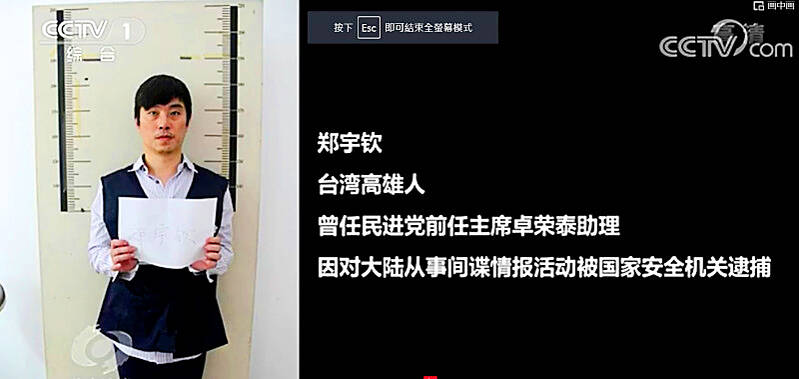
Former Czech Republic-based Taiwanese researcher Cheng Yu-chin (鄭宇欽) has been sentenced to seven years in prison on espionage-related charges, China’s Ministry of State Security announced yesterday. China said Cheng was a spy for Taiwan who “masqueraded as a professor” and that he was previously an assistant to former Cabinet secretary-general Cho Jung-tai (卓榮泰). President-elect William Lai (賴清德) on Wednesday last week announced Cho would be his premier when Lai is inaugurated next month. Today is China’s “National Security Education Day.” The Chinese ministry yesterday released a video online showing arrests over the past 10 years of people alleged to be

THE HAWAII FACTOR: While a 1965 opinion said an attack on Hawaii would not trigger Article 5, the text of the treaty suggests the state is covered, the report says NATO could be drawn into a conflict in the Taiwan Strait if Chinese forces attacked the US mainland or Hawaii, a NATO Defense College report published on Monday says. The report, written by James Lee, an assistant research fellow at Academia Sinica’s Institute of European and American Studies, states that under certain conditions a Taiwan contingency could trigger Article 5 of NATO, under which an attack against any member of the alliance is considered an attack against all members, necessitating a response. Article 6 of the North Atlantic Treaty specifies that an armed attack in the territory of any member in Europe,
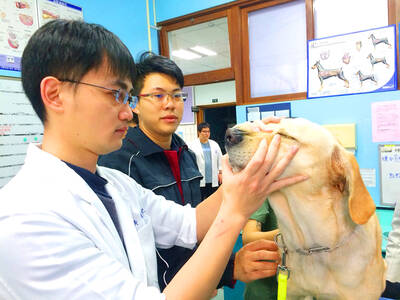
LIKE FAMILY: People now treat dogs and cats as family members. They receive the same medical treatments and tests as humans do, a veterinary association official said The number of pet dogs and cats in Taiwan has officially outnumbered the number of human newborns last year, data from the Ministry of Agriculture’s pet registration information system showed. As of last year, Taiwan had 94,544 registered pet dogs and 137,652 pet cats, the data showed. By contrast, 135,571 babies were born last year. Demand for medical care for pet animals has also risen. As of Feb. 29, there were 5,773 veterinarians in Taiwan, 3,993 of whom were for pet animals, statistics from the Animal and Plant Health Inspection Agency showed. In 2022, the nation had 3,077 pediatricians. As of last

XINJIANG: Officials are conducting a report into amending an existing law or to enact a special law to prohibit goods using forced labor Taiwan is mulling an amendment prohibiting the importation of goods using forced labor, similar to the Uyghur Forced Labor Prevention Act (UFLPA) passed by the US Congress in 2021 that imposed limits on goods produced using forced labor in China’s Xinjiang region. A government official who wished to remain anonymous said yesterday that as the US customs law explicitly prohibits the importation of goods made using forced labor, in 2021 it passed the specialized UFLPA to limit the importation of cotton and other goods from China’s Xinjiang Uyghur region. Taiwan does not have the legal basis to prohibit the importation of goods


 RSS
RSS