


Known as the first premier in the nation’s history to begin his premiership by saying sorry — he apologized over the announcement of oil and electricity price increases being earlier than scheduled — outgoing premier Liu Chao-shiuan (劉兆玄) told his critics at the time that his term would “end with applause.”
While it may not be the applause he had pictured, acknowledgment has been given for his resignation, taking responsibility for the landslides triggered by floods brought by Typhoon Morakot last month that claimed more than 600 lives. Political analysts, however, said Liu had no choice but to leave his post amid a power struggle in the Chinese Nationalist Party (KMT) and his own lackluster approval ratings.
On Aug. 18, in a bid to calm public anger over the government’s much-criticized typhoon relief operations, President Ma Ying-jeou (馬英九) promised that officials found to have mishandled the floods would be held responsible and a Cabinet reshuffle would be made “by me and Premier Liu together.”
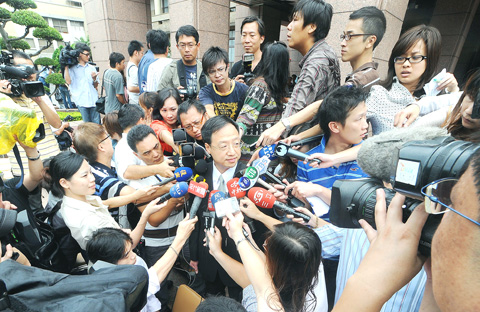
PHOTO: LIU HSIN-DE, TAIPEI TIMES
Speculation on Liu’s future started then, but it soon leaned toward Liu staying in office. Liu took everyone by surprise on Monday when he said that his Cabinet would resign en masse.
How things developed over the few weeks since Liu first offered to step down on Aug. 15 suggests the background to his resignation was not straightforward.
The announcement of Liu’s resignation came six days after he said in an interview that the Cabinet reshuffle would be “a little bigger than small scale.”
In the next two days, Liu did interviews with numerous cable TV stations, which was seen as a move to change the public’s perception of the Cabinet, its image damaged by poor and disorganized relief work.
During the interviews, Liu answered questions without hesitancy on his criteria for selecting new team members. Officials whose overall performance over the past 15 months were under par would be replaced, he said, adding that one of the factors under evaluation would be the Cabinet’s performance when dealing with the global financial crisis.
He also said then that the government would produce a report on its response to the typhoon by the end of the month to serve as a “reference for improvements” and to “restore the truth” regarding the Cabinet’s handling of the disaster “as there are many people jumping to conclusions.”
His remarks were widely interpreted by the media as a sign that Liu would stay on as premier and the size of the Cabinet reshuffle would be scaled down from the “large-scale and comprehensive” overhaul the premier had talked about on Aug. 19.
“From what Liu said, Liu and Ma were thinking differently about the reshuffle. Ma wanted to hold officials responsible by using the reshuffle, but in Liu’s reshuffle plan, apparently that was not factored in,” said an official at the Executive Yuan, who requested anonymity.
The official said Liu resigned to take political responsibility for the government’s poor rescue and relief efforts, but he had still failed to give a clear account of “what was done wrong by which officials.”
“Despite harsh criticism of the government’s performance, Liu had a different opinion. In a closed-door meeting with Master Hsin Yun (星雲) on Aug. 21, he said the government had been ‘wronged,’” the official said.
Spokesmen at both the Executive Yuan and the Presidential Office said Ma and Liu had reached a consensus when Liu offered to resign that Liu stay on temporarily to get the post-disaster reconstruction work on track.
A source close to Liu, however, dismissed those accounts. Liu’s intention to resign had been kept confidential, the source said, and Ma had been under pressure from both KMT headquarters and the party’s legislative caucus to replace Liu.
“Over the 15 months, and especially when his Cabinet was under fire following the flooding, Liu, as an individual unaffiliated with any faction of the KMT, felt that it was difficult to implement policies,” the source said. “Liu therefore suggested that Ma choose someone who had the party behind him.”
Director of Liu’s office, Ting Nai-chi (丁乃琪), on the other hand, denied any drama involving Liu’s resignation.
Saying that she was the only official at the Executive Yuan aware of Liu’s intention to resign, Ting said Liu “had been adamant about his resignation from the very beginning.”
Aside from Ting, Vice Premier Paul Chiu (邱正雄) was the only Cabinet official informed of Liu’s decision to resign prior to Liu’s public announcement on Monday.
Ting, Chiu, and Chiu’s chief secretary Chen Chao-kai (陳肇凱) all declined to comment on when Ma accepted Liu’s resignation, giving the same vague answer that “it was one day last week.”
Sources said there was a significant ratcheting up of pressure on Ma to replace Liu by the party following Liu’s “small reshuffle” remarks last Tuesday, which failed to meet the public’s expectations.
Ting denied the speculation, saying that the message that Liu would stay in office and the reshuffle would be small-scale were done to maintain the morale of officials executing imperative reconstruction work while worrying about a possible Cabinet reshuffle.
National Taiwan University political science professor Chang Lin-cheng (張麟徵) said that “people who know Liu well understand that he would choose to leave even if Ma asked him to stay.”
“Given plummeting approval ratings for Liu, Ma and the government, Liu knew that staying on would harm not only himself, but also Ma,” Chang said.
Shih Cheng-feng (施正鋒), a political commentator, said there was no alternative for Ma but to replace Liu, because only by doing so would it be possible to boost Ma’s declining approval rating.
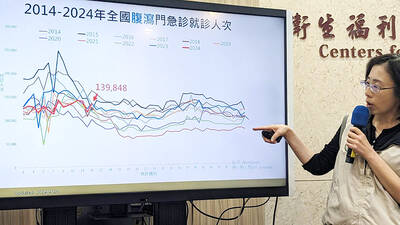
FLU SEASON: Twenty-six severe cases were reported from Tuesday last week to Monday, including a seven-year-old girl diagnosed with influenza-associated encephalopathy Nearly 140,000 people sought medical assistance for diarrhea last week, the Centers for Disease Control (CDC) said on Tuesday. From April 7 to Saturday last week, 139,848 people sought medical help for diarrhea-related illness, a 15.7 percent increase from last week’s 120,868 reports, CDC Epidemic Intelligence Center Deputy Director Lee Chia-lin (李佳琳) said. The number of people who reported diarrhea-related illness last week was the fourth highest in the same time period over the past decade, Lee said. Over the past four weeks, 203 mass illness cases had been reported, nearly four times higher than the 54 cases documented in the same period
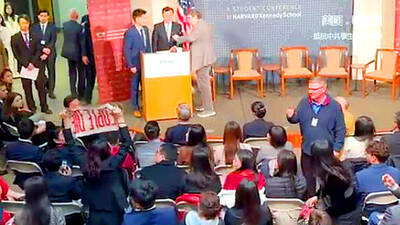
A group of Taiwanese-American and Tibetan-American students at Harvard University on Saturday disrupted Chinese Ambassador to the US Xie Feng’s (謝鋒) speech at the school, accusing him of being responsible for numerous human rights violations. Four students — two Taiwanese Americans and two from Tibet — held up banners inside a conference hall where Xie was delivering a speech at the opening ceremony of the Harvard Kennedy School China Conference 2024. In a video clip provided by the Coalition of Students Resisting the CCP (Chinese Communist Party), Taiwanese-American Cosette Wu (吳亭樺) and Tibetan-American Tsering Yangchen are seen holding banners that together read:

UNAWARE: Many people sit for long hours every day and eat unhealthy foods, putting them at greater risk of developing one of the ‘three highs,’ an expert said More than 30 percent of adults aged 40 or older who underwent a government-funded health exam were unaware they had at least one of the “three highs” — high blood pressure, high blood lipids or high blood sugar, the Health Promotion Administration (HPA) said yesterday. Among adults aged 40 or older who said they did not have any of the “three highs” before taking the health exam, more than 30 percent were found to have at least one of them, Adult Preventive Health Examination Service data from 2022 showed. People with long-term medical conditions such as hypertension or diabetes usually do not
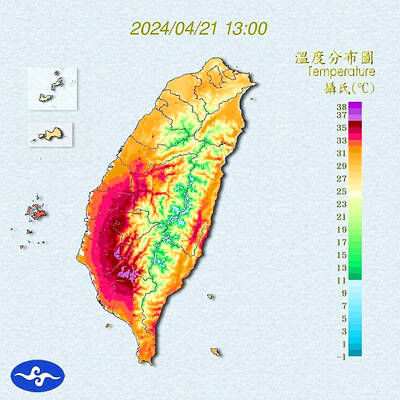
Heat advisories were in effect for nine administrative regions yesterday afternoon as warm southwesterly winds pushed temperatures above 38°C in parts of southern Taiwan, the Central Weather Administration (CWA) said. As of 3:30pm yesterday, Tainan’s Yujing District (玉井) had recorded the day’s highest temperature of 39.7°C, though the measurement will not be included in Taiwan’s official heat records since Yujing is an automatic rather than manually operated weather station, the CWA said. Highs recorded in other areas were 38.7°C in Kaohsiung’s Neimen District (內門), 38.2°C in Chiayi City and 38.1°C in Pingtung’s Sandimen Township (三地門), CWA data showed. The spell of scorching


 RSS
RSS