


While urbanization and economic development improve living standards, they also pose a threat to the survival of Hakka culture in Taiwan and in many other countries, panelists told a forum on urban Hakka yesterday.
“To make a better living, many Hakka migrated from their hometowns to the cities, notably Taipei and Kaohsiung,” public administration professor at National Taipei University Chiu Chang-tai (丘昌泰) — who himself is Hakka — said. “However, as they move into cities, they become ‘invisible.’”
The forum was hosted by National Central University’s College of Hakka Studies and the Taipei County Hakka Affairs Bureau in Taipei yesterday.
Using Taipei City as an example, Chiu said that although many people do not feel there are many Hakka living in Taipei, “studies by academics show there could be as many as 497,000 Hakka in Taipei, or about 20 percent of the population.”
Most Hakka in Taipei are migrants from rural areas in Taoyuan, Hsinchu and Miaoli counties who came to search for a better life, Chiu said.
“Hakka in Taipei intentionally conceal their ethnic identity and learn to speak Hoklo and Mandarin so they won’t be any different from their neighbors and will not become targets of discrimination,” he said. “In fact, when my team and I conducted field research on Hakka in Taipei, most people were reluctant to admit they were Hakka and some even showed hostility we asked if they were Hakka.”
The situation among Hakka in Kaohsiung is similar, he said.
“The Kaohsiung Hakka Affairs Commission said there are as many as 270,000 Hakka — or one sixth of the population — in Kaohsiung City, but people continue to view it as a predominantly Hoklo city,” Chiu said, adding that the invisibility of Hakka is more serious in Kaohsiung than Taipei.
“I visited several Hakka associations in Kaohsiung and was surprised to find that their members usually talk to each other in Hoklo,” he said.
Sichuan Academy of Social Sciences Center for Hakka Studies professor Chen Shisong (陳世松) said the Hakka community in Dongshan (東山), a suburb of the Sichuan provincial capital Chengdu, is facing the same challenge.
Chen said that when young Hakka from rural Dongshan move into the city in the hope of finding a better life, “they lose the environment in which they could pass on Hakka culture and live as Hakka.”
“A Hakka living in the city is no different from others if he doesn’t use Hakka and thus becomes ‘invisible,’” Chen said. “As such, the biggest impact urbanization has had on Hakka is that many are forgetting their mother tongue — the only symbol of Hakka identity.”
This isn’t because Hakka consciously want to abandon their heritage, he said, “but the environment they live in forces them to.”
Vorasakdi Mahatdhanobol, an academic at Chulalongkong University in Thailand, said that most Hakka in Thailand — especially those who live in Bangkok — have lost their culture.
“The few Hakka communities that have managed to keep their traditions are those who live outside Bangkok,” he said.
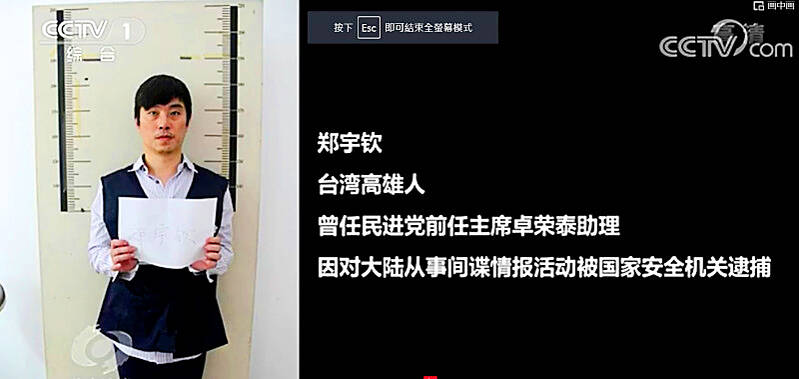
Former Czech Republic-based Taiwanese researcher Cheng Yu-chin (鄭宇欽) has been sentenced to seven years in prison on espionage-related charges, China’s Ministry of State Security announced yesterday. China said Cheng was a spy for Taiwan who “masqueraded as a professor” and that he was previously an assistant to former Cabinet secretary-general Cho Jung-tai (卓榮泰). President-elect William Lai (賴清德) on Wednesday last week announced Cho would be his premier when Lai is inaugurated next month. Today is China’s “National Security Education Day.” The Chinese ministry yesterday released a video online showing arrests over the past 10 years of people alleged to be

THE HAWAII FACTOR: While a 1965 opinion said an attack on Hawaii would not trigger Article 5, the text of the treaty suggests the state is covered, the report says NATO could be drawn into a conflict in the Taiwan Strait if Chinese forces attacked the US mainland or Hawaii, a NATO Defense College report published on Monday says. The report, written by James Lee, an assistant research fellow at Academia Sinica’s Institute of European and American Studies, states that under certain conditions a Taiwan contingency could trigger Article 5 of NATO, under which an attack against any member of the alliance is considered an attack against all members, necessitating a response. Article 6 of the North Atlantic Treaty specifies that an armed attack in the territory of any member in Europe,

LIKE FAMILY: People now treat dogs and cats as family members. They receive the same medical treatments and tests as humans do, a veterinary association official said The number of pet dogs and cats in Taiwan has officially outnumbered the number of human newborns last year, data from the Ministry of Agriculture’s pet registration information system showed. As of last year, Taiwan had 94,544 registered pet dogs and 137,652 pet cats, the data showed. By contrast, 135,571 babies were born last year. Demand for medical care for pet animals has also risen. As of Feb. 29, there were 5,773 veterinarians in Taiwan, 3,993 of whom were for pet animals, statistics from the Animal and Plant Health Inspection Agency showed. In 2022, the nation had 3,077 pediatricians. As of last

XINJIANG: Officials are conducting a report into amending an existing law or to enact a special law to prohibit goods using forced labor Taiwan is mulling an amendment prohibiting the importation of goods using forced labor, similar to the Uyghur Forced Labor Prevention Act (UFLPA) passed by the US Congress in 2021 that imposed limits on goods produced using forced labor in China’s Xinjiang region. A government official who wished to remain anonymous said yesterday that as the US customs law explicitly prohibits the importation of goods made using forced labor, in 2021 it passed the specialized UFLPA to limit the importation of cotton and other goods from China’s Xinjiang Uyghur region. Taiwan does not have the legal basis to prohibit the importation of goods


 RSS
RSS