


While some people might find the sight of oily food detestable, for Maruyama Junko, oil collected from the campus cafeteria was a crucial ingredient in her artworks.
“Every week, I collect about 70 liters of oil from food served in the school cafeteria and mix it with water,” said Maruyama, a Japanese artist in residence at Kuandu Museum of Fine Arts, located on the campus of Taipei National University of the Arts.
“To me, that's where energy comes from — the mixture of oil and water,” she said. “And when I read something like the big bang theory, I try to recreate the vision using oil and water.”
With the aid of these two ingredients, Maruyama turned an ordinary restroom in the museum into an art exhibition.
Using the oil she had collected, she made a soap mixture and plastered it on the pedestal supporting the toilet bowl, turning it into brown, tree-like stump. She also used the same mixture to shape tree branches hanging over the toilet bowl. On the floor is a shallow pool where a mixture of oil and water creates mystifying patterns on the ground.
Aside from installation art, Maruyama has also opened a flower shop on campus. A closer look at these floral creations reveals flowers made from different plastic bags — ranging from the ordinary red-striped ones to those from 7-Eleven convenience stores or Watson's.
The artist-in-residency program sponsored by the museum allows Maruyama and artists from other countries to engage in creative projects without any distraction.
In Japan, Maruyama said she had to take several part-time jobs simultaneously to continue her artistic pursuits.
“In Japan, life was so stressful. I got sort of crazy because of that stressful lifestyle,” she said. “Here life is calm. I can go for a walk in the woods and feel completely refreshed.”
To Seth Lower from the US, the residency program gave him an opportunity to live in a non-English speaking country for the first time.
Lower was here for a project called “Looking for Lee Ming” (尋找李明), who sent him an e-mail from Taiwan last year and told him that he knew him from a dream he had many times in his life. Lee said Lower was the angel in the dream that fought the people who tried to hurt him and sacrificed his life eventually.
“And he [the angel] wrote with his blood on my hand as he died in my arms. Then I remembered, the name that guy wrote. It was your name,” Lee said in his e-mail to Lower.
“Immediate shock” was his initial response, Lower said. “But pretty quickly the feeling went from being scared to wondering what might have happened if this was true.”
He later pitched the idea of finding Lee Ming in Taiwan when he applied for the museum's residency program and got accepted.
Lower said that his past works dealt with coincidences, and he was interested in seeing how the multiplicity of coincidences generates different possibilities.
Lower soon acquired the help of two Taiwanese students, who were assigned by the program to work on the project with him. They posted the message on the university's bulletin board system and waited for a response. They took Lower to Longshan Temple in Taipei and sought guidance from fortune tellers. Lower also met several people called Lee Ming on Facebook in Taipei.
On a trip to Jiufen (九份), the team asked a passersby to pose as Lee Ming in the dream, while Lower, as the angel, pretended to die in Lee's arms.
Lee then turned the quest for a mystic figure into a documentary, which was interwoven with images like traditional puppet shows and the festival rituals at Longshan Temple.
Lower never found Lee Ming. But the search led him to explore a bit more about the country that produced directors like Hou Hsiao-hsien (侯孝賢) and Ang Lee (李安).
“It is interesting to see how the art community could happen in such a traditional place,” he said. “And see how the works get balanced — thinking about moving forward, thinking about the past, and thinking about how to differentiate these two aspects.”
Like most foreigners, Lower said he also experienced some cultural shock.
“I met a guy on a motorcycle who screamed waiguoren [foreigner] at me,” he said. “It was a bit unnerving to be constantly reminded that you are an outsider.”
But he felt pretty much at home overall, and the life he had here was no different from what he had in San Francisco.
Ho Ming-kuei (何明桂), the program coordinator, said the artist-in-residence program started two years ago, when the museum officially appropriated budget to subsidize the artists.
“At the beginning, not too many artists knew about the program so that we had very few applications,” she said, adding that the information later spread through word-of-month and now they have about 20 applicants per year.
Artists who want to participate in the program must first pitch their ideas, which are reviewed by a committee of specialists who select two to three artists. Each artist can stay between two weeks and two months, depending on the time needed to finish their project.
Besides working on the projects, the museum arranges for the resident artists to teach university students in workshops, talk to visitors in a question-and-answer session and explore the art community in Taiwan, Ho said.
Ho said the subsidy only pays for boarding at the university's dormitory and the expenses needed to complete the projects. Artists must pay for their flights to Taiwan and their own living expenses.
“The money may not be much, but our staff try their best to help the artists put their creativity to life,” she said.
Since 2007, the program has subsidized five artists, mainly from Japan and the US. For details, visit http://kdmofa.tnua.edu.tw.
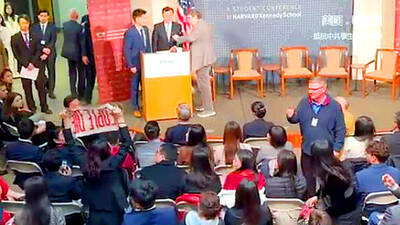
A group of Taiwanese-American and Tibetan-American students at Harvard University on Saturday disrupted Chinese Ambassador to the US Xie Feng’s (謝鋒) speech at the school, accusing him of being responsible for numerous human rights violations. Four students — two Taiwanese Americans and two from Tibet — held up banners inside a conference hall where Xie was delivering a speech at the opening ceremony of the Harvard Kennedy School China Conference 2024. In a video clip provided by the Coalition of Students Resisting the CCP (Chinese Communist Party), Taiwanese-American Cosette Wu (吳亭樺) and Tibetan-American Tsering Yangchen are seen holding banners that together read:

UNAWARE: Many people sit for long hours every day and eat unhealthy foods, putting them at greater risk of developing one of the ‘three highs,’ an expert said More than 30 percent of adults aged 40 or older who underwent a government-funded health exam were unaware they had at least one of the “three highs” — high blood pressure, high blood lipids or high blood sugar, the Health Promotion Administration (HPA) said yesterday. Among adults aged 40 or older who said they did not have any of the “three highs” before taking the health exam, more than 30 percent were found to have at least one of them, Adult Preventive Health Examination Service data from 2022 showed. People with long-term medical conditions such as hypertension or diabetes usually do not
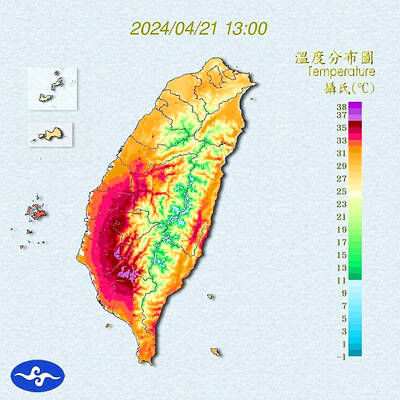
Heat advisories were in effect for nine administrative regions yesterday afternoon as warm southwesterly winds pushed temperatures above 38°C in parts of southern Taiwan, the Central Weather Administration (CWA) said. As of 3:30pm yesterday, Tainan’s Yujing District (玉井) had recorded the day’s highest temperature of 39.7°C, though the measurement will not be included in Taiwan’s official heat records since Yujing is an automatic rather than manually operated weather station, the CWA said. Highs recorded in other areas were 38.7°C in Kaohsiung’s Neimen District (內門), 38.2°C in Chiayi City and 38.1°C in Pingtung’s Sandimen Township (三地門), CWA data showed. The spell of scorching
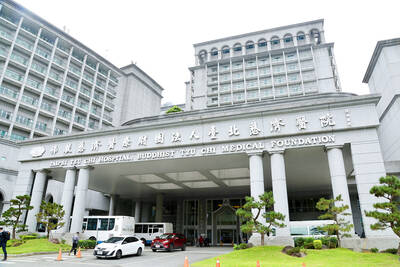
POLICE INVESTIGATING: A man said he quit his job as a nurse at Taipei Tzu Chi Hospital as he had been ‘disgusted’ by the behavior of his colleagues A man yesterday morning wrote online that he had witnessed nurses taking photographs and touching anesthetized patients inappropriately in Taipei Tzu Chi Hospital’s operating theaters. The man surnamed Huang (黃) wrote on the Professional Technology Temple bulletin board that during his six-month stint as a nurse at the hospital, he had seen nurses taking pictures of patients, including of their private parts, after they were anesthetized. Some nurses had also touched patients inappropriately and children were among those photographed, he said. Huang said this “disgusted” him “so much” that “he felt the need to reveal these unethical acts in the operating theater


 RSS
RSS