


President Ma Ying-jeou (馬英九) yesterday acknowledged Beijing’s interference in Taipei’s effort to sign free-trade agreements with other countries, but emphasized it was necessary to sign a trade pact with China as soon as possible, adding that the agreement would steer clear of Taiwan’s statehood.
Ma said his administration intended to negotiate an economic cooperation framework agreement (ECFA) with Beijing to prevent Taiwan from being marginalized in the economic integration of the East Asian region.
He made the remarks when meeting Hayashi Yasuo of the Japan External Trade Organization at the Presidential Office yesterday morning.
Ma said China has made it difficult for Taiwan to sign trade pacts with other countries.
TRADING PARTNERS
Taking Japan as an example, Ma said although Tokyo was Taiwan’s second-largest trading partner, while Taiwan is Japan’s fourth-largest trading partner, Taipei and Tokyo have not had the opportunity to negotiate on a free-trade agreement.
The president said the ECFA would take time to complete, but could be modeled on the deal signed between ASEAN and China, in which an “early harvest” provision was included to ensure the interests of vulnerable industries.
“We need to negotiate with China on the name, content and form before we finalize it,” he said.
Ma said it was a matter of urgency to sign the ECFA with Beijing after the 10-member ASEAN signed a similar deal with Beijing in 2002.
Once the agreement takes effect next year, Ma said, it will deliver a significant blow to local petrochemical, auto parts, machinery and textile industries, which will face levies of 10 percent to 15 percent, while ASEAN members will enjoy zero tariffs.
INVESTMENT
“If we don’t do it now, those industries will suffer and some might leave Taiwan and invest somewhere else, such as in ASEAN countries or China, further worsening the economy,” Ma said.
“An economic institution has estimated that about 100,000 people would lose their jobs,” the president said.
While the opposition has said that the planned agreement would jeopardize Taiwan’s sovereignty, Ma said 50 percent to 60 percent of the public were in favor of the pact thanks to the administration’s aggressive promotion effort.
“Signing an ECFA with Beijing will not only normalize cross-strait trade, but also create an opportunity to engage in similar negotiations with other countries,” he said.
“We will not negotiate on Taiwan’s future in the ECFA, nor will it touch upon unification or independence,” Ma added.
Taiwan is an export-driven economy and exports make up 64 percent of the country’s GDP, Ma said.
Since the country gained accession to the WTO in 2002, Ma said progress on multilateral trade negotiations has been limited, compelling many member countries to engage in the signing of free-trade agreements.
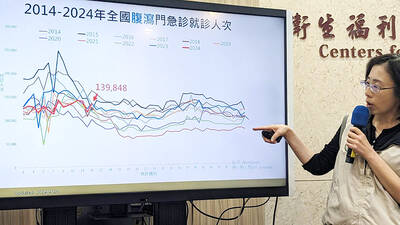
FLU SEASON: Twenty-six severe cases were reported from Tuesday last week to Monday, including a seven-year-old girl diagnosed with influenza-associated encephalopathy Nearly 140,000 people sought medical assistance for diarrhea last week, the Centers for Disease Control (CDC) said on Tuesday. From April 7 to Saturday last week, 139,848 people sought medical help for diarrhea-related illness, a 15.7 percent increase from last week’s 120,868 reports, CDC Epidemic Intelligence Center Deputy Director Lee Chia-lin (李佳琳) said. The number of people who reported diarrhea-related illness last week was the fourth highest in the same time period over the past decade, Lee said. Over the past four weeks, 203 mass illness cases had been reported, nearly four times higher than the 54 cases documented in the same period
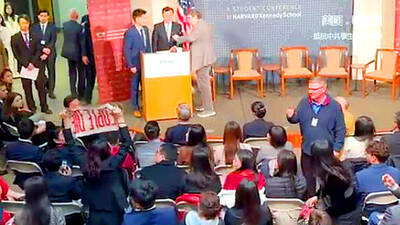
A group of Taiwanese-American and Tibetan-American students at Harvard University on Saturday disrupted Chinese Ambassador to the US Xie Feng’s (謝鋒) speech at the school, accusing him of being responsible for numerous human rights violations. Four students — two Taiwanese Americans and two from Tibet — held up banners inside a conference hall where Xie was delivering a speech at the opening ceremony of the Harvard Kennedy School China Conference 2024. In a video clip provided by the Coalition of Students Resisting the CCP (Chinese Communist Party), Taiwanese-American Cosette Wu (吳亭樺) and Tibetan-American Tsering Yangchen are seen holding banners that together read:
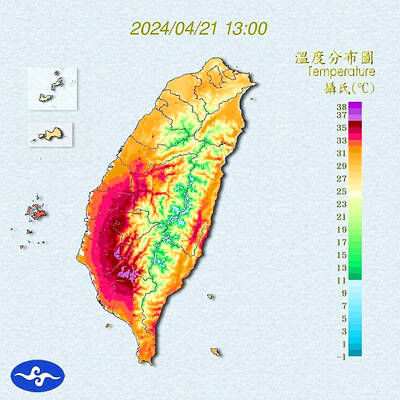
Heat advisories were in effect for nine administrative regions yesterday afternoon as warm southwesterly winds pushed temperatures above 38°C in parts of southern Taiwan, the Central Weather Administration (CWA) said. As of 3:30pm yesterday, Tainan’s Yujing District (玉井) had recorded the day’s highest temperature of 39.7°C, though the measurement will not be included in Taiwan’s official heat records since Yujing is an automatic rather than manually operated weather station, the CWA said. Highs recorded in other areas were 38.7°C in Kaohsiung’s Neimen District (內門), 38.2°C in Chiayi City and 38.1°C in Pingtung’s Sandimen Township (三地門), CWA data showed. The spell of scorching

UNAWARE: Many people sit for long hours every day and eat unhealthy foods, putting them at greater risk of developing one of the ‘three highs,’ an expert said More than 30 percent of adults aged 40 or older who underwent a government-funded health exam were unaware they had at least one of the “three highs” — high blood pressure, high blood lipids or high blood sugar, the Health Promotion Administration (HPA) said yesterday. Among adults aged 40 or older who said they did not have any of the “three highs” before taking the health exam, more than 30 percent were found to have at least one of them, Adult Preventive Health Examination Service data from 2022 showed. People with long-term medical conditions such as hypertension or diabetes usually do not


 RSS
RSS