


Sixteen young academics were recognized yesterday for their achievements at a Junior Researcher Award ceremony hosted by Academia Sinica.
Academia Sinica President Wong Chi-huey (翁啟惠) told the ceremony he was very proud of the quality of research conducted by this year's awardees.
“The academics were selected from a pool of 155 applicants in the fields of mathematics and physical sciences, life sciences and humanities and social sciences,” Wong said.
The award is an annual event that was established in 1995 to honor the work of assistant professors, assistant researchers, associate professors and associate researchers.
Yesterday's youngest recipient, 36-year-old Lin Sung-jan (林頌然), an assistant professor at National Taiwan University's biomedical engineering institute, was praised as a “one-in-a-million doctor-scientist.”
He was recognized for his work in cultivating hair follicle dermal papilla cells, a technology that could help millions battling hair loss.
Associate economics professor at NTU Lin Ming-jen (林明仁), who had published an impressive nine papers in internationally renowned journals in seven years after obtaining his doctorate, was awarded for his research titled Can Hepatitis B Mothers Account for the Number of Missing Women? Evidence from Three Million Newborns in Taiwan that was published in the American Economic Review last year.
In its selection statement, Academia Sinica said that Lin Ming-jen's paper “reconciled the debate between two Nobel Prize winners on their theories why the man-woman ratio in Asia is off-balance.”
While Indian-born Nobel Prize-winning economist Amartya Kumar Sen believes that more baby boys are born in Asia because Asian parents prefer boys over girls, American scientist Baruch Blumberg says the discrepancy came from the fact that hepatitis B is more prevalent in Asia, and hepatitis-B carrier mothers are more likely to give birth to boys.
Lin Ming-jen found that the hepatitis B factor made only a very minor contribution to the gender imbalance in Asia.
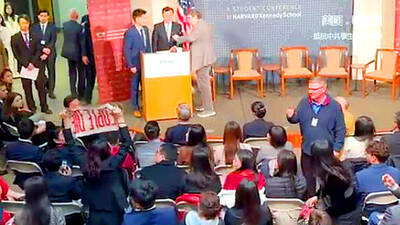
A group of Taiwanese-American and Tibetan-American students at Harvard University on Saturday disrupted Chinese Ambassador to the US Xie Feng’s (謝鋒) speech at the school, accusing him of being responsible for numerous human rights violations. Four students — two Taiwanese Americans and two from Tibet — held up banners inside a conference hall where Xie was delivering a speech at the opening ceremony of the Harvard Kennedy School China Conference 2024. In a video clip provided by the Coalition of Students Resisting the CCP (Chinese Communist Party), Taiwanese-American Cosette Wu (吳亭樺) and Tibetan-American Tsering Yangchen are seen holding banners that together read:

UNAWARE: Many people sit for long hours every day and eat unhealthy foods, putting them at greater risk of developing one of the ‘three highs,’ an expert said More than 30 percent of adults aged 40 or older who underwent a government-funded health exam were unaware they had at least one of the “three highs” — high blood pressure, high blood lipids or high blood sugar, the Health Promotion Administration (HPA) said yesterday. Among adults aged 40 or older who said they did not have any of the “three highs” before taking the health exam, more than 30 percent were found to have at least one of them, Adult Preventive Health Examination Service data from 2022 showed. People with long-term medical conditions such as hypertension or diabetes usually do not
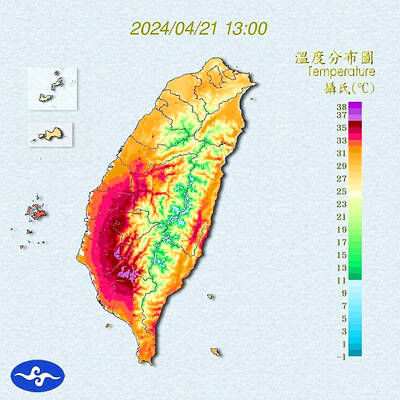
Heat advisories were in effect for nine administrative regions yesterday afternoon as warm southwesterly winds pushed temperatures above 38°C in parts of southern Taiwan, the Central Weather Administration (CWA) said. As of 3:30pm yesterday, Tainan’s Yujing District (玉井) had recorded the day’s highest temperature of 39.7°C, though the measurement will not be included in Taiwan’s official heat records since Yujing is an automatic rather than manually operated weather station, the CWA said. Highs recorded in other areas were 38.7°C in Kaohsiung’s Neimen District (內門), 38.2°C in Chiayi City and 38.1°C in Pingtung’s Sandimen Township (三地門), CWA data showed. The spell of scorching
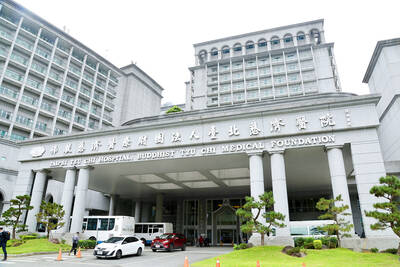
POLICE INVESTIGATING: A man said he quit his job as a nurse at Taipei Tzu Chi Hospital as he had been ‘disgusted’ by the behavior of his colleagues A man yesterday morning wrote online that he had witnessed nurses taking photographs and touching anesthetized patients inappropriately in Taipei Tzu Chi Hospital’s operating theaters. The man surnamed Huang (黃) wrote on the Professional Technology Temple bulletin board that during his six-month stint as a nurse at the hospital, he had seen nurses taking pictures of patients, including of their private parts, after they were anesthetized. Some nurses had also touched patients inappropriately and children were among those photographed, he said. Huang said this “disgusted” him “so much” that “he felt the need to reveal these unethical acts in the operating theater


 RSS
RSS