


Amid speculation that the government has decided to redraw Taiwan’s administrative map to create three special municipalities and 15 counties, experts said political favoritism should not play a role in the country’s electoral development.
The recently amended Local Government Act (地方制度法) requires counties or cities seeking a status upgrade or a merger to submit their applications to the Ministry of the Interior by the end of this month.
As of last week, Taipei County and Taoyuan County had applied for an upgrade to special municipalities, while Taichung County and city as well as Kaohsiung County and city applied to merge into special municipalities.
Apart from these, Changhua County is reportedly planning an upgrade, while Tainan County and Tainan City, as well as Yunlin County and Chiayi County, are preparing bids to merge into special municipalities.
Although the procedures for reviewing the applications are stipulated in the Act, speculation suggests that the review process is little more than a formality as it has already been decided that the existing two municipalities and 23 counties and cities will be remapped into three metropolitan areas and 15 counties.
The plan reportedly favored by the government was drawn up to deliver on President Ma Ying-jeou’s (馬英九) campaign pledge and is widely regarded as beneficial the Chinese Nationalist Party (KMT) in future commissioner elections.
Under the plan, Taipei County will be elevated to the status of a special municipality, as would the soon-to-be-merged Taichung County and city, while Kaohsiung County would also become part of a special municipality after merging with Kaohsiung City.
At the center of the controversy was Taipei County because regulations within the Act stipulate that the term of a city or county chief being upgraded would be extended by one year, a move that would buy another year for the KMT’s unpopular Taipei County Commissioner Chou Hsi-wei (周錫瑋).
Yang Chih-cheng (楊志誠), a professor of politics at the Graduate Institute of Public Policy at Feng Chia University, called on the government to refrain from arbitrarily imposing Ma’s will on the public, saying that “even the president is not above the Local Government Act.”
“The demarcation of administrative districts should be guided by principles that make the country fit for globalization. In the era of globalization, the government should work toward removing obstacles that impede free flow of personnel, commodities and information, and decentralization. The plan to create three metropolises would do exactly the opposite,” Yang said.
Article 4 of the Local Government Act says that an area with a population of over 1.25 million that carries significant weight in political, economic, cultural and urban development would be considered a special municipality.
Shiau Chyuan-jeng (蕭全政), a professor of politics at National Taiwan University, said that the government should contemplate the problem of remapping administrative areas from the viewpoint of the country’s long-term development and not the specific needs of a single district.
“The liberalization of establishing banks in the early 1990s resulted in consequences we are still suffering today. Without appropriate criteria to follow in deciding which administrative districts should be considered municipalities, the number of municipalities could be a problem as political concerns are certainly a factor,” he said.
The Act Governing the Allocation of Government Revenues and Expenditures (財政收支劃分法) stipulates that 43 percent of the central government’s allocated tax revenue go to special municipalities and the remaining 57 percent be divided among the other 23 counties and cities based on each district’s population and area.
The elevation of status to special municipality would grant a county or city a larger budget and the right to employ more personnel.
Shiau urged the government to settle the problem of uneven distribution of resources among municipalities, counties and cities. The reason why so many counties and cities are interested in a status upgrade is so they can remap their districts from the angle of national interests, he said.
Kung Shiann-far (孔憲法), an associate professor at the Department of Urban Planning at National Cheng Kung University, said that Taiwan should have metropolitan areas with populations comparable to other big cities in the world to remain globally competitive.
“The competitiveness should not be built on resources that are supposed to be distributed to other counties and cities. On the contrary, a metropolitan area should be a city capable of driving the development of its neighboring counties and cities,” Kung said.
Integration of neighboring districts and migration should be deciding factors in the process of reviewing the applications as they could affect whether a city would be competitive on the world stage, Kung said.
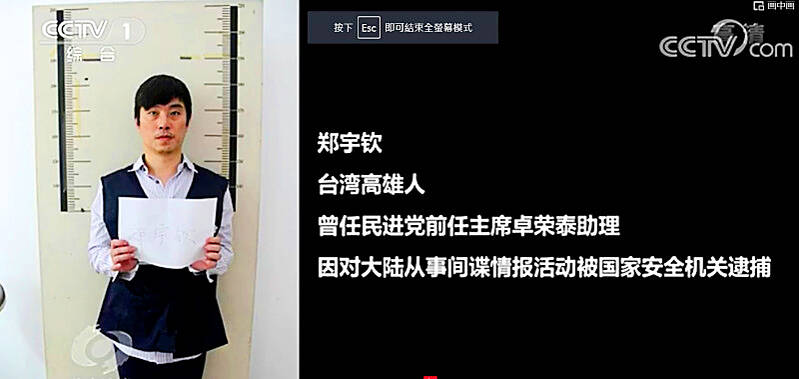
Former Czech Republic-based Taiwanese researcher Cheng Yu-chin (鄭宇欽) has been sentenced to seven years in prison on espionage-related charges, China’s Ministry of State Security announced yesterday. China said Cheng was a spy for Taiwan who “masqueraded as a professor” and that he was previously an assistant to former Cabinet secretary-general Cho Jung-tai (卓榮泰). President-elect William Lai (賴清德) on Wednesday last week announced Cho would be his premier when Lai is inaugurated next month. Today is China’s “National Security Education Day.” The Chinese ministry yesterday released a video online showing arrests over the past 10 years of people alleged to be
THE HAWAII FACTOR: While a 1965 opinion said an attack on Hawaii would not trigger Article 5, the text of the treaty suggests the state is covered, the report says NATO could be drawn into a conflict in the Taiwan Strait if Chinese forces attacked the US mainland or Hawaii, a NATO Defense College report published on Monday says. The report, written by James Lee, an assistant research fellow at Academia Sinica’s Institute of European and American Studies, states that under certain conditions a Taiwan contingency could trigger Article 5 of NATO, under which an attack against any member of the alliance is considered an attack against all members, necessitating a response. Article 6 of the North Atlantic Treaty specifies that an armed attack in the territory of any member in Europe,
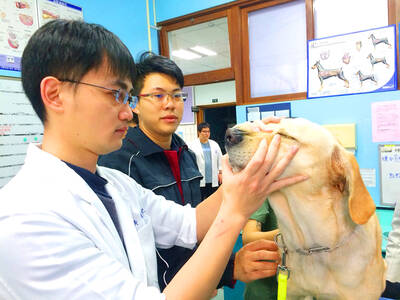
LIKE FAMILY: People now treat dogs and cats as family members. They receive the same medical treatments and tests as humans do, a veterinary association official said The number of pet dogs and cats in Taiwan has officially outnumbered the number of human newborns last year, data from the Ministry of Agriculture’s pet registration information system showed. As of last year, Taiwan had 94,544 registered pet dogs and 137,652 pet cats, the data showed. By contrast, 135,571 babies were born last year. Demand for medical care for pet animals has also risen. As of Feb. 29, there were 5,773 veterinarians in Taiwan, 3,993 of whom were for pet animals, statistics from the Animal and Plant Health Inspection Agency showed. In 2022, the nation had 3,077 pediatricians. As of last
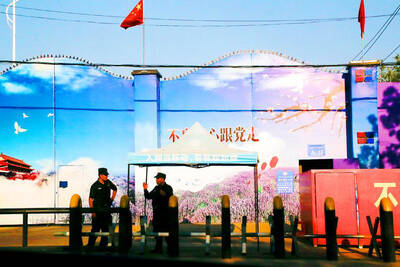
XINJIANG: Officials are conducting a report into amending an existing law or to enact a special law to prohibit goods using forced labor Taiwan is mulling an amendment prohibiting the importation of goods using forced labor, similar to the Uyghur Forced Labor Prevention Act (UFLPA) passed by the US Congress in 2021 that imposed limits on goods produced using forced labor in China’s Xinjiang region. A government official who wished to remain anonymous said yesterday that as the US customs law explicitly prohibits the importation of goods made using forced labor, in 2021 it passed the specialized UFLPA to limit the importation of cotton and other goods from China’s Xinjiang Uyghur region. Taiwan does not have the legal basis to prohibit the importation of goods


 RSS
RSS