


A Taiwanese cartoonist is being recognized for his work in China, an accolade that speaks volumes about both his popularity and changing attitudes toward social issues in China.
Late last month, Hangzhou City in eastern China signed a contract with Chu Teh-yung (朱德庸) to build a museum celebrating his accomplishments. The ultramodern structure, scheduled to open next year, will be the centerpiece of a sprawling animation complex that will also include artist workshops and luxury hotels.
Chu's often sharp depiction of family issues such as parental pressure on underachieving children and generational conflicts was a bit cutting edge for China when introduced a decade ago.
But no longer.
His six main comic books have been made into Chinese stage shows or TV series, and Chu has become a household name there.
His success reflects two shifts: a narrowing social gap between China and wealthier Taiwan as Chinese move up the economic ladder, and Beijing's gradual easing of limits on cultural expression.
The 49-year-old cartoonist also steers clear of political themes.
That's somewhat unusual in Taiwan, which is known for its hotly contested, even divisive politics. But it's a winning approach in China, where the one-party, authoritarian government brooks little dissent.
Under the recently signed deal, the Hangzhou government is providing 260 million yuan (US$38 million) for the building's construction while leaving the interior design and exhibition content to the cartoonist.
“The museum will be my concept,” Chu said. “They agreed not to interfere.”
That is a rare concession in tightly controlled China, which still works to insure that cultural content reflects prevailing political beliefs.
In one celebrated case in 2007, censors deleted scenes from Taiwanese director Ang Lee's (李安) World War II drama Lust, Caution, because of sexually explicit content and suggestions that one of the main characters was not sufficiently loyal to the Chinese cause.
Despite the political differences between Taiwan and China, the two societies share a common cultural background, a major reason why Chu's comics resonate in China.
Beijing poet and publisher Shen Haopo says he supports the planned museum, because Chu is “a master, a guidepost,” whose work is an exemplar of positive moral values.
“China is at a juncture of absorbing foreign values to enrich our own culture,” Shen said. “We need a model for our young artists.”
Chu's work was first introduced to China a decade ago when local cartoons typically served the propaganda interests of the Chinese Communist Party.
His humor and sarcasm — rare among Chinese artists of the time — soon won him widespread popularity.
Particularly enthusiastic was the new class of white-collar urban dwellers, who related to Chu's depictions of parental pressure on children and clashes over arranged marriages versus love matches.
“They see in my cartoons their own stories, in my characters people who are struggling with the same family and marriage problems as they themselves are,” said Chu, who sports shoulder-length hair.
His latest work — The Absolute Kid — focuses on children indulging in their rich fantasy lives as they come under increasing parental pressure.
In one apposite selection, a boy waits at a bus stop after repeated attempts to escape his elders on a flying blanket, a broom and feathered wings.
“Every child is an angel until he is dragged down from heaven by adults' worries,” Chu said.
Another popular work, the long-running Uptown Singles, portrays four avant-garde women and their earnest pursuit of love amid traditional expectations of gender subservience.
In one telling episode, the four fashionably dressed women hold their heads up high as they parade a man tied to a leash like a dog.
In another, one of the women ejects a succession of suitors from her door and then observes tartly: “Whether we should love men or ourselves more remains a lingering question.”
Chu, who began his cartoon career in 1988 when Taiwan was just beginning its own tortuous transition from one-party dictatorship to freewheeling democracy, says politics plays second fiddle in most peoples' lives.
Self-fulfillment and raising healthy children are far more important, he said.
He says that the new Hangzhou museum, to be built next to picturesque West Lake, will present a wide array of his cartoons and sculptures, including a toilet shaped as a whale's mouth and a doorknob that looks like a person.
“I want to show that humor can be immersed into daily lives,” he said. “I want to cheer up the many among us who have enough hardship as it is.”
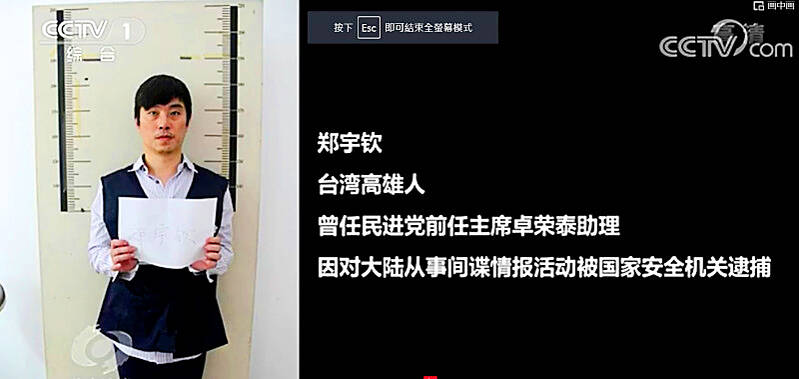
Former Czech Republic-based Taiwanese researcher Cheng Yu-chin (鄭宇欽) has been sentenced to seven years in prison on espionage-related charges, China’s Ministry of State Security announced yesterday. China said Cheng was a spy for Taiwan who “masqueraded as a professor” and that he was previously an assistant to former Cabinet secretary-general Cho Jung-tai (卓榮泰). President-elect William Lai (賴清德) on Wednesday last week announced Cho would be his premier when Lai is inaugurated next month. Today is China’s “National Security Education Day.” The Chinese ministry yesterday released a video online showing arrests over the past 10 years of people alleged to be
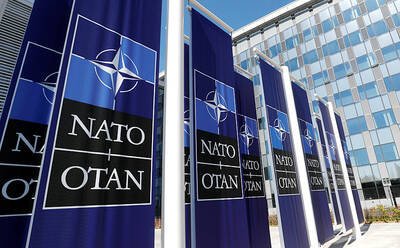
THE HAWAII FACTOR: While a 1965 opinion said an attack on Hawaii would not trigger Article 5, the text of the treaty suggests the state is covered, the report says NATO could be drawn into a conflict in the Taiwan Strait if Chinese forces attacked the US mainland or Hawaii, a NATO Defense College report published on Monday says. The report, written by James Lee, an assistant research fellow at Academia Sinica’s Institute of European and American Studies, states that under certain conditions a Taiwan contingency could trigger Article 5 of NATO, under which an attack against any member of the alliance is considered an attack against all members, necessitating a response. Article 6 of the North Atlantic Treaty specifies that an armed attack in the territory of any member in Europe,
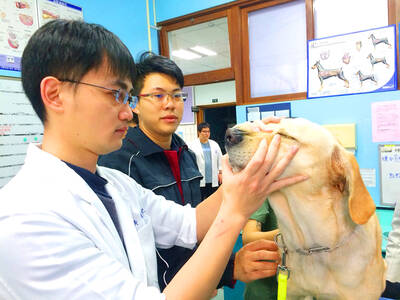
LIKE FAMILY: People now treat dogs and cats as family members. They receive the same medical treatments and tests as humans do, a veterinary association official said The number of pet dogs and cats in Taiwan has officially outnumbered the number of human newborns last year, data from the Ministry of Agriculture’s pet registration information system showed. As of last year, Taiwan had 94,544 registered pet dogs and 137,652 pet cats, the data showed. By contrast, 135,571 babies were born last year. Demand for medical care for pet animals has also risen. As of Feb. 29, there were 5,773 veterinarians in Taiwan, 3,993 of whom were for pet animals, statistics from the Animal and Plant Health Inspection Agency showed. In 2022, the nation had 3,077 pediatricians. As of last
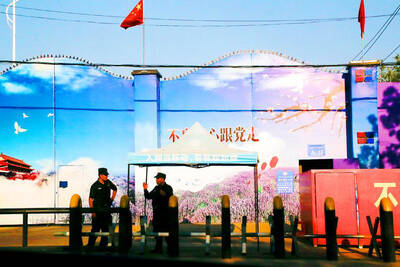
XINJIANG: Officials are conducting a report into amending an existing law or to enact a special law to prohibit goods using forced labor Taiwan is mulling an amendment prohibiting the importation of goods using forced labor, similar to the Uyghur Forced Labor Prevention Act (UFLPA) passed by the US Congress in 2021 that imposed limits on goods produced using forced labor in China’s Xinjiang region. A government official who wished to remain anonymous said yesterday that as the US customs law explicitly prohibits the importation of goods made using forced labor, in 2021 it passed the specialized UFLPA to limit the importation of cotton and other goods from China’s Xinjiang Uyghur region. Taiwan does not have the legal basis to prohibit the importation of goods


 RSS
RSS