


With “no success can compensate the failure in the home” as their rallying cry, for 52 years, thousands of young Mormon men and women, often on bikes, have been carrying out their missions in Taiwan.
“I am in Taiwan because I want to share the principles that my family had taught me when I was growing up,” said 20 year-old Brady Rice from Alpine, Utah.
Rice's clean-shaven all-American looks are not the image most people associate with the word “elder” on his nametag.
In the Church of Jesus Christ of Latter-day Saints, commonly known as the Mormon Church, the word “elder” is given to signify a high-level of priesthood. Latter-day Saints believe that all men, at age 19, who have been called to serve a two-year proselytizing mission, must receive this type of priesthood before they can wear the black nametag on their chests.
Young women at age 21 are also encouraged to devote 18 months to a mission.
Over the past few years, Taiwan has seen an increase in the number of senior missionaries. The Sparrows, a couple from Colorado Spring, Colorado, spearhead much of the Mormons' local humanitarian efforts. Most recently, they brought boxes of baby blankets knitted by church members to the children at a local Catholic charity.
The main duty of the missionaries, said Norman Neilson, the president of the Taipei Mission, is to “share the gospel of Jesus Christ and tell the Taiwanese brothers and sisters that families can be together forever.”
As a young man in 1971, Neilson served in Taiwan, and he recalls a country largely covered with rice paddies. The number of Mormons in Taiwan at the time was about 4,400, mostly US missionaries.
Nearly four decades later, its membership has grown 10-fold to 47,000 and its missionaries have to move through heavy traffic instead of dodging water buffalos.
The missionaries, who cover three missions in Taipei, Taichung and Kaohsiung, also come from a variety of places, including the UK, Canada, Australia, Germany, Indonesia, New Zealand, Singapore, the Philippines and Hong Kong. There are also a handful of native Taiwanese.
“But a few things have remained the same and that is the hardworking ethic of the Taiwanese people and their love and commitment to their families,” Neilson said.
Tanner Jacobson, who hails from Chandler, Arizona, said the strong emphasis on family was a common thread between the Mormon church and Taiwanese culture.
“It's amazing to see how hard people here work to provide for their families,” he said.
Rice said he had found the topic of families and respect for ancestors is a good icebreaker. Missionaries often encourage people to set aside Monday nights as “Family Home Evening” so families can spend time together. A church-published handbook has ideas and topics for family nights.
“It is a special time to renew friendships and teach children the principles and values you want them to learn. If you don't teach them, who will?” Neilson said.
The idea has been emulated by the government to promote more quality time for parents and their kids.
Missionaries are also required to volunteer in their local communities, and many have done so by helping people move, volunteering at hospitals, serving as crossing-guards, giving free English lessons or participating in beautification projects such as the World Beach Clean-up Day. A Filipina missionary, Reyes, works with migrant workers from the Philippines.
In April last year, Taichung Mayor Jason Hu (胡志強) enlisted several Mormon missionaries to help correct the English used in city street signs as part of his effort to make Taichung a more English-friendly environment.
The church also offers career counseling for both members and non-members and programs to help smokers and alcoholics to end their addictions. Several missionaries have spoken at the Tucheng Jail on the danger of substance abuse.
However, some bloggers in Taiwan have been critical of the church and its missionaries, calling them “ignorant, annoying, obnoxious and brainwashed” and slamming the church as racist and homophobic.
One person who asked to be identified only by the surname Wang, criticized the Mormon church as a cult and said its members are instructed to recruit as many believers as possible in order to secure their place in heaven.
“That's why they wouldn't leave me alone for a long time,” Wang said.
The Latter-day Saints also have to deal with their historical links to polygamy. The HBO show Big Love about a polygamist Mormon family has been aired in Taiwan. The Latter-day Saints stress that polygamy has not been practiced in the church for more than a century and members who are discovered to have multiple spouses are excommunicated.
Jaime Marbury from Texas said she rarely gets asked about polygamy, but she has had to learn to deal with rejection.
“Most people are more interested in why we are so happy all the time,” she said.
“It is hard to hear rejections, but whenever I get rejected, I just think about of the message we are sharing and all the good things that have happened and the wonderful people we have met,” she said.
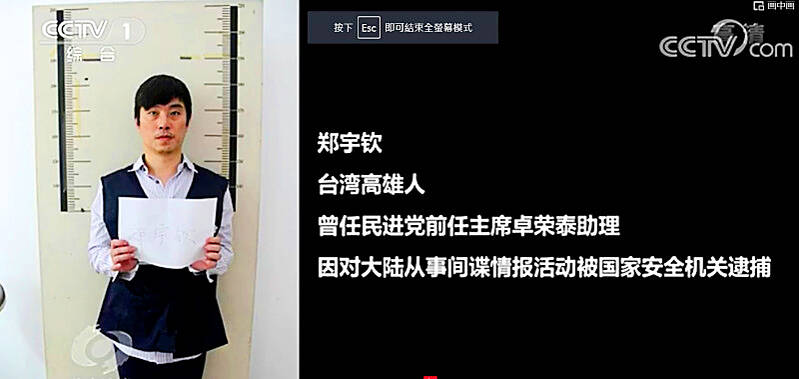
Former Czech Republic-based Taiwanese researcher Cheng Yu-chin (鄭宇欽) has been sentenced to seven years in prison on espionage-related charges, China’s Ministry of State Security announced yesterday. China said Cheng was a spy for Taiwan who “masqueraded as a professor” and that he was previously an assistant to former Cabinet secretary-general Cho Jung-tai (卓榮泰). President-elect William Lai (賴清德) on Wednesday last week announced Cho would be his premier when Lai is inaugurated next month. Today is China’s “National Security Education Day.” The Chinese ministry yesterday released a video online showing arrests over the past 10 years of people alleged to be

THE HAWAII FACTOR: While a 1965 opinion said an attack on Hawaii would not trigger Article 5, the text of the treaty suggests the state is covered, the report says NATO could be drawn into a conflict in the Taiwan Strait if Chinese forces attacked the US mainland or Hawaii, a NATO Defense College report published on Monday says. The report, written by James Lee, an assistant research fellow at Academia Sinica’s Institute of European and American Studies, states that under certain conditions a Taiwan contingency could trigger Article 5 of NATO, under which an attack against any member of the alliance is considered an attack against all members, necessitating a response. Article 6 of the North Atlantic Treaty specifies that an armed attack in the territory of any member in Europe,

LIKE FAMILY: People now treat dogs and cats as family members. They receive the same medical treatments and tests as humans do, a veterinary association official said The number of pet dogs and cats in Taiwan has officially outnumbered the number of human newborns last year, data from the Ministry of Agriculture’s pet registration information system showed. As of last year, Taiwan had 94,544 registered pet dogs and 137,652 pet cats, the data showed. By contrast, 135,571 babies were born last year. Demand for medical care for pet animals has also risen. As of Feb. 29, there were 5,773 veterinarians in Taiwan, 3,993 of whom were for pet animals, statistics from the Animal and Plant Health Inspection Agency showed. In 2022, the nation had 3,077 pediatricians. As of last

XINJIANG: Officials are conducting a report into amending an existing law or to enact a special law to prohibit goods using forced labor Taiwan is mulling an amendment prohibiting the importation of goods using forced labor, similar to the Uyghur Forced Labor Prevention Act (UFLPA) passed by the US Congress in 2021 that imposed limits on goods produced using forced labor in China’s Xinjiang region. A government official who wished to remain anonymous said yesterday that as the US customs law explicitly prohibits the importation of goods made using forced labor, in 2021 it passed the specialized UFLPA to limit the importation of cotton and other goods from China’s Xinjiang Uyghur region. Taiwan does not have the legal basis to prohibit the importation of goods


 RSS
RSS