


A group of professors and students at National Chiao Tung University in Hsinchu have founded a biopharmaceutical company to produce magnetic-sensitive microcapsules using nanotechnology that can be used in fighting cancer, cosmetics and other biomedical applications.
The research group is composed of two professors at the university's Graduate Institute of Materials Science and Engineering, who serve as consultants, and four postgraduate students from the institute, with one serving as general manager of the newly formed Advanced Delivery Technology Inc (ADT).
The company was established thanks to a NT$1 million (US$30,000) award presented to the team last month by the Industrial Bank of Taiwan after the team won second place in the 10th annual Win by Entrepreneurship, Work with Innovation and Networking (WeWin) competition organized by the bank in March.
The team won by publishing its work on Advanced Delivery Technology (ADT) — including the controlled rupturing of magnetic polyelectrolyte microcapsules for drug delivery — under the guidance of professors Chen San-yuan (陳三元) and Liu Dean-mo (劉典謨)
Chen said he believed a good thesis would remain nothing more than “empty talk” if it was not put into application, and this prompted him and Liu to assist the students in establishing ADT.
Liu said that although the four students were from the same institute, they had different academic backgrounds. For example, he said, one is a pharmaceutical major and holds a license to practice pharmacy.
ADT's principal aim is to promote self-assembled amphiphilic nanocapsules and drug-loading nanoparticle delivery systems, Liu said.
In the team's study, a magnetic-sensitive microcapsule was prepared using a polyelectrolyte to construct the shell, he said.
Experimental observations have shown that the presence of the magnetic nanoparticles in the shell structure allows it to evolve from nanocavity development to final rupture of the shell under given magnetic stimuli of different time durations, he said.
This evolution, he said, allows a corresponding variation of the drug release profile, from relatively slow release to burst-like behavior, at different stages of stimulus. This in turn allows drugs to be delivered at a predetermined time and at a predetermined location in the body, which could be very useful, particularly in the treatment of cancer.
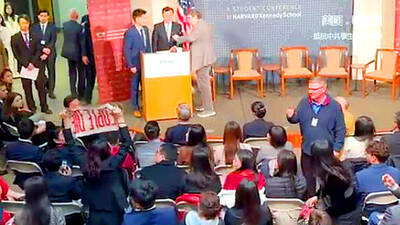
A group of Taiwanese-American and Tibetan-American students at Harvard University on Saturday disrupted Chinese Ambassador to the US Xie Feng’s (謝鋒) speech at the school, accusing him of being responsible for numerous human rights violations. Four students — two Taiwanese Americans and two from Tibet — held up banners inside a conference hall where Xie was delivering a speech at the opening ceremony of the Harvard Kennedy School China Conference 2024. In a video clip provided by the Coalition of Students Resisting the CCP (Chinese Communist Party), Taiwanese-American Cosette Wu (吳亭樺) and Tibetan-American Tsering Yangchen are seen holding banners that together read:

UNAWARE: Many people sit for long hours every day and eat unhealthy foods, putting them at greater risk of developing one of the ‘three highs,’ an expert said More than 30 percent of adults aged 40 or older who underwent a government-funded health exam were unaware they had at least one of the “three highs” — high blood pressure, high blood lipids or high blood sugar, the Health Promotion Administration (HPA) said yesterday. Among adults aged 40 or older who said they did not have any of the “three highs” before taking the health exam, more than 30 percent were found to have at least one of them, Adult Preventive Health Examination Service data from 2022 showed. People with long-term medical conditions such as hypertension or diabetes usually do not
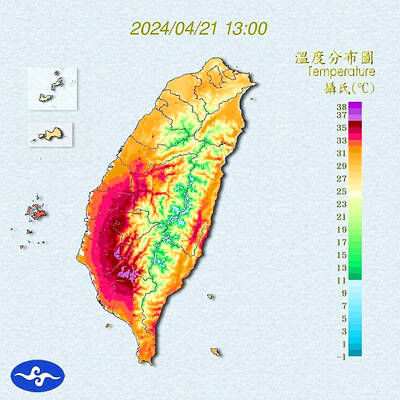
Heat advisories were in effect for nine administrative regions yesterday afternoon as warm southwesterly winds pushed temperatures above 38°C in parts of southern Taiwan, the Central Weather Administration (CWA) said. As of 3:30pm yesterday, Tainan’s Yujing District (玉井) had recorded the day’s highest temperature of 39.7°C, though the measurement will not be included in Taiwan’s official heat records since Yujing is an automatic rather than manually operated weather station, the CWA said. Highs recorded in other areas were 38.7°C in Kaohsiung’s Neimen District (內門), 38.2°C in Chiayi City and 38.1°C in Pingtung’s Sandimen Township (三地門), CWA data showed. The spell of scorching
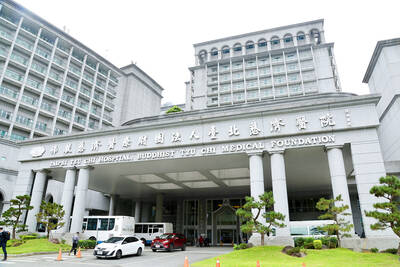
POLICE INVESTIGATING: A man said he quit his job as a nurse at Taipei Tzu Chi Hospital as he had been ‘disgusted’ by the behavior of his colleagues A man yesterday morning wrote online that he had witnessed nurses taking photographs and touching anesthetized patients inappropriately in Taipei Tzu Chi Hospital’s operating theaters. The man surnamed Huang (黃) wrote on the Professional Technology Temple bulletin board that during his six-month stint as a nurse at the hospital, he had seen nurses taking pictures of patients, including of their private parts, after they were anesthetized. Some nurses had also touched patients inappropriately and children were among those photographed, he said. Huang said this “disgusted” him “so much” that “he felt the need to reveal these unethical acts in the operating theater


 RSS
RSS