


Taipei Times (TT): In addition to the risk of being laid off, what other problems do workers around the world face in the current economic circumstances?
Lee Jeong-won: This economic downturn is much more severe [than past recessions]. Many people have compared it to the Great Depression of the 1930s. The economies of many countries, including South Korea and Taiwan, are contracting.
In such circumstances, workers are sure to be affected in ways such as being laid off or having their workload decreased or their wages cut.
It is especially difficult for part-time workers in terms of salary and benefits. Companies are undergoing organizational restructuring and industry upgrades, so workers are also facing the challenge of the ever-changing demands of their jobs.
TT: What are your thoughts on companies using unpaid leave to cut costs?
Lee: We see many companies using unpaid leave in South Korea, too. But for workers, a month’s salary is perhaps the minimum amount they need to survive the month. So this practice has a huge impact on workers. Many labor associations, including the MTU, are opposed to unpaid leave.
So what alternatives are there? If companies are unable to pay workers their full wages, the government should subsidize workers to make up for the income they have lost through unpaid leave.
In some countries, the government subsidizes companies with bailout plans, but I believe the money should go directly to the workers at the very bottom. It’s the workers who are struggling to survive.
The South Korean government gives corporate tax benefits to companies who promise not to lay off employees, but I think that this policy is unacceptable. Any form of labor policy should be carried out only under the condition that workers do not get pay cuts. If companies promise not to lay off workers, but force workers to accept lower wages, this is unacceptable.
Another example of an unacceptable policy is “youth internship programs.” New graduates who have trouble finding a job can find contractor or internship positions through the government program, but workers who find jobs through this program have to accept a 20 percent pay cut.
Government officials praise the policy, saying it will shorten the period of time needed for new graduates to land a job, while lowering the unemployment rate. But the KCTU opposes this policy.
TT: Why?
Lee: The unemployment rate is so high; many people are willing to do any kind of job, no matter what the conditions are like. But the KCTU believes that workers should not have to make compromises on their job security and benefits. Workers have the right to good work conditions and we should be the ones to safeguard these rights.
TT: Korea has lower unemployment than other Asian countries, including Taiwan and Japan. Do you think the numbers reflect the true situation?
Lee: The unemployment rate has been rising since last year. However, there is a gap between the government’s official statistics and the actual situation. The government only counts the unemployed, but labor associations take into account those who are underemployed.
If we include these workers, total unemployed would reach 3 million. The government says 820,000 are unemployed, but its statistics do not reflect reality.
TT: What do you mean by underemployment?
Lee: The government’s definition of unemployment is very strict. For example, even if a worker faces work reduction and ends up working only 10 hours a week, he or she is still considered “employed” by government standards.
But labor associations view them as underemployed because they are partly out of work.
TT: In many Asian countries, especially Taiwan, a majority of workers work overtime. What do you think of job sharing, a policy that some countries have adopted to include more of the working population?
Lee: Labor associations support this concept, because more people can find jobs, but job sharing should only be conducted under the condition that workers salaries are not lowered as a result of fewer work hours. For example, if a worker does half the amount of work, but receives only half the original salary, this is unacceptable. The worker needs the full amount to survive.
Labor associations in South Korea believe that responsibility for the economic downturn should not be shouldered by workers.
In the economic downturn of 1997 to 1998, the concept that workers should have a share of the responsibility for the economic downturn was very popular. At the time, government officials believed workers should accept lower wages in times of slower production.
As a result, workers suffered, not companies.
TT: Many labor associations in Taiwan are urging the government to decrease the quota for hiring foreign workers to protect the jobs of domestic workers. The government has also promised to cut the foreign workforce by 30,000 this year. What do you think of this policy?
Lee: The South Korean government has also said it would cut one-third of the foreign workforce. It said it would award bonuses to companies that replaced foreign workers with domestic workers. But in most cases, the kind of work done by foreign workers is unsanitary, dangerous or involves harsh conditions with very low wages, so domestic workers are unwilling to do such work.
The unemployment problem stems from mass layoffs by companies, yet the government is trying to shift the focus to migrant workers, who are taking the blame for a problem they haven’t caused.
The policy of replacing foreign labor with domestic workers proposes to subsidize employers who, by improving working conditions, can replace their foreign workforce with South Korean workers.
What employer would actually spend the money necessary to improve facilities to receive a mere 1,200,000 won [US$890]?
It is also doubtful whether domestic workers would actually take the jobs migrant workers now occupy. This is because of the low wages, long hours and poor conditions. The work most migrants do is already a separate labor market.
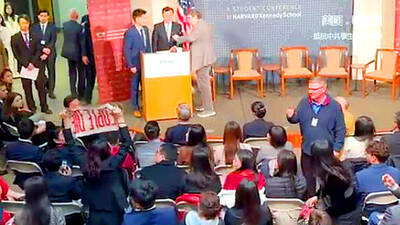
A group of Taiwanese-American and Tibetan-American students at Harvard University on Saturday disrupted Chinese Ambassador to the US Xie Feng’s (謝鋒) speech at the school, accusing him of being responsible for numerous human rights violations. Four students — two Taiwanese Americans and two from Tibet — held up banners inside a conference hall where Xie was delivering a speech at the opening ceremony of the Harvard Kennedy School China Conference 2024. In a video clip provided by the Coalition of Students Resisting the CCP (Chinese Communist Party), Taiwanese-American Cosette Wu (吳亭樺) and Tibetan-American Tsering Yangchen are seen holding banners that together read:

UNAWARE: Many people sit for long hours every day and eat unhealthy foods, putting them at greater risk of developing one of the ‘three highs,’ an expert said More than 30 percent of adults aged 40 or older who underwent a government-funded health exam were unaware they had at least one of the “three highs” — high blood pressure, high blood lipids or high blood sugar, the Health Promotion Administration (HPA) said yesterday. Among adults aged 40 or older who said they did not have any of the “three highs” before taking the health exam, more than 30 percent were found to have at least one of them, Adult Preventive Health Examination Service data from 2022 showed. People with long-term medical conditions such as hypertension or diabetes usually do not
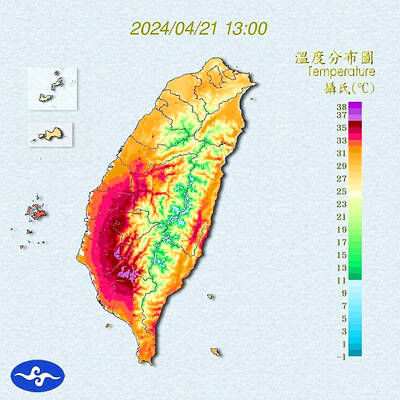
Heat advisories were in effect for nine administrative regions yesterday afternoon as warm southwesterly winds pushed temperatures above 38°C in parts of southern Taiwan, the Central Weather Administration (CWA) said. As of 3:30pm yesterday, Tainan’s Yujing District (玉井) had recorded the day’s highest temperature of 39.7°C, though the measurement will not be included in Taiwan’s official heat records since Yujing is an automatic rather than manually operated weather station, the CWA said. Highs recorded in other areas were 38.7°C in Kaohsiung’s Neimen District (內門), 38.2°C in Chiayi City and 38.1°C in Pingtung’s Sandimen Township (三地門), CWA data showed. The spell of scorching
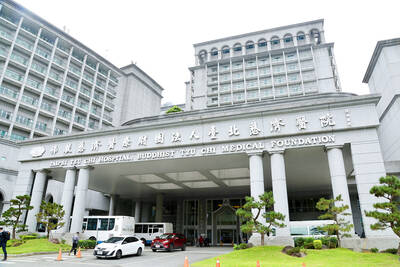
POLICE INVESTIGATING: A man said he quit his job as a nurse at Taipei Tzu Chi Hospital as he had been ‘disgusted’ by the behavior of his colleagues A man yesterday morning wrote online that he had witnessed nurses taking photographs and touching anesthetized patients inappropriately in Taipei Tzu Chi Hospital’s operating theaters. The man surnamed Huang (黃) wrote on the Professional Technology Temple bulletin board that during his six-month stint as a nurse at the hospital, he had seen nurses taking pictures of patients, including of their private parts, after they were anesthetized. Some nurses had also touched patients inappropriately and children were among those photographed, he said. Huang said this “disgusted” him “so much” that “he felt the need to reveal these unethical acts in the operating theater


 RSS
RSS