


Researchers at National Cheng Kung University (NCKU) have developed the world’s first pocket-sized breast cancer detector for household use, the university announced yesterday.
Experiments on human beings may start later this year to pave the way for mass production next year, said Tzeng Yonhua (曾永華), vice president for research and development at NCKU.
The device, which is about the same size as an iPhone, uses near-infrared technology and is intended for the early detection of breast cancer, Tzeng said.
The invention is based on previous research by US biophysicist Britton Chance, who is now a distinguished professor in NCKU’s Institute of Innovations and Advanced Studies, Tzeng said.
NCKU has focused its research on reducing the size of the device since taking over the research project two years ago.
Releasing near-infrared light on five to seven different wavelengths to detect potential cancer cells, the device performs non-invasive screening without the need for users to remove clothing or underwear, Tzeng said.
“The device is especially helpful to women who are too embarrassed to undergo screening in hospitals,” he said.
Equipped with a liquid-crystal-display panel and a personal data storage disc, the device enables users to store the result of the screening and show it to their doctor for further diagnosis if abnormalities are detected, Tzeng said.
He said the technology can also be used to measure brain oxygen levels and blood glucose levels as well as detect pancreatic cancer.
Taiwanese manufacturers have expressed an interest in helping NCKU convert the prototype into viable samples, which will be sent to hospitals and medical schools in other countries for testing, Tzeng said.
He said the device is expected to be sold at around NT$10,000 per unit, making it affordable for most households.
THE HAWAII FACTOR: While a 1965 opinion said an attack on Hawaii would not trigger Article 5, the text of the treaty suggests the state is covered, the report says NATO could be drawn into a conflict in the Taiwan Strait if Chinese forces attacked the US mainland or Hawaii, a NATO Defense College report published on Monday says. The report, written by James Lee, an assistant research fellow at Academia Sinica’s Institute of European and American Studies, states that under certain conditions a Taiwan contingency could trigger Article 5 of NATO, under which an attack against any member of the alliance is considered an attack against all members, necessitating a response. Article 6 of the North Atlantic Treaty specifies that an armed attack in the territory of any member in Europe,
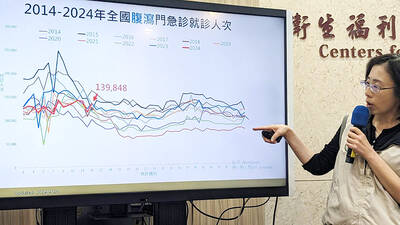
FLU SEASON: Twenty-six severe cases were reported from Tuesday last week to Monday, including a seven-year-old girl diagnosed with influenza-associated encephalopathy Nearly 140,000 people sought medical assistance for diarrhea last week, the Centers for Disease Control (CDC) said on Tuesday. From April 7 to Saturday last week, 139,848 people sought medical help for diarrhea-related illness, a 15.7 percent increase from last week’s 120,868 reports, CDC Epidemic Intelligence Center Deputy Director Lee Chia-lin (李佳琳) said. The number of people who reported diarrhea-related illness last week was the fourth highest in the same time period over the past decade, Lee said. Over the past four weeks, 203 mass illness cases had been reported, nearly four times higher than the 54 cases documented in the same period
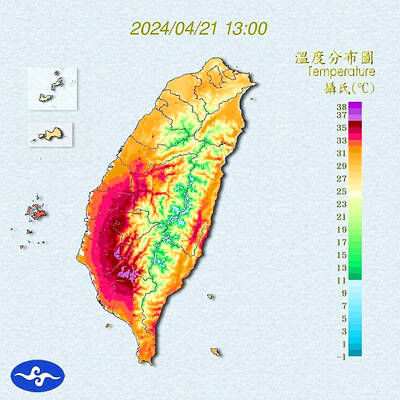
Heat advisories were in effect for nine administrative regions yesterday afternoon as warm southwesterly winds pushed temperatures above 38°C in parts of southern Taiwan, the Central Weather Administration (CWA) said. As of 3:30pm yesterday, Tainan’s Yujing District (玉井) had recorded the day’s highest temperature of 39.7°C, though the measurement will not be included in Taiwan’s official heat records since Yujing is an automatic rather than manually operated weather station, the CWA said. Highs recorded in other areas were 38.7°C in Kaohsiung’s Neimen District (內門), 38.2°C in Chiayi City and 38.1°C in Pingtung’s Sandimen Township (三地門), CWA data showed. The spell of scorching
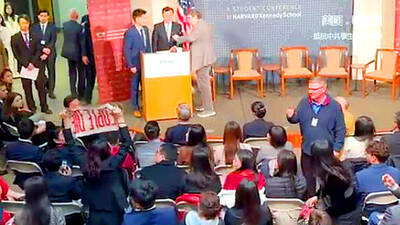
A group of Taiwanese-American and Tibetan-American students at Harvard University on Saturday disrupted Chinese Ambassador to the US Xie Feng’s (謝鋒) speech at the school, accusing him of being responsible for numerous human rights violations. Four students — two Taiwanese Americans and two from Tibet — held up banners inside a conference hall where Xie was delivering a speech at the opening ceremony of the Harvard Kennedy School China Conference 2024. In a video clip provided by the Coalition of Students Resisting the CCP (Chinese Communist Party), Taiwanese-American Cosette Wu (吳亭樺) and Tibetan-American Tsering Yangchen are seen holding banners that together read:


 RSS
RSS