


The world political order will see dramatic changes within 15 years if China’s economic and military power surpasses that of the US, a diplomacy professor told a cross-strait forum yesterday.
Lai Yueh-tchienn (賴岳謙) of National Chengchi University said time will be on Beijing’s side if its economic growth continues and there is no war in the Taiwan Strait.
Under such circumstances, Lai estimated China’s economic clout would catch up with the US in 15 years.
While the US pours substantial military resources into guarding the Pacific Ocean and the Atlantic, China only has the Pacific to worry about and can focus on building a strong navy.
If China’s military, political and economic sway continues to grow, the political order will see drastic changes and the US and EU must face the fact that Beijing wants to play a more decisive role in the international community, he said.
Lai made the remarks at a forum organized by the Taiwan New Century Foundation and Nanhua University’s Center for Peace and Strategic Studies in Taipei.
The forum discussed the impact of Association for Relations Across the Taiwan Strait Chairman Chen Yunlin’s (陳雲林) visit and the concept of “peaceful development” in the Taiwan Strait.
Lai said China’s strategy of “peaceful development” was to create a peaceful and stable environment for itself to aid its growth.
China hopes this strategy will deter outside forces while it develops military power sufficient to maintain its economic and political order in the case of war.
Lai said that while China hoped to reach this goal by 2030, it could accomplish it as early as 2020.
China’s recent acknowledgment that it was building aircraft carriers and developing guided missiles with a range of 400km were two clear manifestations of its military ambition, he said.
George Liu (劉志聰), a researcher at the Center for Peace and Strategic Studies, said there would be no “peaceful development” in the Strait unless Taiwan surrendered.
Liu said China would continue its military buildup if Taiwan did not accept unification.
Shih Cheng-feng (施正鋒), a political commentator, said depending on China’s economy was risky.
Investing in China, he said, was like “a blood transfusion with the risk of being infected with HIV.”
Shih criticized the meeting between Chen and President Ma Ying-jeou (馬英九).
He also warned against signing a peace agreement with Beijing, citing Tibet’s experiences with state violence despite the peace treaty signed in the 1950s after its occupation.
Chang Wu-ueh (張五岳), director of the Graduate Institute of China Studies at Tamkang University, urged representatives of the Chinese Nationalist Party (KMT) and Democratic Progressive Party to negotiate.
Chang also called on the public to welcome any cross-strait negotiations or dialogue that could help increase the nation’s international space and economic development as well as deepen its democracy and respect for human rights.
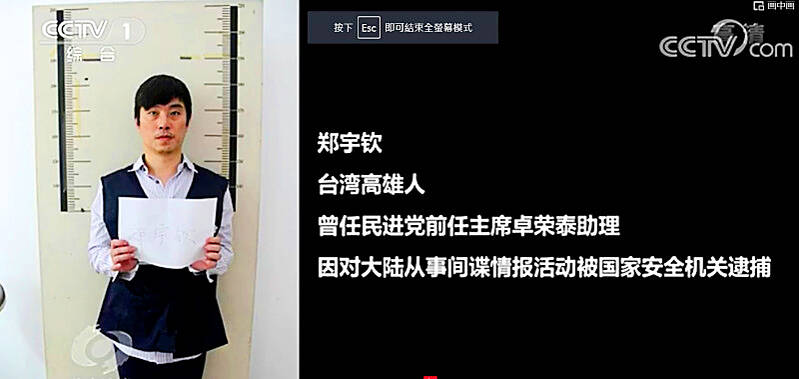
Former Czech Republic-based Taiwanese researcher Cheng Yu-chin (鄭宇欽) has been sentenced to seven years in prison on espionage-related charges, China’s Ministry of State Security announced yesterday. China said Cheng was a spy for Taiwan who “masqueraded as a professor” and that he was previously an assistant to former Cabinet secretary-general Cho Jung-tai (卓榮泰). President-elect William Lai (賴清德) on Wednesday last week announced Cho would be his premier when Lai is inaugurated next month. Today is China’s “National Security Education Day.” The Chinese ministry yesterday released a video online showing arrests over the past 10 years of people alleged to be
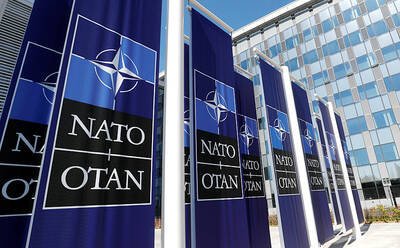
THE HAWAII FACTOR: While a 1965 opinion said an attack on Hawaii would not trigger Article 5, the text of the treaty suggests the state is covered, the report says NATO could be drawn into a conflict in the Taiwan Strait if Chinese forces attacked the US mainland or Hawaii, a NATO Defense College report published on Monday says. The report, written by James Lee, an assistant research fellow at Academia Sinica’s Institute of European and American Studies, states that under certain conditions a Taiwan contingency could trigger Article 5 of NATO, under which an attack against any member of the alliance is considered an attack against all members, necessitating a response. Article 6 of the North Atlantic Treaty specifies that an armed attack in the territory of any member in Europe,
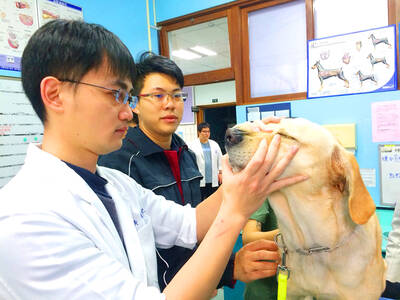
LIKE FAMILY: People now treat dogs and cats as family members. They receive the same medical treatments and tests as humans do, a veterinary association official said The number of pet dogs and cats in Taiwan has officially outnumbered the number of human newborns last year, data from the Ministry of Agriculture’s pet registration information system showed. As of last year, Taiwan had 94,544 registered pet dogs and 137,652 pet cats, the data showed. By contrast, 135,571 babies were born last year. Demand for medical care for pet animals has also risen. As of Feb. 29, there were 5,773 veterinarians in Taiwan, 3,993 of whom were for pet animals, statistics from the Animal and Plant Health Inspection Agency showed. In 2022, the nation had 3,077 pediatricians. As of last
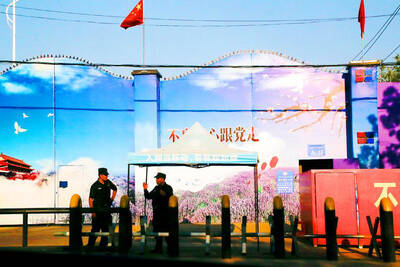
XINJIANG: Officials are conducting a report into amending an existing law or to enact a special law to prohibit goods using forced labor Taiwan is mulling an amendment prohibiting the importation of goods using forced labor, similar to the Uyghur Forced Labor Prevention Act (UFLPA) passed by the US Congress in 2021 that imposed limits on goods produced using forced labor in China’s Xinjiang region. A government official who wished to remain anonymous said yesterday that as the US customs law explicitly prohibits the importation of goods made using forced labor, in 2021 it passed the specialized UFLPA to limit the importation of cotton and other goods from China’s Xinjiang Uyghur region. Taiwan does not have the legal basis to prohibit the importation of goods


 RSS
RSS