


Every Saturday and Sunday morning, Canadian pan flute artist Bernier Sylvain drives to Tamsui MRT Station and waits for the draw with other street artists to secure a performance spot at the rear of the station.
If he is lucky enough to get a spot, Sylvain starts setting up speakers, tuning devices, a small table displaying his printed CDs and a donation box, and begins his four to five-hour pan flute performance in the afternoon.
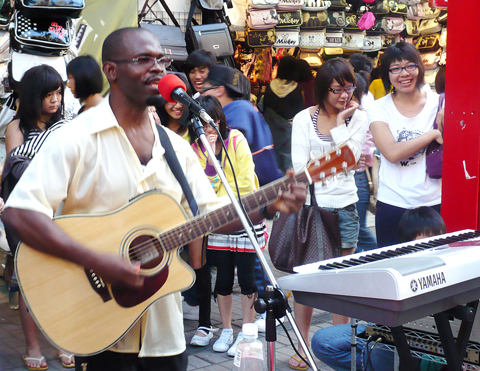
PHOTO: MO YAN-CHIH, TAIPEI TIMES
Sylvain’s soft and unique pan flute music always attracts the crowd’s attention.
Some commuters have even become fans and come to listen to his music regularly.
“People enjoy my music … And I like performing here [in Tamsui, 淡水] because everyone is happy to hear me play,” he said.
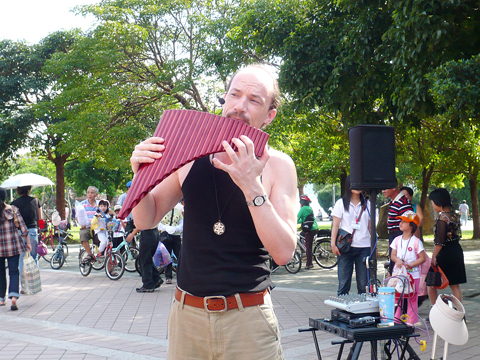
PHOTO: MO YAN-CHIH, TAIPEI TIMES
Sylvain, whose career as a full-time street artist began at a subway station in Montreal when he was 15 years old, traveled to Taiwan four years ago with his Taiwanese wife and became one of five certified foreign street artists in Taipei City since the Cultural Affairs Department began pushing for street arts in 2003.
The department implemented the Taipei City Street Artists Performance Permit in 2005, and a total of 677 street artists received certificates, said Chen Kuan-fu (陳冠甫), chief secretary of the department.
The permit system was inspired by the cities of Cambridge, San Francisco and Tokyo, where governments have set up special districts for street artists.
The Taipei City Government followed suit, allowing street artists to perform at more than 100 public spaces across Taipei, he said.
Sylvain chose Tamsui as his regular performing spot because it was less crowded than other public spaces.
Forty-year-old singer and songwriter Kent John from the US, on the other hand, performs mostly in Ximending (西門町).
Coming to Taiwan in 1997 to do missionary work, John started singing on the streets in Taipei about one and a half years ago, and was surprised to find that more and more people have learned to appreciate street art.
“People like good music and good performances. I have always been a musician, I give my best performances, and the audience expects us street artists to be professional,” he told the Taipei Times after performing in a corner of Ximending on a Sunday afternoon.
John played guitar and sang songs ranging from country music to rock ’n’ roll.
His lively music and constant interactions with the crowd made his performances quite popular.
However, John’s wife, Jasmine Chou, who accompanies him to performance sites, said street art was too immature in Taiwan to make a living out of it.
“Sometimes we only get NT$200 to NT$300 after performing all afternoon … I guess people are too shy or not used to giving street artists cash rewards,” she said.
Another street artist, Patricia Santoro, an Uruguayan who came to Taiwan more than 20 years ago, can only do street art as a part time job, too, despite over 20 years of experience as a clay artist.
“Street artists can be excellent and professional artists, but not every artist is lucky enough to be able to do full-time street art,” she said.
Santoro, who acquired a street artist’s permit last year, offers clay craftwork classes at her workshop, and showcases her artwork on Xiangti Boulevard (香提大道) at Xinyi New Life Square during weekends.
Her ceramic art, mainly light colored elves, fairies and animals, are especially popular among female customers, who stop at her table to watch her make the dolls.
Santoro says she chooses light or bright colors for her works because she wants her art to make people feel happy.
She appreciates the city government’s efforts to promote street art in Taipei, but says it should provide more public space for street artists.
A permanent location to hold a regular “fair” every weekend where people can bring their kids and enjoy great art and performances would be better, she said.
Sylvain, John and another street artist, Daniel Greenberg, echoed Santoro’s comments and suggested that the city government open up more venues for street artists and place less restrictions on where they can perform.
The department should take advantage of the permit system to separate professional street artists from those who perform mostly for charity, so that street art can be appreciated as a genuine art form, Sylvain said.
Greenberg, who returned to the US after finishing his studies in Taiwan in September, agreed that the city government should put more effort into encouraging street artists, especially foreign ones.
“Overall, being a street performer was an immensely rewarding experience … I really loved playing on the streets of Taipei and was always amazed at the generosity of Taiwanese people,” he told the Taipei Times in an e-mail.
Lee Shun-lin (李順霖), a staff member at the city’s culture department, said it was more difficult for foreigners to obtain permits because they were required to first receive work certificates in their field of art from the Council of Labor Affairs.
The permit, however, is effective indefinitely once it is issued and the city government is opening up more public spaces, including parks, plazas and sidewalks, for street performance, he said.
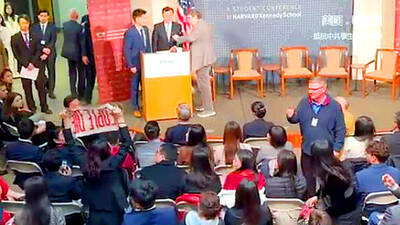
A group of Taiwanese-American and Tibetan-American students at Harvard University on Saturday disrupted Chinese Ambassador to the US Xie Feng’s (謝鋒) speech at the school, accusing him of being responsible for numerous human rights violations. Four students — two Taiwanese Americans and two from Tibet — held up banners inside a conference hall where Xie was delivering a speech at the opening ceremony of the Harvard Kennedy School China Conference 2024. In a video clip provided by the Coalition of Students Resisting the CCP (Chinese Communist Party), Taiwanese-American Cosette Wu (吳亭樺) and Tibetan-American Tsering Yangchen are seen holding banners that together read:

UNAWARE: Many people sit for long hours every day and eat unhealthy foods, putting them at greater risk of developing one of the ‘three highs,’ an expert said More than 30 percent of adults aged 40 or older who underwent a government-funded health exam were unaware they had at least one of the “three highs” — high blood pressure, high blood lipids or high blood sugar, the Health Promotion Administration (HPA) said yesterday. Among adults aged 40 or older who said they did not have any of the “three highs” before taking the health exam, more than 30 percent were found to have at least one of them, Adult Preventive Health Examination Service data from 2022 showed. People with long-term medical conditions such as hypertension or diabetes usually do not
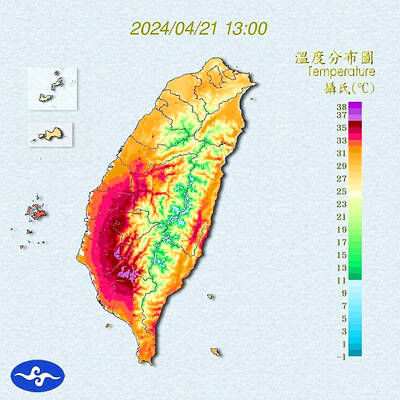
Heat advisories were in effect for nine administrative regions yesterday afternoon as warm southwesterly winds pushed temperatures above 38°C in parts of southern Taiwan, the Central Weather Administration (CWA) said. As of 3:30pm yesterday, Tainan’s Yujing District (玉井) had recorded the day’s highest temperature of 39.7°C, though the measurement will not be included in Taiwan’s official heat records since Yujing is an automatic rather than manually operated weather station, the CWA said. Highs recorded in other areas were 38.7°C in Kaohsiung’s Neimen District (內門), 38.2°C in Chiayi City and 38.1°C in Pingtung’s Sandimen Township (三地門), CWA data showed. The spell of scorching
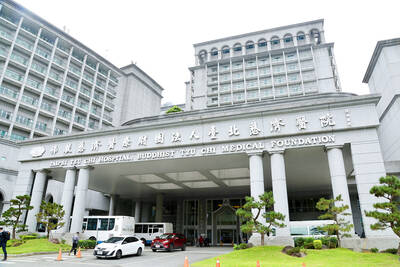
POLICE INVESTIGATING: A man said he quit his job as a nurse at Taipei Tzu Chi Hospital as he had been ‘disgusted’ by the behavior of his colleagues A man yesterday morning wrote online that he had witnessed nurses taking photographs and touching anesthetized patients inappropriately in Taipei Tzu Chi Hospital’s operating theaters. The man surnamed Huang (黃) wrote on the Professional Technology Temple bulletin board that during his six-month stint as a nurse at the hospital, he had seen nurses taking pictures of patients, including of their private parts, after they were anesthetized. Some nurses had also touched patients inappropriately and children were among those photographed, he said. Huang said this “disgusted” him “so much” that “he felt the need to reveal these unethical acts in the operating theater


 RSS
RSS