


The Atomic Energy Council (AEC) yesterday touted its success in developing a diagnostic radiopharmaceutical treatment that is not only low-cost, but also offers much better diagnostic results for the structurally dense breast tissues of Asian women.
“Cancer is the top cause of death in the country, while heart-related diseases are second,” said Liao Mei-hsiu (廖美秀), an assistant researcher at the AEC's Institute of Nuclear Energy Research.
Two decades ago, the annual number of deaths caused by cervical cancer were twice the number of breast cancer, but today the situation has been completely reversed, Liao said.
Besides the fact that people are now eating a fattier diet — with fried chicken and frosted cakes appearing regularly on menus —one of the reasons for the reversal is that “Asian women are usually more reluctant to go for ob-gyn checkups,” Liao said.
“While cervical cancer can now be conveniently diagnosed at community clinics with pap smears, advanced diagnostic equipment for breast cancer [such as magnetic resonance imaging (MRI) machines] can only be found in larger hospitals,” Liao said.
The reluctance of Taiwanese women to undergo such important checkups could result in their missing the prime time for treatment, as stage zero breast cancer has a recovery rate of more than 98 percent and about 35 percent of stage two patients die from the disease, Liao said.
Another factor that contributes to the deaths may be that while mammography works relatively well for Western women, it has only a 15 percent to 30 percent accuracy rate for Asian women, as the latter have breasts that are more structurally dense and contain less fat, so the technique cannot usually detect minuscule early stage tumors, Liao said.
Fortunately, a new technique called molecular breast imaging (MBI) has recently been developed in the US, Liao said.
“A patient is injected with a radiotracer that has a high affinity for cancer cells, and then placed under a gamma ray camera that can pick up any highlighted spots,” Liao said.
However, while MBI offers an accuracy rate for early cancer detection comparable to the costly MRI examinations, a shot of the imported Cardiolite brand radiotracercould still set a patient back a hefty NT$12,000, she said.
After a six-year research program to find a new production method for a drug alternative, the institute introduced its MBI kit on the market in February, Liao said, adding that in the past few months, the NT$6,000 kit had proven as effective as its imported counterpart.
The technetium-99m drug can also be used to diagnose heart diseases with equally satisfactory results, she said.
With the preliminary success, the kit, which is only available in a number of hospitals at present — including the Taipei and Taichung Veterans' General hospitals — will be available at more hospitals soon, she said.
In addition, the AEC is now working on a mobile dedicated breast imaging system, which is a smaller version of an MBI machine, so that local clinics can easily afford them and therefore offer breast cancer checkups to their clients, Liao said.
“So far, we are in our second year of development and have a promising prototype. If we are successful, Taiwanese women will have a breast cancer diagnostic package that is both convenient and inexpensive,” she said.
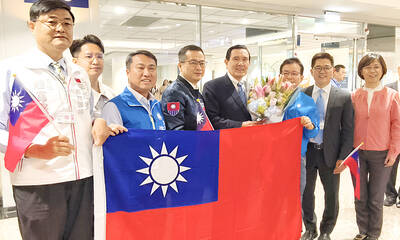
Former president Ma Ying-jeou’s (馬英九) mention of Taiwan’s official name during a meeting with Chinese President Xi Jinping (習近平) on Wednesday was likely a deliberate political play, academics said. “As I see it, it was intentional,” National Chengchi University Graduate Institute of East Asian Studies professor Wang Hsin-hsien (王信賢) said of Ma’s initial use of the “Republic of China” (ROC) to refer to the wider concept of “the Chinese nation.” Ma quickly corrected himself, and his office later described his use of the two similar-sounding yet politically distinct terms as “purely a gaffe.” Given Ma was reading from a script, the supposed slipup
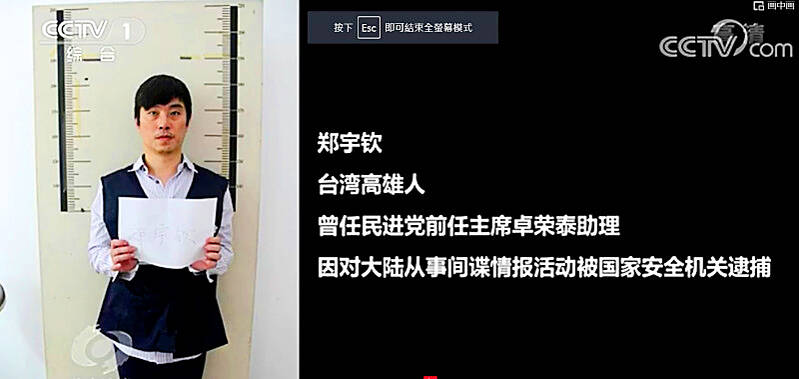
Former Czech Republic-based Taiwanese researcher Cheng Yu-chin (鄭宇欽) has been sentenced to seven years in prison on espionage-related charges, China’s Ministry of State Security announced yesterday. China said Cheng was a spy for Taiwan who “masqueraded as a professor” and that he was previously an assistant to former Cabinet secretary-general Cho Jung-tai (卓榮泰). President-elect William Lai (賴清德) on Wednesday last week announced Cho would be his premier when Lai is inaugurated next month. Today is China’s “National Security Education Day.” The Chinese ministry yesterday released a video online showing arrests over the past 10 years of people alleged to be
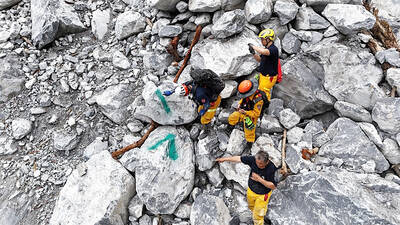
The bodies of two individuals were recovered and three additional bodies were discovered on the Shakadang Trail (砂卡礑) in Taroko National Park, eight days after the devastating earthquake in Hualien County, search-and-rescue personnel said. The rescuers reported that they retrieved the bodies of a man and a girl, suspected to be the father and daughter from the Yu (游) family, 500m from the entrance of the trail on Wednesday. The rescue team added that despite the discovery of the two bodies on Friday last week, they had been unable to retrieve them until Wednesday due to the heavy equipment needed to lift
THE HAWAII FACTOR: While a 1965 opinion said an attack on Hawaii would not trigger Article 5, the text of the treaty suggests the state is covered, the report says NATO could be drawn into a conflict in the Taiwan Strait if Chinese forces attacked the US mainland or Hawaii, a NATO Defense College report published on Monday says. The report, written by James Lee, an assistant research fellow at Academia Sinica’s Institute of European and American Studies, states that under certain conditions a Taiwan contingency could trigger Article 5 of NATO, under which an attack against any member of the alliance is considered an attack against all members, necessitating a response. Article 6 of the North Atlantic Treaty specifies that an armed attack in the territory of any member in Europe,


 RSS
RSS