


In a bid to better protect the nation’s NT$8 billion (US$240 million) annual poultry market, the Council of Agriculture yesterday touted its success in developing a vaccine to combat Riemerella anatipestifer (RA), a common and contagious disease that affects young waterfowl.
“Taiwanese consume about 38 million ducks and geese a year, however when RA hits young birds on a farm it kills 75 percent of them, causing a drastic financial blow to the livestock farmer,” Animal Health Research Institute Director Chao Parn-hwa (趙磐華) said.
Prior to the institute’s research, poultry farmers did not usually use vaccines to protect their assets from this disease, Chao said, adding that the increasing prevalence of the illness and the financial strain it can cause had prompted the institute to develop the vaccine.
When affected, a young bird develops symptoms such as ocular and nasal discharges, tremors of the head and neck, sepsis and a cheese-like excretion around the heart, Chao said.
Even if a duckling or young goose survives, its compromised immune system causes retarded growth, “which means that the bird is worthless on the market,” Chao said.
Three years ago, the institute began to isolate 21 serological types of the virus in the hope of developing a vaccine to combat the disease.
“With the help of several veterinary schools, we identified six of the most common serological types [types 1, 2, 6, 8, 10 and 11] and started work on making vaccines for them … Now, we have made vaccines for three of the most common viral types — types 1, 2 and 6 — and have tested it on a total of 5,000 waterfowl around the country,” Chao said.
Aiming for a 50 percent protection rate against mortality, the institute said that it had developed proven vaccines that work.
“The vaccines worked best in Peking Ducks [used mostly for roasting], but it also works well on Muscovy Ducks [eaten during winter with ginger and rice wine] and White Roman Geese,” Chao said.
Following their success, Chao said his team would apply for registrations for the new vaccines so that they could hopefully be on the market next year.
The institute is planning to work on vaccines for serological types 6, 8 and 11, as well as conducting technical transfers of the vaccines to privately owned pharmaceutical companies, he said.

Former president Ma Ying-jeou’s (馬英九) mention of Taiwan’s official name during a meeting with Chinese President Xi Jinping (習近平) on Wednesday was likely a deliberate political play, academics said. “As I see it, it was intentional,” National Chengchi University Graduate Institute of East Asian Studies professor Wang Hsin-hsien (王信賢) said of Ma’s initial use of the “Republic of China” (ROC) to refer to the wider concept of “the Chinese nation.” Ma quickly corrected himself, and his office later described his use of the two similar-sounding yet politically distinct terms as “purely a gaffe.” Given Ma was reading from a script, the supposed slipup
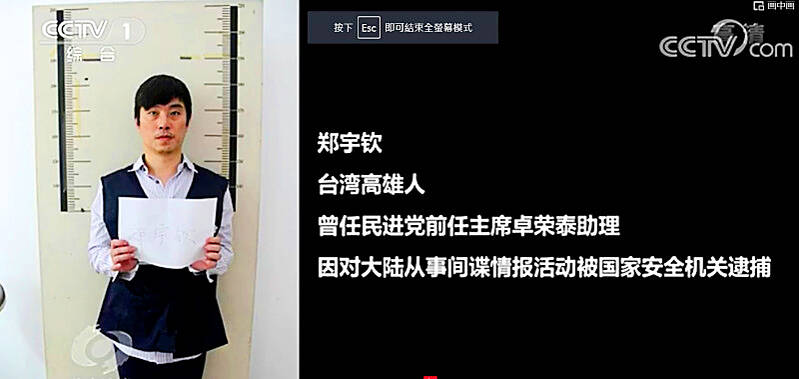
Former Czech Republic-based Taiwanese researcher Cheng Yu-chin (鄭宇欽) has been sentenced to seven years in prison on espionage-related charges, China’s Ministry of State Security announced yesterday. China said Cheng was a spy for Taiwan who “masqueraded as a professor” and that he was previously an assistant to former Cabinet secretary-general Cho Jung-tai (卓榮泰). President-elect William Lai (賴清德) on Wednesday last week announced Cho would be his premier when Lai is inaugurated next month. Today is China’s “National Security Education Day.” The Chinese ministry yesterday released a video online showing arrests over the past 10 years of people alleged to be
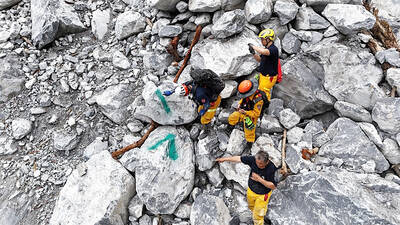
The bodies of two individuals were recovered and three additional bodies were discovered on the Shakadang Trail (砂卡礑) in Taroko National Park, eight days after the devastating earthquake in Hualien County, search-and-rescue personnel said. The rescuers reported that they retrieved the bodies of a man and a girl, suspected to be the father and daughter from the Yu (游) family, 500m from the entrance of the trail on Wednesday. The rescue team added that despite the discovery of the two bodies on Friday last week, they had been unable to retrieve them until Wednesday due to the heavy equipment needed to lift
THE HAWAII FACTOR: While a 1965 opinion said an attack on Hawaii would not trigger Article 5, the text of the treaty suggests the state is covered, the report says NATO could be drawn into a conflict in the Taiwan Strait if Chinese forces attacked the US mainland or Hawaii, a NATO Defense College report published on Monday says. The report, written by James Lee, an assistant research fellow at Academia Sinica’s Institute of European and American Studies, states that under certain conditions a Taiwan contingency could trigger Article 5 of NATO, under which an attack against any member of the alliance is considered an attack against all members, necessitating a response. Article 6 of the North Atlantic Treaty specifies that an armed attack in the territory of any member in Europe,


 RSS
RSS