


Coral ecosystems could disappear completely by the end of the century if measures are not taken to reduce carbon emissions, Allen Chen (陳昭倫), an associate researcher at Academia Sinica*s Research Center for Biodiversity, said recently.
Chen made the comments based on a research project conducted by his team and volunteers since the beginning of this year entitled ※2008 International Coral Year.§
If humans do not cut their carbon emissions, carbon concentrations in the atmosphere could reach 500 parts per million (ppm) between 2050 and 2100, raising the world*s temperature by 2足C or more and would cause coral to stop building reefs, Chen said. The disappearance of the coral ecosystem would produce a ripple effect and be detrimental to human survival, he said.
Twenty years ago, Taiwan*s sea floors were still 80 percent covered with coral, but now rapid increases in human activity has severely tipped the balance of coral reef ecosystems.
Except for the eastern seas, where some 70 percent of the sea floor is still coral-rich, sea regions near areas of frequent human activity, such as Green Island and Penghu, are now only 45 percent covered in coral, Chen said, adding that the observation rate of some types of fish is now close to zero.
Chen said the fish are not only the stars of coral reef systems, but they also stabilize the food chain within them. When they reduce in number, it is an indicator that the reef is not functioning well, Chen said.
※If a strong typhoon comes at this time, the entire ecosystem could be damaged and dissolve,§ he said.
Citing a paper published in the journal Nature last year, 25 percent of the current carbon dioxide in the atmosphere (380ppm) dissolves in water, producing carbonic acid, Chen said.
The acidity in the ocean could result in the retardation of calcium carbonate formation, because it would lower the concentration of carbonate in the water, which in turn would slow the calcium carbonate from being accumulated and built into coral reefs, he said.
In addition, ocean habitats were increasingly damaged and seas were filled with plastic bags, bottles, broken nets and straws that would not decompose for centuries, Chen said.
The trash was causing the oceans to suffer from ※indigestion§ and killing coral systems, he said.
To save the ocean, people need to change their habits, the center*s researcher and deputy chief Chen Ming-hsiu (鄭明修) said.
For example, people should stop using disposable chopsticks, cut back on drinking bottled water, drive less, recycle and refuse to eat seafood that cannot be bred in fish farms, such as lobster, Chen said.

Former president Ma Ying-jeou’s (馬英九) mention of Taiwan’s official name during a meeting with Chinese President Xi Jinping (習近平) on Wednesday was likely a deliberate political play, academics said. “As I see it, it was intentional,” National Chengchi University Graduate Institute of East Asian Studies professor Wang Hsin-hsien (王信賢) said of Ma’s initial use of the “Republic of China” (ROC) to refer to the wider concept of “the Chinese nation.” Ma quickly corrected himself, and his office later described his use of the two similar-sounding yet politically distinct terms as “purely a gaffe.” Given Ma was reading from a script, the supposed slipup
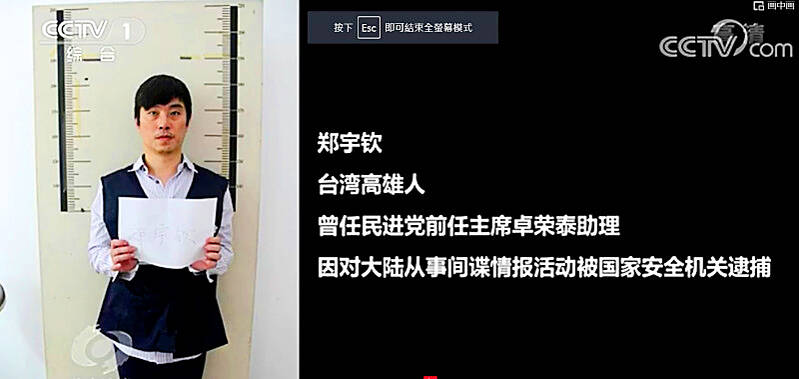
Former Czech Republic-based Taiwanese researcher Cheng Yu-chin (鄭宇欽) has been sentenced to seven years in prison on espionage-related charges, China’s Ministry of State Security announced yesterday. China said Cheng was a spy for Taiwan who “masqueraded as a professor” and that he was previously an assistant to former Cabinet secretary-general Cho Jung-tai (卓榮泰). President-elect William Lai (賴清德) on Wednesday last week announced Cho would be his premier when Lai is inaugurated next month. Today is China’s “National Security Education Day.” The Chinese ministry yesterday released a video online showing arrests over the past 10 years of people alleged to be
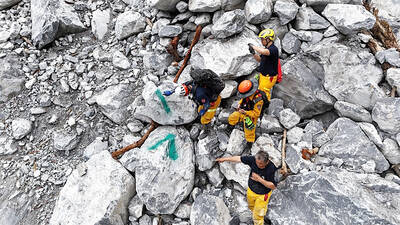
The bodies of two individuals were recovered and three additional bodies were discovered on the Shakadang Trail (砂卡礑) in Taroko National Park, eight days after the devastating earthquake in Hualien County, search-and-rescue personnel said. The rescuers reported that they retrieved the bodies of a man and a girl, suspected to be the father and daughter from the Yu (游) family, 500m from the entrance of the trail on Wednesday. The rescue team added that despite the discovery of the two bodies on Friday last week, they had been unable to retrieve them until Wednesday due to the heavy equipment needed to lift

MIX-UP: Kaohsiung Municipal Min-Sheng Hospital director Yen Chia-chi was suspended from his duties after surgeons operated on the wrong patient last week The Kaohsiung Department of Health yesterday fined Kaohsiung Municipal Min-Sheng Hospital NT$500,0000 for misidentifying two patients and consequently causing one of them to undergo the wrong surgery last week. The hospital’s director Yen Chia-chi (顏家祺) was suspended from his duties. The surgeon who was scheduled to operate on the patient was given a major demerit and is subject to subsequent disciplinary actions. Demerits were given to the anesthesiologist, the nurse in the operation room, the nurse in the ward and the worker who helped transfer the patient from the ward to the operation room for having failed to verify the patient’s identity. Meanwhile, the


 RSS
RSS