


Given the recent string of losses caused by natural disasters, the government should establish a “homeland monitoring and inspection center” to attain more accurate estimations on the loading tolerance of impact-sensitive areas and prevent future damage, National Taiwan University professors said yesterday.
The forum came in the wake of the recent damages and losses from typhoons Sinlaku and Jangmi.
The Lushan hot spring area in Nantou County’s Jenai Township (仁愛) was devastated last month by Sinlaku, which brought torrential rains and mudslides that completely destroyed several hotels in the area.
Taipei City’s Maokong Gondola was shut down indefinitely on Wednesday amid questions of whether its foundation may have been weakened by Jangmi last weekend.
“Over the past one to two decades, [all we say] is ‘this is a hard-learned lesson,’” professor David Chang (張長義) told the forum.
“However, little had been done to systematically compile and analyze the information obtained,” he said.
As climate change is impacting the world on a global scale, many advanced countries are relying on homeland monitoring and inspection systems to assess land loading tolerance as well as reduce natural disaster losses to a minimum, panelists at the forum said.
Chang said Taiwan urgently needed such a system, as land on the island is delicate and vulnerable to a variety of disasters.
The recent losses and damage, however, were caused by both natural and human factors and therefore had been partially preventable, he said.
“The 921 Earthquake [in 1999] loosened the surface soil of the island … [Since then], typhoons are producing direr impacts … When you expand roads on high mountains from one lane to two lanes, or build more buildings on slopes than the landscape can support, the land becomes even more sensitive,” he said.
As the environment changes day by day and becomes drastically different after a heavy rain, continuous monitoring can provide the government with concrete information on how to safely utilize land — from gauging construction limits to forming emergency evacuation plans, geography professor Lin Jiun-chuan (林俊全) said.
“The hotels around the Lushan Hot Spring were built where they shouldn’t be — at the bottom of a valley where water is supposed to flow,” Lin said.
Another example was the Central Cross-Island Highway, which was damaged by the 921 Earthquake, and which the participants at yesterday’s forum unanimously said should stay broken.
“What we need to ask is, do we really need a road this [nice and big] atop mountains?” Lin said.
Asked whether the building-dense Cingjing Farm (清境農場) in the mountain of Nantou County would be “the next Lushan Hot Spring,” both Lin and Chang said the possibility existed.
“Land there should be used for forests, but is instead being used to build hotels,” Chang said.
“According to the Homeland Restoration Act (國土復育條例), all of those hotels built by non-Aborigines should be demolished,” Chang said.

Former president Ma Ying-jeou’s (馬英九) mention of Taiwan’s official name during a meeting with Chinese President Xi Jinping (習近平) on Wednesday was likely a deliberate political play, academics said. “As I see it, it was intentional,” National Chengchi University Graduate Institute of East Asian Studies professor Wang Hsin-hsien (王信賢) said of Ma’s initial use of the “Republic of China” (ROC) to refer to the wider concept of “the Chinese nation.” Ma quickly corrected himself, and his office later described his use of the two similar-sounding yet politically distinct terms as “purely a gaffe.” Given Ma was reading from a script, the supposed slipup
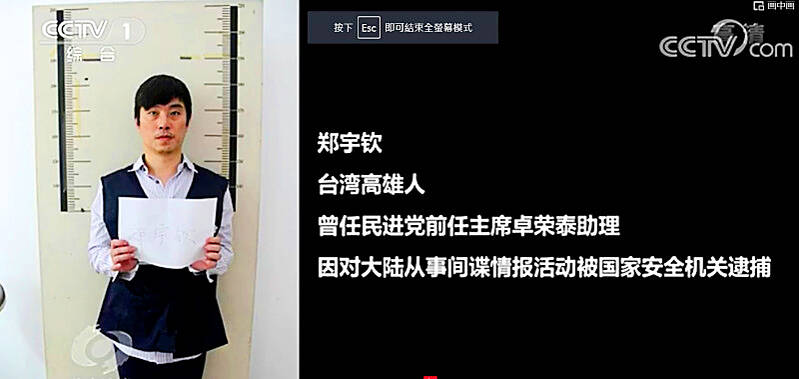
Former Czech Republic-based Taiwanese researcher Cheng Yu-chin (鄭宇欽) has been sentenced to seven years in prison on espionage-related charges, China’s Ministry of State Security announced yesterday. China said Cheng was a spy for Taiwan who “masqueraded as a professor” and that he was previously an assistant to former Cabinet secretary-general Cho Jung-tai (卓榮泰). President-elect William Lai (賴清德) on Wednesday last week announced Cho would be his premier when Lai is inaugurated next month. Today is China’s “National Security Education Day.” The Chinese ministry yesterday released a video online showing arrests over the past 10 years of people alleged to be

THE HAWAII FACTOR: While a 1965 opinion said an attack on Hawaii would not trigger Article 5, the text of the treaty suggests the state is covered, the report says NATO could be drawn into a conflict in the Taiwan Strait if Chinese forces attacked the US mainland or Hawaii, a NATO Defense College report published on Monday says. The report, written by James Lee, an assistant research fellow at Academia Sinica’s Institute of European and American Studies, states that under certain conditions a Taiwan contingency could trigger Article 5 of NATO, under which an attack against any member of the alliance is considered an attack against all members, necessitating a response. Article 6 of the North Atlantic Treaty specifies that an armed attack in the territory of any member in Europe,
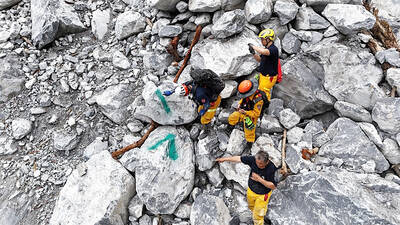
The bodies of two individuals were recovered and three additional bodies were discovered on the Shakadang Trail (砂卡礑) in Taroko National Park, eight days after the devastating earthquake in Hualien County, search-and-rescue personnel said. The rescuers reported that they retrieved the bodies of a man and a girl, suspected to be the father and daughter from the Yu (游) family, 500m from the entrance of the trail on Wednesday. The rescue team added that despite the discovery of the two bodies on Friday last week, they had been unable to retrieve them until Wednesday due to the heavy equipment needed to lift


 RSS
RSS