


A build-own-operate (BOO) project to manufacture influenza vaccine has been suspended after years of delays, delivering a setback to the nation’s ambitious plan to be the first to build an independent and self-sufficient vaccine manufacturing capacity, government and pharmaceutical industry sources said last week.
The project, which was launched in 2004, will be put on hold after an operational plan submitted by Dutch pharmaceutical company Akzo Nobel was rejected by the Department of Health earlier this month for failing to meet criteria stipulated in the Act for Promotion of Private Participation in Infrastructure Projects (促進民間參與公共建設法), a senior department official said on condition of anonymity.
Although Akzo Nobel is making a final pitch by appealing the decision, a source close to the project said that “it is fair to say the project is terminated, at least for now.”
Despite the frustrating experience and outcome, the government and private sector are still enthusiastic about vaccine BOO deals, an official at the Centers for Disease Control said, adding that the government has not given up hope and strongly believes that “in its second try, the project will go smoothly.”
Steve Chan (詹啟賢), chairman and CEO of ADImmune Corporation (ADI) and a prominent figure in medical and political circles, also expressed interest in participating in the project should the government decide to relaunch it.
The dual-purpose project, set up amid concerns over an influenza pandemic triggered by a flu strain like H5N1, was aimed at building the country’s capacity to develop and manufacture influenza vaccine by using the advanced cell-based method with the cooperation of the pharmaceutical company.
The vaccine plant under the BOO would provide seasonal influenza vaccines, for which Taiwan at present relies entirely on imports, but should a pandemic occur, the facility would expand to manufacture specific vaccine to tackle the pandemic.
Under the original design, the construction of the plant should have been completed last year and should have become operational this year.
The facility would have produced 2.5 million doses of seasonal influenza vaccine annually, with the department allocating NT$4 billion (US$124.4 million) for guaranteed purchases.
But the project has been mired in difficulties arising from competition between foreign and local companies, international business mergers and complex legal issues.
The project was at least two to three years behind schedule. Public health officials, however, have managed to find consolation in “the good news” that an influenza pandemic has not occurred.
They also said that in recent years, local pharmaceutical companies have acquired advanced biotechnology and manufacturing capabilities, pointing to cooperation between ADI and Dutch biomedical company Crucell.
The private venture is expected to manufacture about 30 million doses of flu vaccine annually for both the domestic and international markets, ADI said.
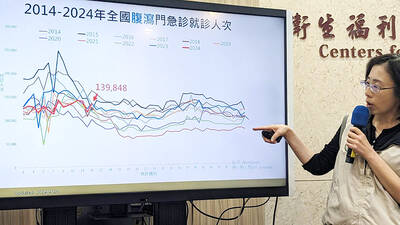
FLU SEASON: Twenty-six severe cases were reported from Tuesday last week to Monday, including a seven-year-old girl diagnosed with influenza-associated encephalopathy Nearly 140,000 people sought medical assistance for diarrhea last week, the Centers for Disease Control (CDC) said on Tuesday. From April 7 to Saturday last week, 139,848 people sought medical help for diarrhea-related illness, a 15.7 percent increase from last week’s 120,868 reports, CDC Epidemic Intelligence Center Deputy Director Lee Chia-lin (李佳琳) said. The number of people who reported diarrhea-related illness last week was the fourth highest in the same time period over the past decade, Lee said. Over the past four weeks, 203 mass illness cases had been reported, nearly four times higher than the 54 cases documented in the same period
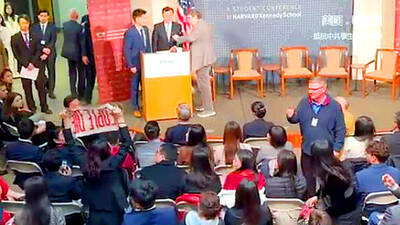
A group of Taiwanese-American and Tibetan-American students at Harvard University on Saturday disrupted Chinese Ambassador to the US Xie Feng’s (謝鋒) speech at the school, accusing him of being responsible for numerous human rights violations. Four students — two Taiwanese Americans and two from Tibet — held up banners inside a conference hall where Xie was delivering a speech at the opening ceremony of the Harvard Kennedy School China Conference 2024. In a video clip provided by the Coalition of Students Resisting the CCP (Chinese Communist Party), Taiwanese-American Cosette Wu (吳亭樺) and Tibetan-American Tsering Yangchen are seen holding banners that together read:
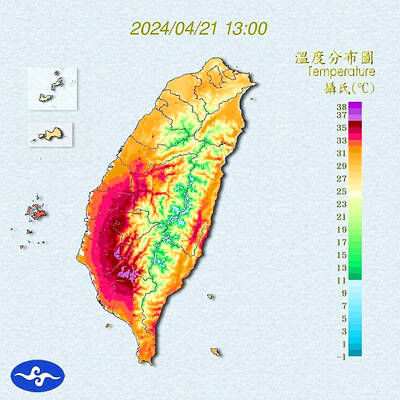
Heat advisories were in effect for nine administrative regions yesterday afternoon as warm southwesterly winds pushed temperatures above 38°C in parts of southern Taiwan, the Central Weather Administration (CWA) said. As of 3:30pm yesterday, Tainan’s Yujing District (玉井) had recorded the day’s highest temperature of 39.7°C, though the measurement will not be included in Taiwan’s official heat records since Yujing is an automatic rather than manually operated weather station, the CWA said. Highs recorded in other areas were 38.7°C in Kaohsiung’s Neimen District (內門), 38.2°C in Chiayi City and 38.1°C in Pingtung’s Sandimen Township (三地門), CWA data showed. The spell of scorching

UNAWARE: Many people sit for long hours every day and eat unhealthy foods, putting them at greater risk of developing one of the ‘three highs,’ an expert said More than 30 percent of adults aged 40 or older who underwent a government-funded health exam were unaware they had at least one of the “three highs” — high blood pressure, high blood lipids or high blood sugar, the Health Promotion Administration (HPA) said yesterday. Among adults aged 40 or older who said they did not have any of the “three highs” before taking the health exam, more than 30 percent were found to have at least one of them, Adult Preventive Health Examination Service data from 2022 showed. People with long-term medical conditions such as hypertension or diabetes usually do not


 RSS
RSS