


Inside his ruby-hued, custom-designed office in Flushing, Queens, David Peng is surrounded by the tokens of the present. There, on a shelf, rests a dog-eared copy of the New York City Building Code, bulging with memo stickers with notes written in Chinese. There, in the back, stands a drafting table, opposite a scroll blessing his company, Windstar Construction.
And there, next to the tea set on his desk, is a rare memento from the past: a weathered pamphlet called Modern Pentathlon: The Challenge of Skill and Endurance, written in Chinese with black-and-white photos of a young Olympic hopeful — Peng.
It is a chapter of his life that Peng, a 55-year-old immigrant from Taiwan, hardly dwells upon anymore. But it is a story that nonetheless played out in the shadow of a moment in Olympic history in which the messy collision of sports and politics derailed the aspirations of athletes like Peng.
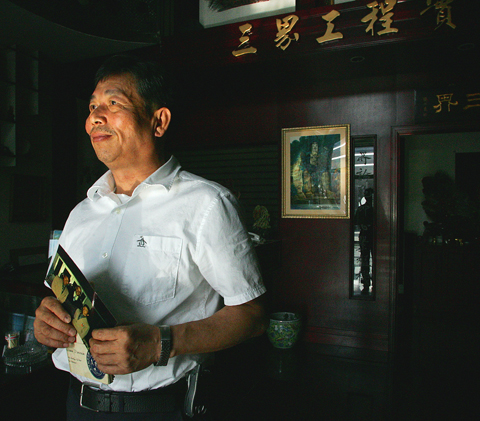
PHOTO: NY TIMES NEWS SERVICE
In 1976, Peng was vying for a spot to represent Taiwan in the pentathlon and he had traveled to San Antonio, Texas, with another Taiwanese competitor to train for two months with the US team. But a few weeks before the start of the Olympics in Montreal, after Canada bowed to pressure from Beijing, Peng learned that Taiwanese athletes would not participate. China had demanded that the Republic of China team change its name in order to take part in the Games.
“We were very innocent and we didn’t know what was going on,” Peng said during an interview in Mandarin.
The Games foreshadowed the politically charged Olympic boycotts of 1980 and 1984. But for Taiwanese athletes, the summer of 1976 may have been especially raw because their country had participated in the Winter Olympics a few months earlier.
So imagine Peng’s amazement that China is now the host of these high-profile Olympics and that Taiwanese athletes are competing on Chinese soil. In fact, Peng is so riveted that he put an extra television set in his office and asked a friend to tape the pentathlon event. Peng said he cheers for all “Chinese” athletes — regardless of what national anthem they sing.
“I never thought this was possible,” Peng said. “So much has changed in such a short period of time. I’m very proud of the Chinese people. The Chinese have always been seen as weak; now we are showing that we can be strong.”
Peng grew up as the son of a carpenter in Hualien. He was a gifted swimmer and runner in high school. During a mandatory stint in the military, he was tapped to join an elite naval unit that recruited the strongest and the fittest.
As a versatile athlete, he began training for the pentathlon, which combines cross-country running, swimming and pistol shooting — all familiar disciplines for a military man — with epee fencing and horse-jumping.
He earned the nickname “Po Dan,” or “break an egg,” a play on his given name, Yan-dan.
Peng said it was meant to symbolize the hope that he could achieve an athletic breakthrough.
Thorn Bigley, who was the director of development programs at the San Antonio pentathlon center at the time, vividly recalls Peng and the other Taiwanese athlete, Chang Chi-ming (張基明). Peng and Chang were hardly medal threats. Like most of the pentathletes from other countries who trained in San Antonio, they were weak in fencing and horse-jumping. But whatever they lacked in skills, they tried to compensate with their determination and sportsmanship, Bigley said.
“They were athletic, they worked hard and they were like Special Forces guys — really strong,” he said.
To this day, there remains a bit of confusion over Peng’s exact Olympic status, since his name was not on the official Taiwanese roster for the 1976 Games, although Chang’s was. But in an interview from her office in Taipei, Chi Cheng (紀政), a former world record-holder in track, said that Peng may well have been part of the delegation and that his story was consistent with an elite athlete hoping to go to Montreal.
Bigley, meanwhile, said the San Antonio training center typically would have welcomed only international athletes who were en route to the Olympics.
“Obviously, they were representing their country,” said Bigley, now a business consultant in Golden, Colorado. “It was kind of a given: They were the athletes training for that event.”
After Peng returned to Taiwan having never realized his Olympic moment, he coached pentathletes for a year and edited the training pamphlet. But he quit after he concluded that his students would never be able to compete in the Olympics because of politics.
“As an athlete, you train so hard and you have a goal of competing,” he said. “But if you can’t compete, then what’s the goal?”
Peng immigrated to the US in 1983 with his wife and two children. In short order, his family forged a classic tale: He got a job in construction, then started his own company building apartments and houses. His wife got a job as a lab technician. Today, their daughter is a doctor and their son may one day take over the family business.
Peng is not given to ruing his past. He had a hard time, at a reporter’s request, finding photos of his pentathlon days, producing two snapshots of a banquet in San Antonio. Bigley later confirmed that they showed Peng and Chang with pentathlon coaches.
There are also no signs of Peng’s athletic past in the waiting area of his office. Instead, the walls are stocked with large works of Chinese art.
“The past is the past, so I don’t think about it much,” he said.
Peng did, however, allow for one moment of reflection. It was 1986, and he traveled with his family to Montreal to see the venues where he had hoped to compete.
They were deserted. The flagpoles did not have any flags. The swimming pool did not have any water. The track-and-field stadium was empty.
Peng said he thought about what could have been, before putting it all behind him and returning to his life in New York.
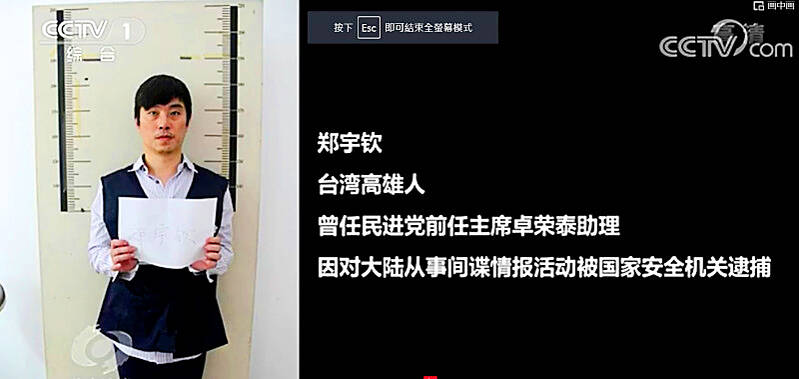
Former Czech Republic-based Taiwanese researcher Cheng Yu-chin (鄭宇欽) has been sentenced to seven years in prison on espionage-related charges, China’s Ministry of State Security announced yesterday. China said Cheng was a spy for Taiwan who “masqueraded as a professor” and that he was previously an assistant to former Cabinet secretary-general Cho Jung-tai (卓榮泰). President-elect William Lai (賴清德) on Wednesday last week announced Cho would be his premier when Lai is inaugurated next month. Today is China’s “National Security Education Day.” The Chinese ministry yesterday released a video online showing arrests over the past 10 years of people alleged to be

THE HAWAII FACTOR: While a 1965 opinion said an attack on Hawaii would not trigger Article 5, the text of the treaty suggests the state is covered, the report says NATO could be drawn into a conflict in the Taiwan Strait if Chinese forces attacked the US mainland or Hawaii, a NATO Defense College report published on Monday says. The report, written by James Lee, an assistant research fellow at Academia Sinica’s Institute of European and American Studies, states that under certain conditions a Taiwan contingency could trigger Article 5 of NATO, under which an attack against any member of the alliance is considered an attack against all members, necessitating a response. Article 6 of the North Atlantic Treaty specifies that an armed attack in the territory of any member in Europe,

LIKE FAMILY: People now treat dogs and cats as family members. They receive the same medical treatments and tests as humans do, a veterinary association official said The number of pet dogs and cats in Taiwan has officially outnumbered the number of human newborns last year, data from the Ministry of Agriculture’s pet registration information system showed. As of last year, Taiwan had 94,544 registered pet dogs and 137,652 pet cats, the data showed. By contrast, 135,571 babies were born last year. Demand for medical care for pet animals has also risen. As of Feb. 29, there were 5,773 veterinarians in Taiwan, 3,993 of whom were for pet animals, statistics from the Animal and Plant Health Inspection Agency showed. In 2022, the nation had 3,077 pediatricians. As of last

XINJIANG: Officials are conducting a report into amending an existing law or to enact a special law to prohibit goods using forced labor Taiwan is mulling an amendment prohibiting the importation of goods using forced labor, similar to the Uyghur Forced Labor Prevention Act (UFLPA) passed by the US Congress in 2021 that imposed limits on goods produced using forced labor in China’s Xinjiang region. A government official who wished to remain anonymous said yesterday that as the US customs law explicitly prohibits the importation of goods made using forced labor, in 2021 it passed the specialized UFLPA to limit the importation of cotton and other goods from China’s Xinjiang Uyghur region. Taiwan does not have the legal basis to prohibit the importation of goods


 RSS
RSS