


The Mainland Affairs Council (MAC) yesterday promised to further loosen cross-strait regulations relating to education, including extending the time Chinese students remain in the country for study and recognizing educational credentials from China.
Straits Exchange Foundation (SEF) Secretary-General Kao Kong-lian (高孔廉) said that educational exchanges between both sides of the Taiwan Strait were bound to improve cultural understanding and defuse tensions. And with that in mind, Kao said they would consider the proposals.
Kao made the remarks in Taipei yesterday morning while attending a workshop for Taiwanese students studying in China.
The two-day event was organized by the council, the SEF, the Ministry of Education, Chinese Youth International and Taiwan Students Union.
ONE YEAR’S STUDY
While Chinese students are allowed to stay in Taiwan for four months, Kao said it would make sense to extend that time to a year for the convenience of the students. Under this scenario, students could study for a whole academic year, he said.
As recognition of Chinese educational credentials did not require negotiations with China, Kao said it was the goal of the administration to recognize Chinese educational credentials as China does.
Kao pointed out, however, that the government will do so in a “selective” manner, emphasizing that recognizing Chinese educational credentials is different from allowing Chinese-education graduates to take national examinations to obtain certain professional licenses, such as practicing Chinese medicine.
DOUBLE DEGREES
Kao said it was also the goal of the government to allow students to obtain double degrees in Taiwan and China.
Kao said many people agreed that cross-strait relations over the past few months have improved compared with those during the former administration. Improved ties were attributed to improved communication, Kao said, especially in terms of business and culture.
With the negotiation channel in place, Kao said, both sides of the Strait could resolve many problems through the conduit.
In the future, Kao said the administration would like to see a liaison office set up to “directly” resolve problems.
“Many people hope to see peace and stability in the Taiwan Strait,” he said. “Because that’s how Taiwan can continue to survive and develop and China can continue to strengthen its economy and improve its livelihood.”
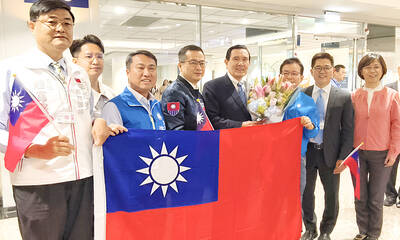
Former president Ma Ying-jeou’s (馬英九) mention of Taiwan’s official name during a meeting with Chinese President Xi Jinping (習近平) on Wednesday was likely a deliberate political play, academics said. “As I see it, it was intentional,” National Chengchi University Graduate Institute of East Asian Studies professor Wang Hsin-hsien (王信賢) said of Ma’s initial use of the “Republic of China” (ROC) to refer to the wider concept of “the Chinese nation.” Ma quickly corrected himself, and his office later described his use of the two similar-sounding yet politically distinct terms as “purely a gaffe.” Given Ma was reading from a script, the supposed slipup
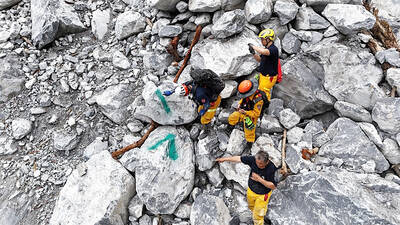
The bodies of two individuals were recovered and three additional bodies were discovered on the Shakadang Trail (砂卡礑) in Taroko National Park, eight days after the devastating earthquake in Hualien County, search-and-rescue personnel said. The rescuers reported that they retrieved the bodies of a man and a girl, suspected to be the father and daughter from the Yu (游) family, 500m from the entrance of the trail on Wednesday. The rescue team added that despite the discovery of the two bodies on Friday last week, they had been unable to retrieve them until Wednesday due to the heavy equipment needed to lift
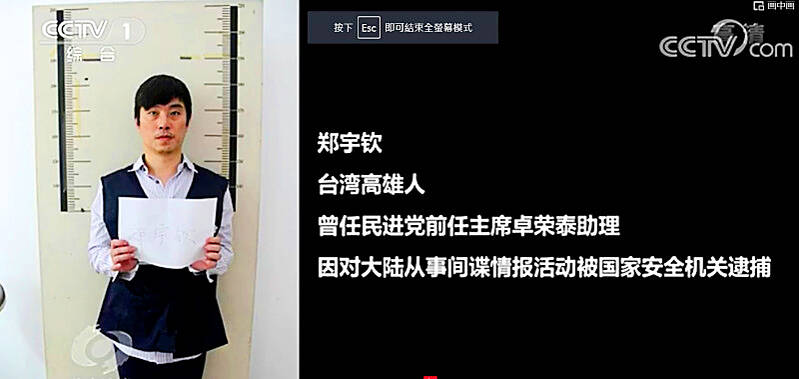
Former Czech Republic-based Taiwanese researcher Cheng Yu-chin (鄭宇欽) has been sentenced to seven years in prison on espionage-related charges, China’s Ministry of State Security announced yesterday. China said Cheng was a spy for Taiwan who “masqueraded as a professor” and that he was previously an assistant to former Cabinet secretary-general Cho Jung-tai (卓榮泰). President-elect William Lai (賴清德) on Wednesday last week announced Cho would be his premier when Lai is inaugurated next month. Today is China’s “National Security Education Day.” The Chinese ministry yesterday released a video online showing arrests over the past 10 years of people alleged to be
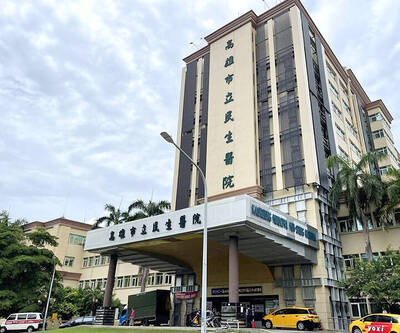
MIX-UP: Kaohsiung Municipal Min-Sheng Hospital director Yen Chia-chi was suspended from his duties after surgeons operated on the wrong patient last week The Kaohsiung Department of Health yesterday fined Kaohsiung Municipal Min-Sheng Hospital NT$500,0000 for misidentifying two patients and consequently causing one of them to undergo the wrong surgery last week. The hospital’s director Yen Chia-chi (顏家祺) was suspended from his duties. The surgeon who was scheduled to operate on the patient was given a major demerit and is subject to subsequent disciplinary actions. Demerits were given to the anesthesiologist, the nurse in the operation room, the nurse in the ward and the worker who helped transfer the patient from the ward to the operation room for having failed to verify the patient’s identity. Meanwhile, the


 RSS
RSS