


There is a case for former president Chen Shui-bian (陳水扁) to make in President Ma Ying-jeou's (馬英九) declassification of the documents pertaining to Chen's "state affairs fund," analysts said, citing not only national security but also confidentiality within the Presidential Office.
Chen and Ma have locked horns since the Presidential Office announced on Wednesday that Ma had decided to declassify documents concerning Chen’s “state affairs fund,” saying that they should not have been classified in the first place.
The office, however, did not use the word “declassification,” and instead said the government was “revoking the earlier classification.”
The Presidential Office dismissed allegations that the move was politically motivated and that the disclosure of the documents would harm national security or national interests.
Chen’s office, however, called Ma’s decision “illegal” and “unconstitutional” and said Ma made the decision based on political considerations.
They said the move not only jeopardized national security and national interests, but also left the former president having to choose between keeping national secrets and defending himself.
The Democratic Progressive Party (DPP) legislative caucus filed a lawsuit against Ma on Friday, accusing him of treason. Ma, however, brushed off the suit, saying he would not be scared off by litigation and would continue to do the “right thing.”
Chao Yung-mau (趙永茂), a political science professor at National Taiwan University, said that the sitting president should respect the executive privilege of his or her predecessor as the Council of Grand Justices has confirmed the president’s constitutional right to decide what constitutes a state secret and the right to refuse disclosure.
Rather than declassifying the documents, Chao said, Ma should have made clear that he respected Chen’s executive privilege but he disagreed with Chen’s classification of the documents.
Chao argued that the president should be entitled to secrecy to a certain extent because the head of state must be able to talk openly with his advisers and staff at the Presidential Office and not constantly worry about being subpoenaed, Chao said.
“Even if a president makes a wrong decision, he or she will be judged either by history, at the ballot box or by the courts if any law is broken,” he said.
Although the president enjoys immunity against criminal charges, Chao said there is a mechanism in place to keep the president in check, including impeachment and recall.
Chen survived the recall vote and averted impeachment during his two terms in office, but he paid the price politically when he was blamed for his party’s election losses in the legislative and presidential elections this year, Chao said.
While the Presidential Office drew parallels between the Watergate scandal and Chen’s “state affairs fund,” Chao said the two cases were different in nature.
Lai I-chung (賴怡忠), an executive member of the pro-localization Taiwan Thinktank, agreed, saying that it was idiotic to compare the two cases because in former US president Richard Nixon’s case, a crime had been committed and he tried to cover it up, but in Chen’s case nobody knows whether a crime has been committed or not.
Lai criticized Ma for politicizing the matter and for announcing the decision before his overseas trip tomorrow.
Lai said Ma might realize he would not get much media attention for the upcoming visit so he used the matter to keep his party busy playing the issue and securing media attention.
The matter could also divert attention from his administration for recent improper remarks and decisions regarding the Beijing Olympics, Lai said.
Lai agreed that the Presidential Office should be entitled to confidentiality so the president and his advisers and staff could talk freely, but he said that all conversations and meetings should be recorded and kept secret before being made available after a certain period of time.
Calling the Presidential Office’s move “illegal and unconstitutional,” Chang Wen-chen (張文貞), an associate law professor at National Taiwan University, said that Ma did not have the right to “revoke” classifications made by the Chen administration because Constitutional Interpretation No. 627 clearly states that any dispute regarding the president’s executive privilege is up to a special court to decide.
“If Ma can declassify the documents of the Chen administration, can he also declassify the documents concerning late presidents Chiang Kai-shek (蔣介石) and Chiang Ching-kuo (蔣經國)?” she said. “What he has done has caused grave damage to the constitutional system and order.”
Chang, however, said that it was “over the top” to charge Ma with treason.
Chang said the Special Investigation Section of the Supreme Court Prosecutor’s Office has the absolute right to request access to the classified documents, but it must be done in a legal and constitutional manner. In other words, they must seek permission first at the Taipei District, then the High Court and then the Special Court, she said.
To resolve the problem, Chang suggested that Chen ask the Council of Grand Justices for a further interpretation of ruling No. 627.
Chang agreed with Chao and Lai that the president, his advisers and staff should enjoy confidentiality at the Presidential Office, including their conversations, memos and suggestions.
“The reason is simple,” she said. “Who would want to work for the president or give him advice if they have to constantly worry about being sued or called to testify in court?”
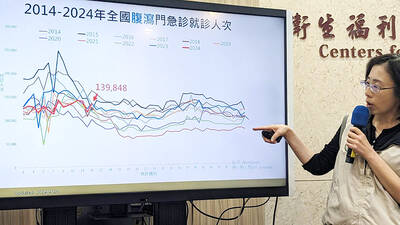
FLU SEASON: Twenty-six severe cases were reported from Tuesday last week to Monday, including a seven-year-old girl diagnosed with influenza-associated encephalopathy Nearly 140,000 people sought medical assistance for diarrhea last week, the Centers for Disease Control (CDC) said on Tuesday. From April 7 to Saturday last week, 139,848 people sought medical help for diarrhea-related illness, a 15.7 percent increase from last week’s 120,868 reports, CDC Epidemic Intelligence Center Deputy Director Lee Chia-lin (李佳琳) said. The number of people who reported diarrhea-related illness last week was the fourth highest in the same time period over the past decade, Lee said. Over the past four weeks, 203 mass illness cases had been reported, nearly four times higher than the 54 cases documented in the same period
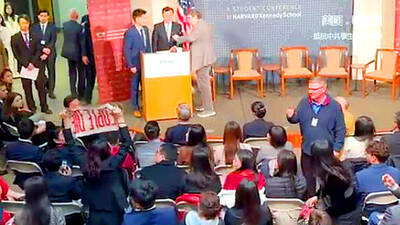
A group of Taiwanese-American and Tibetan-American students at Harvard University on Saturday disrupted Chinese Ambassador to the US Xie Feng’s (謝鋒) speech at the school, accusing him of being responsible for numerous human rights violations. Four students — two Taiwanese Americans and two from Tibet — held up banners inside a conference hall where Xie was delivering a speech at the opening ceremony of the Harvard Kennedy School China Conference 2024. In a video clip provided by the Coalition of Students Resisting the CCP (Chinese Communist Party), Taiwanese-American Cosette Wu (吳亭樺) and Tibetan-American Tsering Yangchen are seen holding banners that together read:

UNAWARE: Many people sit for long hours every day and eat unhealthy foods, putting them at greater risk of developing one of the ‘three highs,’ an expert said More than 30 percent of adults aged 40 or older who underwent a government-funded health exam were unaware they had at least one of the “three highs” — high blood pressure, high blood lipids or high blood sugar, the Health Promotion Administration (HPA) said yesterday. Among adults aged 40 or older who said they did not have any of the “three highs” before taking the health exam, more than 30 percent were found to have at least one of them, Adult Preventive Health Examination Service data from 2022 showed. People with long-term medical conditions such as hypertension or diabetes usually do not
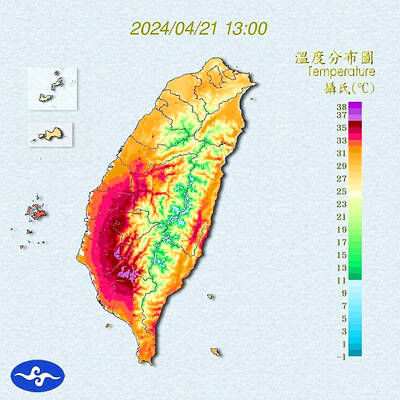
Heat advisories were in effect for nine administrative regions yesterday afternoon as warm southwesterly winds pushed temperatures above 38°C in parts of southern Taiwan, the Central Weather Administration (CWA) said. As of 3:30pm yesterday, Tainan’s Yujing District (玉井) had recorded the day’s highest temperature of 39.7°C, though the measurement will not be included in Taiwan’s official heat records since Yujing is an automatic rather than manually operated weather station, the CWA said. Highs recorded in other areas were 38.7°C in Kaohsiung’s Neimen District (內門), 38.2°C in Chiayi City and 38.1°C in Pingtung’s Sandimen Township (三地門), CWA data showed. The spell of scorching


 RSS
RSS